
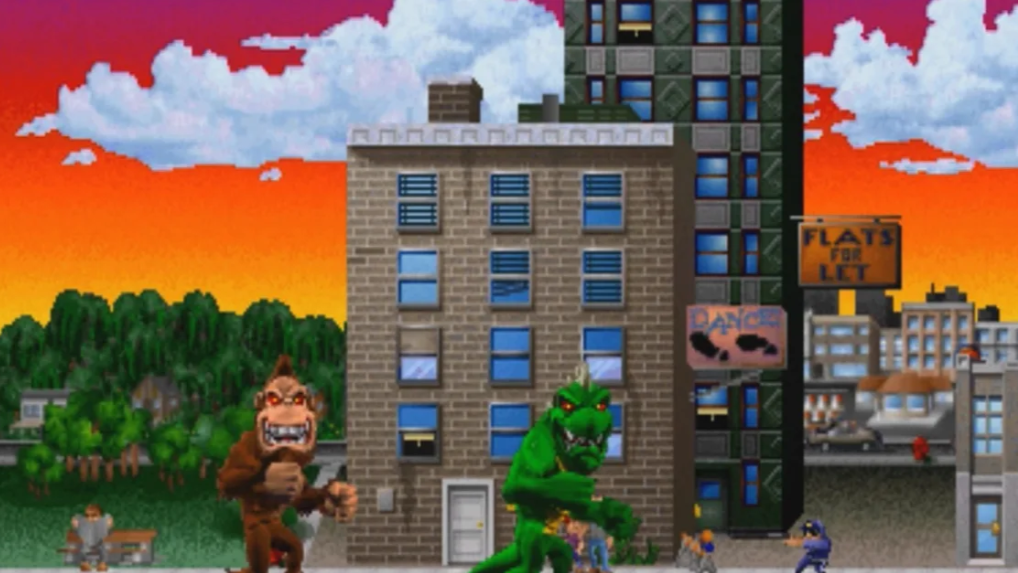
The moment you hand a human being a test, a second process starts running underneath the first. They manage themselves. They reach for the answer they think is wanted instead of the one that is true.
Psychometrics has a clinical name for it, demand characteristics, and it ties deeply to Campbell's law and the Hawthorne effect. A hundred years of assessment has spent enormous effort trying to suppress it. Test anxiety. The rehearsed interview answer. The personality survey that quietly flatters the person filling it out. The instrument ends up measuring the performance of being measured, and the realest version of the person never shows up to the exam.
There is exactly one place where humans make hundreds of genuine decisions in a row and forget that anyone is watching. A good game.
The thing games already solved
A player forty hours into a campaign is not managing an impression. They have stopped thinking about the designer, the score, the watcher. They are inside the problem. When the firefight goes bad and they have to choose who to save, that choice is not a performance. It is the choice they actually make with some form of cost on the table and the clock running. That is the cleanest read of a person you can get outside a laboratory, and video games produce it by the thousand, for free, as a side effect of being fun.
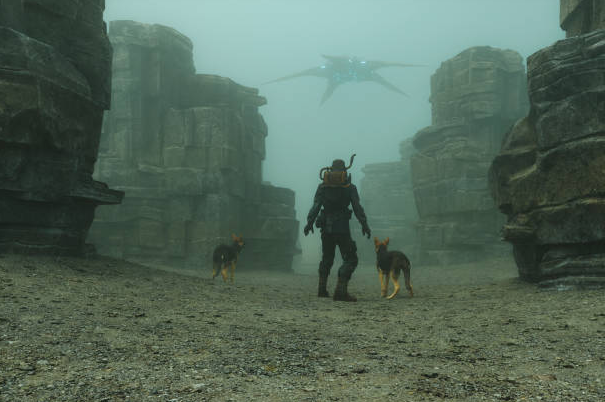
Mass Effect made you choose who lived. Skyrim let you talk your way past the guard or kick the door in. The minutes you spent shoving a boulder to clear a path, the call you made at the squad checkpoint, the alien puzzle you solved that looked nothing like anything on Earth, all of it was a real decision made while you had forgotten it would ever be counted.
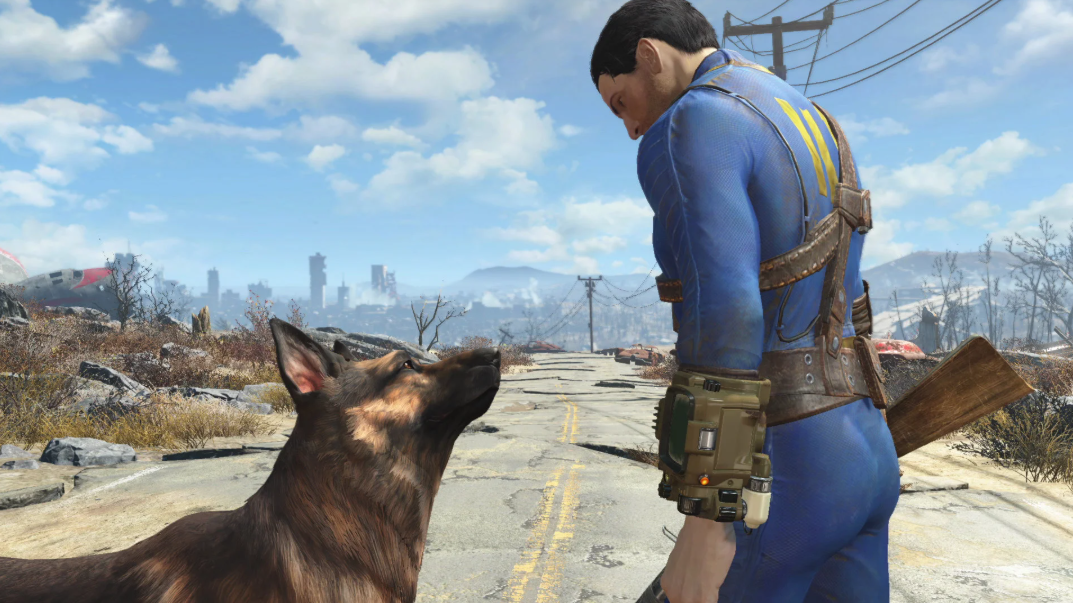
Designers even have a private shorthand for one of these tells. Did you pet the dog? Nothing rewards you for it. No achievement, no loot, no progress. Petting the dog is what a person does when there is no instrumental reason to, which is precisely why it says something true about them. It is disposition leaking out in a moment that does not count.
The Vitruvian Quotient is built on a claim that fits this exactly: real intelligence is not one number, and a single real act pulls on several capacities at once. A dog trainer reading an animal is using language, motor coordination, knowledge, reasoning, emotion, and social awareness in the same breath. A player taking a castle is doing the same thing. So the question stops being how do we test them and becomes which moments of real play can we measure cleanly, and what do they measure.
Not the whole game. A few real moments.

Here is the objection, and it is correct. People roleplay. They run a villain for fun, keep three save files, charge a fortress with a butter knife just to see what happens. If you tried to score an entire playthrough you would measure mostly noise and mischief.
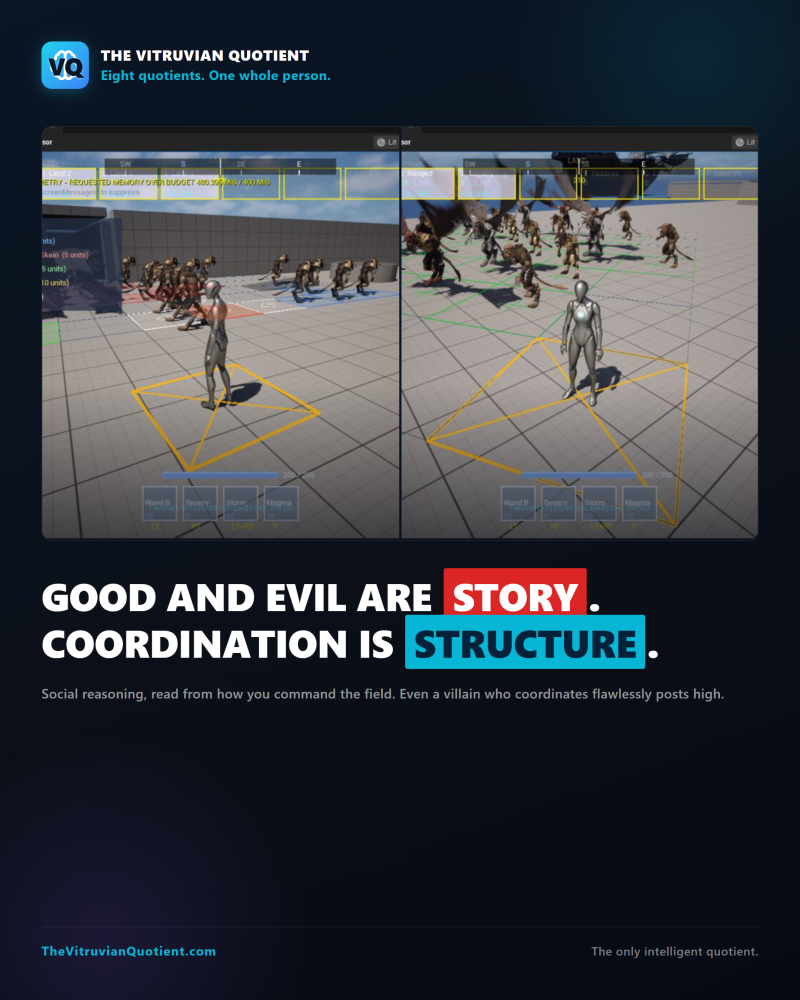
So you do not score the whole game. You score a small number of designed moments that are forced, bounded, and tied to whether the player wins, plus a quiet layer of behind-the-scenes signal underneath. You read the pattern across those moments, never a single choice. And you measure the structure of what the player did, not whether it was good or evil. A ruthless raider who runs a flawless, perfectly coordinated boarding action is posting high social reasoning. Good and evil are story. Coordination is structure. The framework scores the structure, which is why a player performing the villain still hands you honest data on the axis they are not even thinking about.
When a player hits a wall in a good game, they reach for one of three routes: the forceful one, the creative one, or the collaborative one. Those routes are three different quotients, and they are the three that hold up under scrutiny, because the player already understands them as play.
Reasoning, where the player shows their head
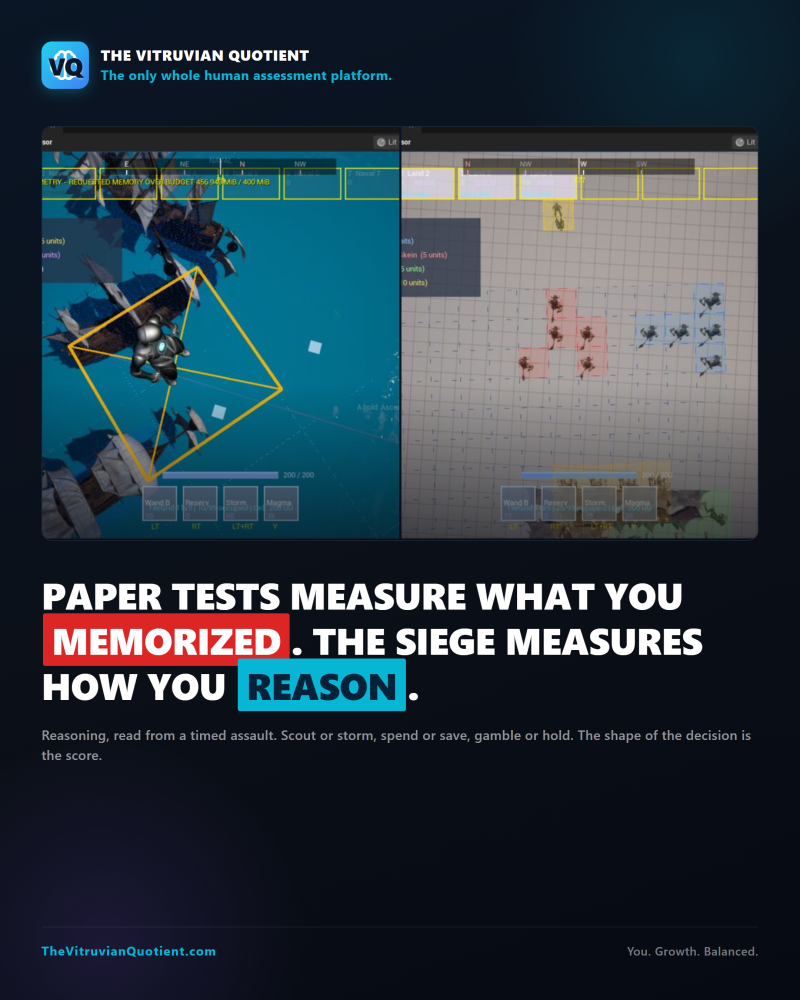
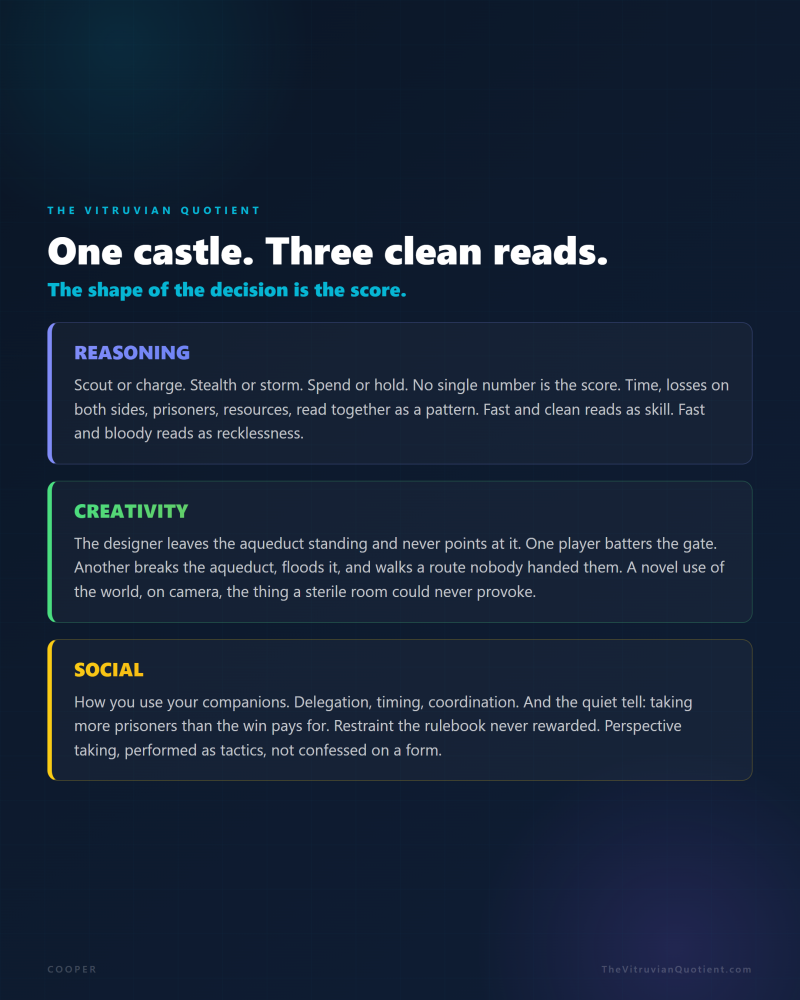
Give a player a castle and a clock. Take it in forty-five minutes. Now watch the shape of the decision.
Did they scout first or charge in. Stealth or storm. Did they husband their resources or burn everything in the opening minutes. Did they take the safe win or gamble for the bigger one and pay for it in losses. Did the timer sharpen them or rattle them. None of that is a questionnaire. It is reasoning made visible, captured as behavior, under a real constraint the player accepted because it is the game. A player who scouts, sequences the assault, and spends carefully is showing you planning and risk calculus more honestly than any logic puzzle, because the cost of being wrong is a cost they actually feel.
And no single number is the score. Time, entry point, casualties on both sides, prisoners taken, resources spent, these are read together as a pattern. Fast with low losses and little spent reads as skill. Fast with heavy losses and everything burned reads as recklessness. The same castle, and the shape of the whole decision tells you what any one measurement could not.
Creativity, where the player uses the world
The cleanest creative signal in a game is the unscripted solution. The designer leaves the aqueduct standing and never points at it. One player batters the front gate. Another floods it by breaking the aqueduct and walks in through a route nobody handed them. That second player is generating a novel use of the available world, on camera, with no prompt, which is the exact thing creativity tests have always tried and mostly failed to provoke in a sterile room. Games provoke it constantly, because the world is a box of tools and the fun is in finding the use that was always there and never marked.
Social reasoning, where the player coordinates
If the player has companions, how they are used is a direct read. Delegation, timing, coordinating other agents toward a goal. And the quiet one: restraint that nothing pays for. If taking prisoners earns a better outcome, taking exactly enough is optimization, which is its own signal. Taking more than the win requires is the pet-the-dog tell again, the disposition the rulebook never rewarded. Predicting the defenders by stepping into their position is perspective taking, the foundation of the whole social domain, performed as tactics instead of confessed on a form.
This already has a name
A measurement lab has been doing exactly this for twenty years. Valerie Shute at Florida State calls it stealth assessment, and her stated goal is to blur the boundaries between game play, learning, and assessment. Her team embedded measurement inside commercial games and checked it against ordinary tests. Persistence, read from how kids pushed through hard quests in one study, came back reliable at 0.87. Problem solving and systems thinking, read from play, tracked with external measures. The numbers hold.
One of her worked examples is almost this article. In The Elder Scrolls IV: Oblivion, the player has to cross a river full of fish that kill you. Swim it, find a bridge, levitate over, freeze it and slide across, dig a tunnel underneath. The game scores the choice on two axes: novelty, how rare that solution is across all players, and efficiency, whether it worked for the time and resources it cost. Freezing and sliding scores high on both. Swimming scores low on both. That is a creativity measurement pulled from a medieval castle game, years ago. Swap the river for an aqueduct and you have the castle.
The method underneath is called evidence-centered design: name the capacity you care about, name the behavior that would reveal it, then build the task that forces the behavior out. Competency, evidence, task. In our terms, the quotient, the tell, and the castle. The field has also been honest for years about the one hard tradeoff, how much to lock a player onto a fixed path for clean data against how much to let them roam. Lock it down and the data is reliable but the game narrows. Leave it open and the game breathes but the signal blurs. Our answer is the whole design: a few locked, decisive moments for the clean read, and a quiet ambient layer underneath for the rest.
One honest difference. Classic stealth assessment hides completely and runs the entire time. Ours does not. The player knows they are inside an assessment, the measured moments are deliberate, and we score the structure of the choice, not its morality, which is exactly what lets an aware player still hand over honest data. We took a twenty-year-old method and turned it from an invisible net into a handful of clean instruments.
One act, measured several ways
This is where it loops back into the platform. In The Vitruvian Quotient a single piece of real work rarely feeds only one quotient. Signal captured in one task is souped across the others. The castle is one act, and it carries reasoning, creativity, and social coordination at the same time, the same way the framework already reads a written response, a debate, or a timed build across multiple capacities at once. The game is not a separate gimmick bolted on the side. It is the framework's core claim, that intelligence shows up in integrated real action, rendered as something a person actually wants to do.
And it is scored the way the rest of the platform is scored. On the same scale, from disability through gift, with no ceiling and no floor, and without any AI in the loop unless you choose to turn that feature on. The measurement lives behind the scenes, in the coordination layer, not in the player's face. What the player sees is a castle and a clock. What the teacher or clinician sees is a clean read on how this person reasons, invents, and coordinates when they have forgotten to perform.
The point
For a hundred years we built tests that announce themselves, and then we spent the next hundred trying to undo the damage that announcement does. The anxiety, the rehearsal, the flattering answer, the gap between what a person writes on the form and what they do when it counts.
A well built game closes that gap by accident, and then keeps it closed for forty hours at a stretch. Point a calibrated instrument at the few moments that matter, read the structure instead of the story, and the test disappears into the thing the player was going to do anyway. The best test is one the person forgets they are taking. We can finally build it, because the medium that makes people forget has existed the whole time. We were just using it to keep score instead of to take measure.
This is part of The Vitruvian Quotient. It is in playtesting now, and a short castle demo is in the works. And yes, you can pet the dog.
The only intelligent quotient.