
June 26, 2026
Most emotional intelligence tests work the same way. They hand you a sentence like "I am aware of my emotions" and ask you to rate yourself from 1 to 5. A scoring key turns that self-rating into a number. Notice what it actually measures: how you reason about yourself, and how you choose to describe yourself. It doesn't measure whether you can read a room, calm your own nerves, or feel what someone else is feeling. EQ throws all of that out.
EQ measures what your mind and your body actually do with emotion.
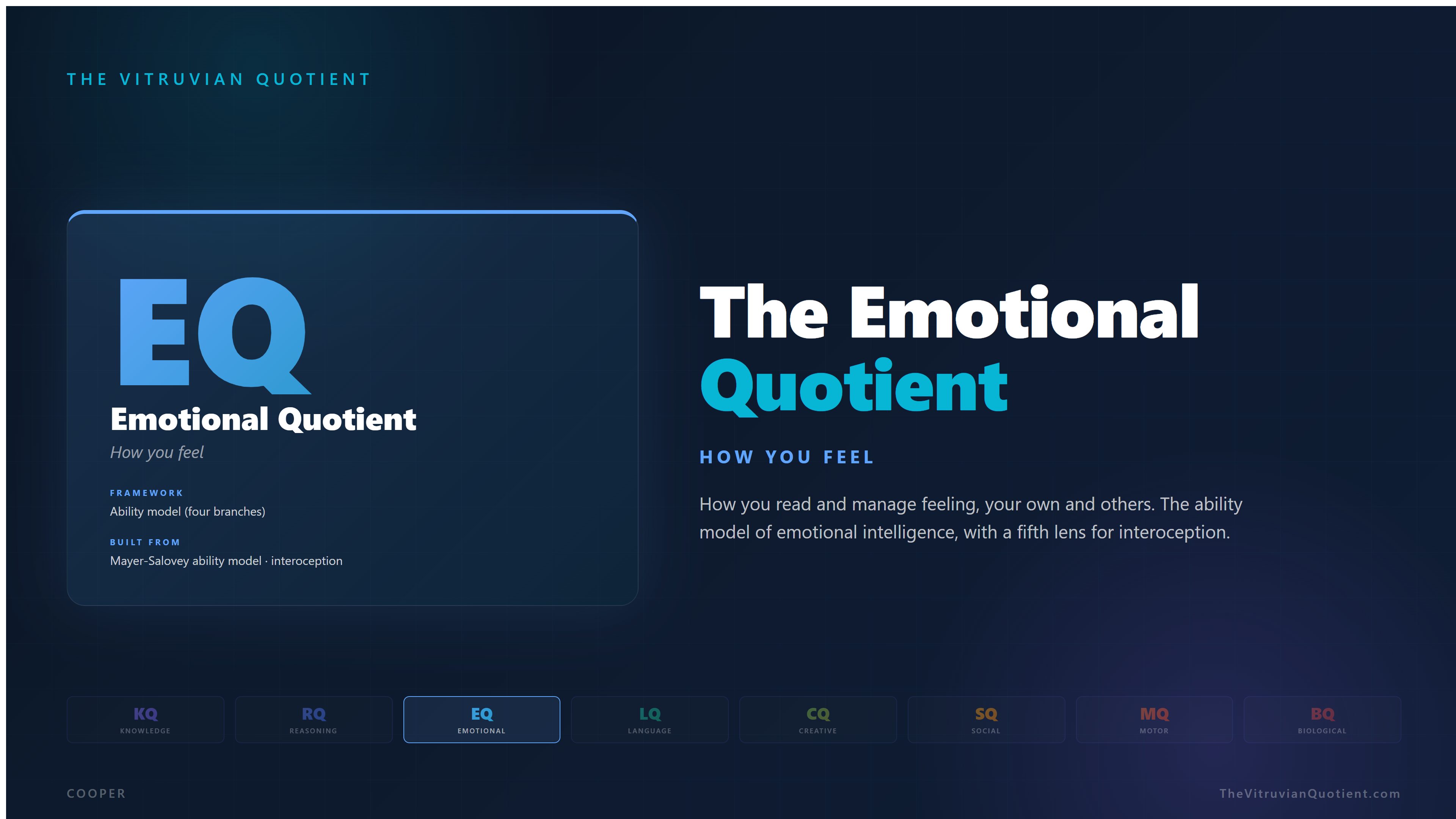
The big idea: emotional intelligence isn't one lump. It's a set of separate faculties, and EQ scores each one on its own. We use the Mayer-Salovey four-branch model, which is open, peer-reviewed science you can look up, plus a fifth piece that's unique to VQ:
- Perceiving: can you read emotion, in yourself and in other people?
- Using: can you put emotion to work to help you think and decide?
- Understanding: do you know how emotions blend and turn into each other? The difference between guilt and shame, the way nervousness can tip into anger.
- Managing: when a feeling shows up, can you handle it well instead of being run by it?
- Interoception: can you actually feel your own body? This is the VQ-native fifth, built on the Schandry heartbeat method.
Here's what makes it more academic instead of just a self-reporting pop-sci quiz. EQ doesn't stop at asking you about feelings. It reads different kinds of signals than others. The VQ Platform can even measure EQ during sports or group projects when there's data.
What you say. You get a real situation. Your project partner criticized your work in front of the whole team. What do you do next, and why? You answer in your own words, and we score that answer against a clear rubric. Did you name the feeling? Did you separate the critique from the delivery? Did you pick a strategy that actually works? We're not hunting for one right answer. We're reading what your response shows.
What your heart can add. With your consent, and on the equipment that supports it, EQ can also glance at a body signal alongside your works. The heart tends to respond differently when your attention is on someone else than when your own distress takes over, and that difference can add a little context to the picture. It's a supporting read, not the score itself. When the conditions aren't right to capture it cleanly, this part simply drops out, the same as any branch we didn't reach.
How closely you sense your own body. There's a short, optional exercise where you sit quietly and try to feel your own heartbeat, with no hand on your pulse. Comparing what you sensed to what your heart actually did gives a rough feel for how tuned-in you are. It's a light, low-stakes signal, offered where it fits and skipped where it doesn't, and it's there to round out the picture rather than to grade you.
Now the honest part, scored the same way KQ does it. Each branch we have data for gets a score from 0 to 100. The branches we didn't touch in a session simply drop out, so you're never punished for something we never measured. Your headline EQ is the honest average of the branches we did measure, and that average has no shortcuts. A strong Managing score doesn't get to paper over a weak Perceiving one. Gaps surface. They don't get covered up, because the whole point is to show you where you can grow.
A few clever, honest extras:
- One moment, several reads. When you answer that conflict scenario out loud, your words are the main read, and where the setup allows, smaller cues like the steadiness in your voice can add to the picture. It's one behavior looked at a few ways, instead of three separate quizzes.
- Ability over self-image. Because we read what you do and what your body does, EQ catches the oldest problem in this field: the person who's sure they're emotionally brilliant and isn't, and the reserved one who actually is. The score comes from what you demonstrate.
- Built on open science. The four-branch ability model (Salovey and Mayer) and the heartbeat method (Schandry) are public, peer-reviewed work you can look up. There's no proprietary black box here, and no single number pretending to be your whole emotional life.
- Trained judgment stays in the loop. A teacher, counselor, or clinician can set the context per student and per situation. For the body-based parts, the test-taker's comfort and consent come first. In the platform it's all a simple selection, and you control the settings in your own profile. Not part of an institution? Sign up to be your own teacher. A parent? VQ already works as a full homeschool management tool, right out of the box.
The Vitruvian Quotient. Emotional intelligence measured by what you actually do, in the real situations you work through.