
I am a Millennial, and I have been appalled by my generation for some time. Long before anyone was filming themselves about Gen Z.
Let's be clear. I play the banjo, guitar, drums, ukulele, and piano. Not like a genius or anything. I speak English fluently, a lot of French and Spanish, and a little Russian. I won a national tennis championship hosted by an Olympian. I was drafted to DC United at age 13 even though I couldn't afford it. I started my first business at twenty-one. The second, at twenty-five, was the nation's first occupational trade school for apolitical campaign management. I bought my first restaurant in my early thirties.
Let's also be clearer. I was born with a speech impediment and had to do Hooked on Phonics and pre-K. To maintain honors I was always in extra stuff before and after school other than sports such as choir, after school tutor (I was tutored every year), extra scheduled reading time in the library, and hanging out with special needs students. Spanish became required in my school district by 3rd grade We were allowed to switch to French later but still a requirement. And I grew up in one of the poorest states in the United States.
This is not a kids-these-days complaint from someone insulated above the problem. It is the opposite. I watched the decline from inside my own generation. And then from under the one before me. But more importantly, I know what it is like to struggle as well as to thrive from it.
At eight and at twelve I already knew more than most of the Gen X and Boomer adults around me, and I could feel it. I would win a family game of Monopoly or Risk or Scrabble and a grown adult would flip the board or quit the moment a child took Park Place. Grown adults, in the mid-nineties, throwing a tantrum over losing a board game to a kid.
I was watching the maturity void before I had a name for it. Adults were the first thing that did not add up, not Gen Z.
I was also the kind of student the system has no way to measure.
By third grade I had read every nonfiction book in my elementary school. Not most. Every one. The school's response tells you everything about the instrument they had. First, they put me to work. I wrote the reading-comprehension tests for each new nonfiction book that came in. Then, after my IQ tested high as a kid on the late 1900s IQ scale, they kneecapped me. No more nonfiction. Fiction only. My own mother enforced the rule at home.
So, I did to fiction what I had done to fact. I read in series, the way I always had, three and four books at a time, the animal books and the planet books and the dinosaur books traded for Goosebumps and The Boxcar Children and C.S. Lewis and Harry Potter and Lemony Snicket and Animorphs, every series I could reach, beating every test attached to them. This was fourth and fifth grade.
A system met a student it could not locate, so it conscripted me into labor. No, honestly, I got a plaque in the library and was quite happy. However, the system had no instrument for the whole range of a human being, top or bottom. It showed that to me.
I have spent the years since on the bottom end of that same failure, and on building the instrument that was missing.
The teachers are saying it now
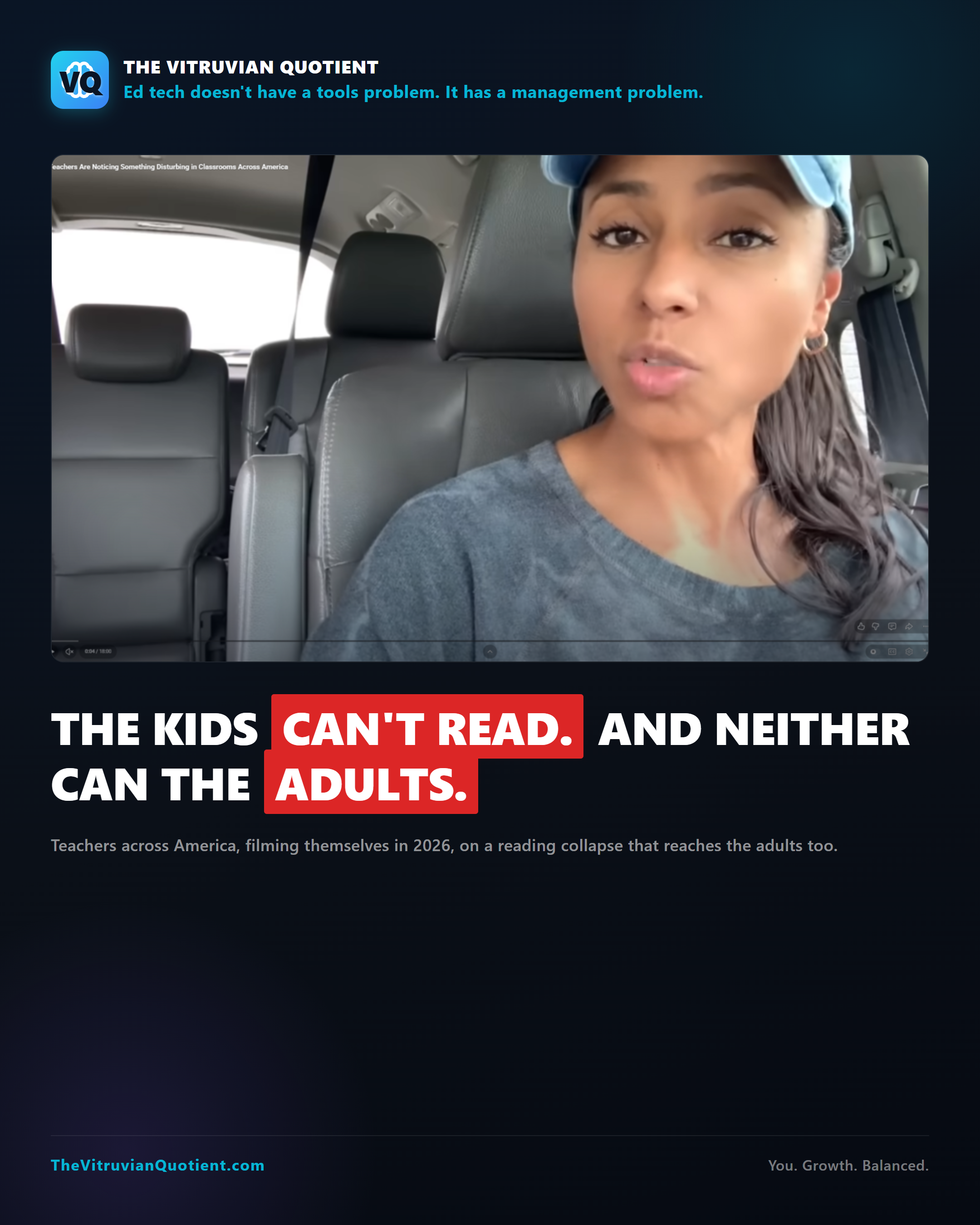
Now look at the classroom end, today, in the teachers' own words. They are filming themselves by the thousands. The kids cannot read, across every kind of school. One teacher, four years in, who teaches kids with learning disabilities to read, put the real problem in a single line.
"Teacher to student ratio makes it nearly impossible to differentiate all different reading levels consistently, every single day, for targeted reading instruction."
She knows what each child needs. She has no instrument to deliver it to thirty children at thirty levels at once. Another named the trap exactly.
"I struggle with being told I have to focus on grade level text when my kids are not reading grade level. Do I push them, or come down to their level? In reality, what are we doing?"
She is teaching a grade-level fiction to children the system refuses to locate. The same failure I grew up inside, pointed the other direction. She is not failing to teach. She is failing to measure, because nothing in her room records where each kid actually stands.
And the part no one wants to say out loud, said by a teacher: the kids cannot read, and neither can the adults.
The litmus test the adults fail
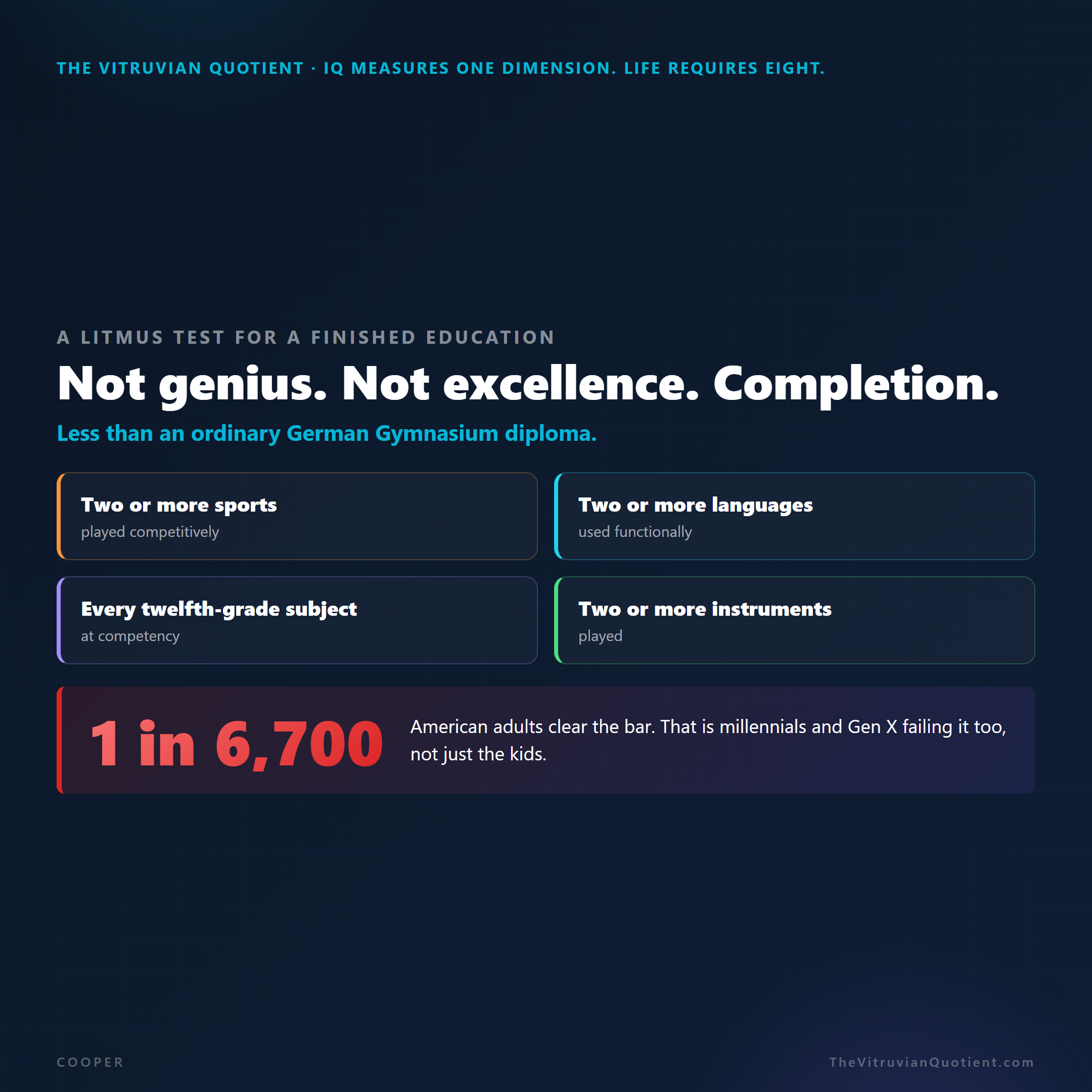
Years ago I designed a litmus test for a finished education. Not genius. Not excellence. Completion. It's basically what's done by a normal 1900s education. Two or more sports played competitively. Two or more languages used functionally. Two or more musical instruments. Essay competency. Competency across every twelfth-grade subject. Do math in your head.
Less than an ordinary German Gymnasium certifies as a normal diploma. Run the compound probability across American adults and it comes out to roughly one in 6,700.
One in 6,700. Those are not the children. Those are the adults.
Millennials and Gen X cannot clear the bar for a complete education either. This is the unpopular observation I opened with, in one number. The decline did not begin with Gen Z. It ate the generations now raising them. I clear all six criteria, and I did it from abject poverty in Kentucky, which removes the easy excuse.
This is not about who could afford what. It is about a civilization that stopped producing whole people and lost the instrument to even notice.
Look at what the litmus measures. Sports. Languages. Instruments. The full span of subjects. A whole human across domains, not a number from one test. That completeness is the thing we stopped making, and a single reading score was never going to catch its absence.
What Horvath gets right... again
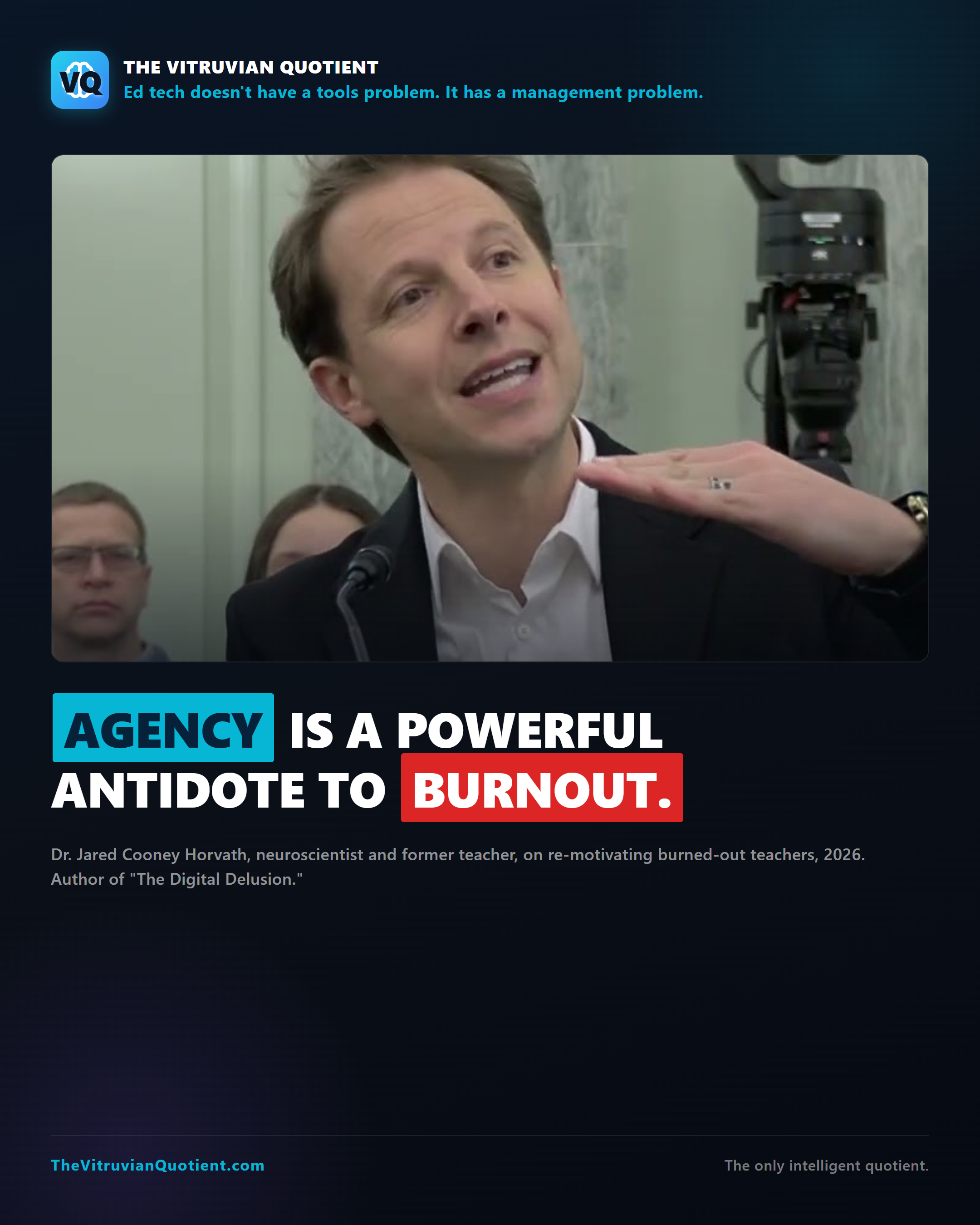
The most useful voice on the teaching side of this is Dr. Jared Cooney Horvath, a neuroscientist and former teacher. Asked recently how to re-motivate teachers who are burned out and ready to walk, he refused the obvious answer. Not more strategies. Not more tools. Not more tips and tricks. Go back to learning.
"You focus back to learning. [...] But very rarely do we talk about learning. We usually talk shop, form."
Talk to teachers about how memory and attention work, about why a kid aces a concept on Tuesday and bombs it on Friday, and they come alive, because the craft is why they came. His words for what that restores: agency over the form they use in the classroom. And agency is a powerful antidote to burnout.
Keep that word. Agency. Edtech has been its single largest thief.
"Form. Follows. Function."
For twenty years education technology did not sit beside the teacher. It climbed into the front seat and made itself the lesson. The screen became the main event. The dashboard became a second job. The teacher's day filled with running the tool instead of teaching the kid. Horvath has spent a career and several books, including "The Digital Delusion," on one finding: the learning gains never arrived to justify it. The screen time arrived. The decline arrived. The burnout arrived. Form crowded out learning and got sold back to teachers as progress.
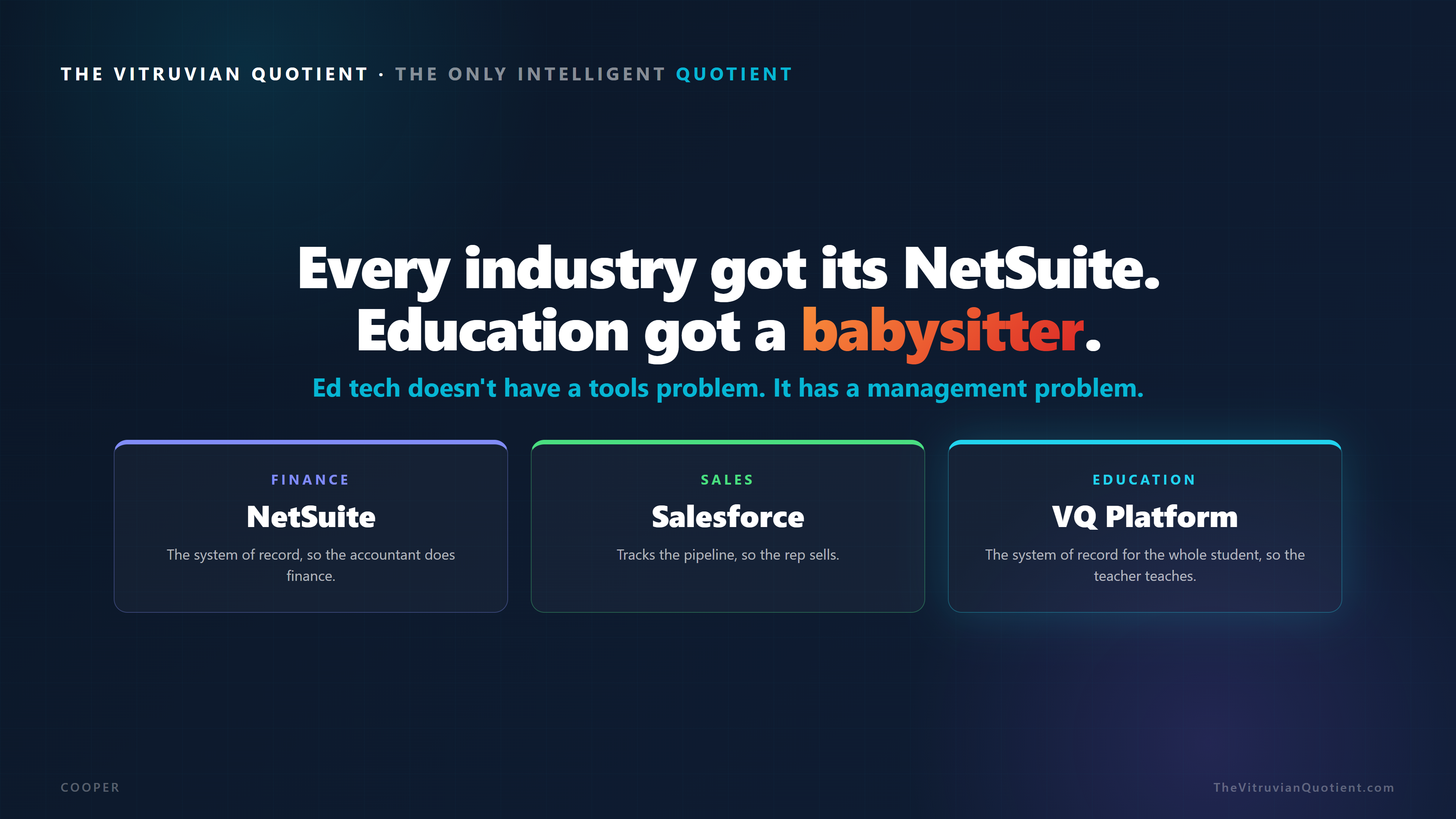
Every industry got its NetSuite
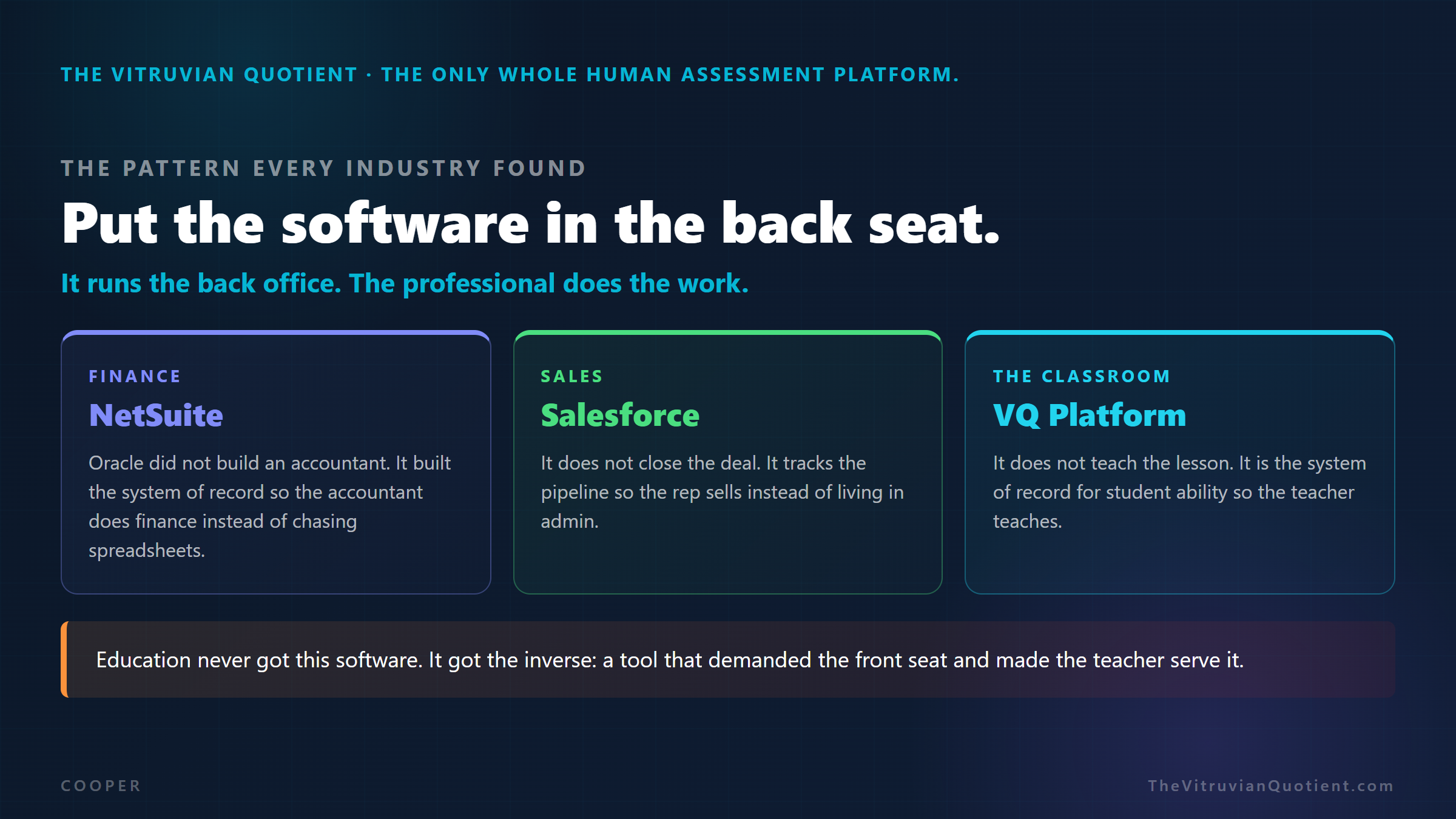
Every other profession solved this years ago, and solved it the same way. Accountants got NetSuite. Oracle did not build an accountant. It built the system of record holding the numbers in one place so the accountant does finance instead of chasing spreadsheets. Salespeople got Salesforce. It does not close the deal. It tracks the pipeline so the rep sells instead of living in admin. In every field that won its time back, the software took the back seat. It ran the coordination from the back office and handed the professional their hours and their judgment back.
Education never got that software. We never built the NetSuite for student ability or the Salesforce for the classroom. We built the inverse. A tool that demanded the front seat and made the teacher serve it. A babysitter for the kid and a second job for the adult.
The fix is not a better teaching app. We have ten thousand of those, and they are the problem Horvath names. The fix is to put edtech in the back seat for once.
The fix is to build edtech that helps teachers get back to teaching.
What that actually looks like
This is the whole reason I built Computer Adaptive Curriculum (CAC), The Vitruvian Quotient Framework, and The VQ Platform, and, it is the instrument the eight-year-old version of me needed and never had.
The measurement lives behind the work, not in front of the student's face. A teacher sequences a lesson across any span, a day or a full year, and assigns it to a class with a start date. From there the system runs the form. It spawns the work to every student, scores what is scorable, adapts what comes next, and tracks who is where. Every item carries the same calibration as the test, difficulty, quotient, grade, so the curriculum measures itself as the student performs, across the full range of ability from disability through gift, with no ceiling and no floor.
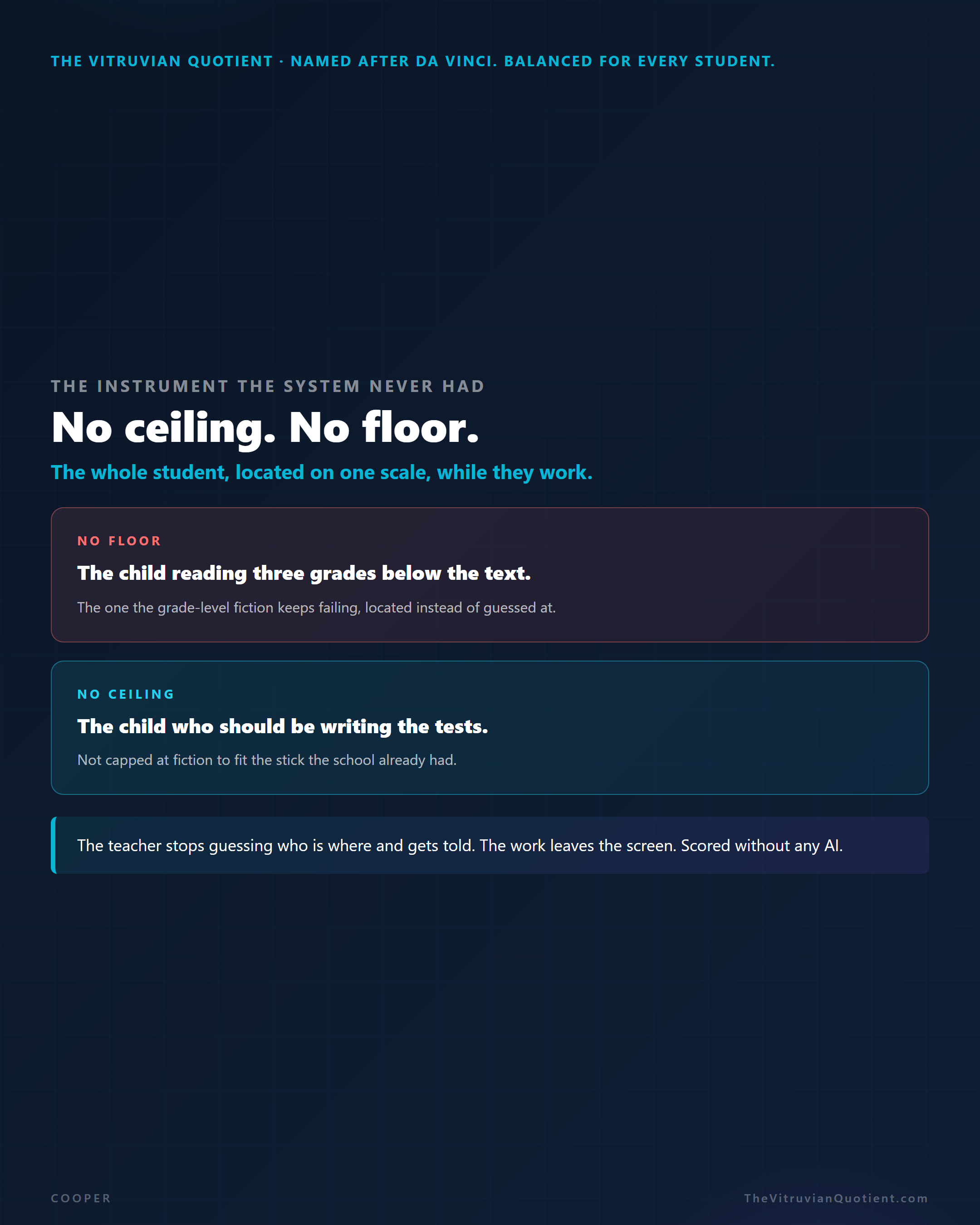
Read both ends of my own story against that last line. No floor means the system locates the child reading three grades below the assigned text, the one the grade-level fiction keeps failing. No ceiling means it locates the child who should be writing the reading tests instead of being capped at fiction. On one scale. Automatically. While they work. The teacher stops guessing who is where and gets told.
And the work leaves the screen. On paper. Out loud. On a field. In a workshop. Because the calibration is set in advance and the data accrues per student in the back office, no one has to glue a child to a tablet to know how the child is doing. Because The Vitruvian Quotient measures eight quotients at once, a single piece of work is measured eight ways. The litmus made operational: movement and sport, language, the instruments and the making, the full span of knowledge, all of it scored from real work. A written response also informs language. A debate also informs social reasoning. The teacher is not feeding a machine. The machine is feeding the teacher.
It is Oracle for student ability and Salesforce for the classroom. A system of record for where every student stands, and a management layer running the roster, the sequencing, the assigning, the grading, the tracking. The unglamorous coordination currently eating a teacher's nights and weekends, moved to the back office where it belongs.
Agency, returned
Put Horvath's word back. When the form is handled, the teacher gets the learning back. The monotony automates, the screen recedes, and the person in the room is free to do the craft she came for. To watch the patterns. To ask why this student fails on Friday but not on Tuesday. To teach the child in front of her instead of the standard on the page. Agency over form. The exact thing Horvath says brings a burned-out teacher back.
This does not cure the literacy decline. It does not teach reading and it does not teach math. The teachers filming themselves are right about exposure, consistency, screens, and homes where no one reads, and no platform fixes those. This is infrastructure, the way NetSuite is infrastructure. It does the measurement and the management so the human does the teaching.
Built and running
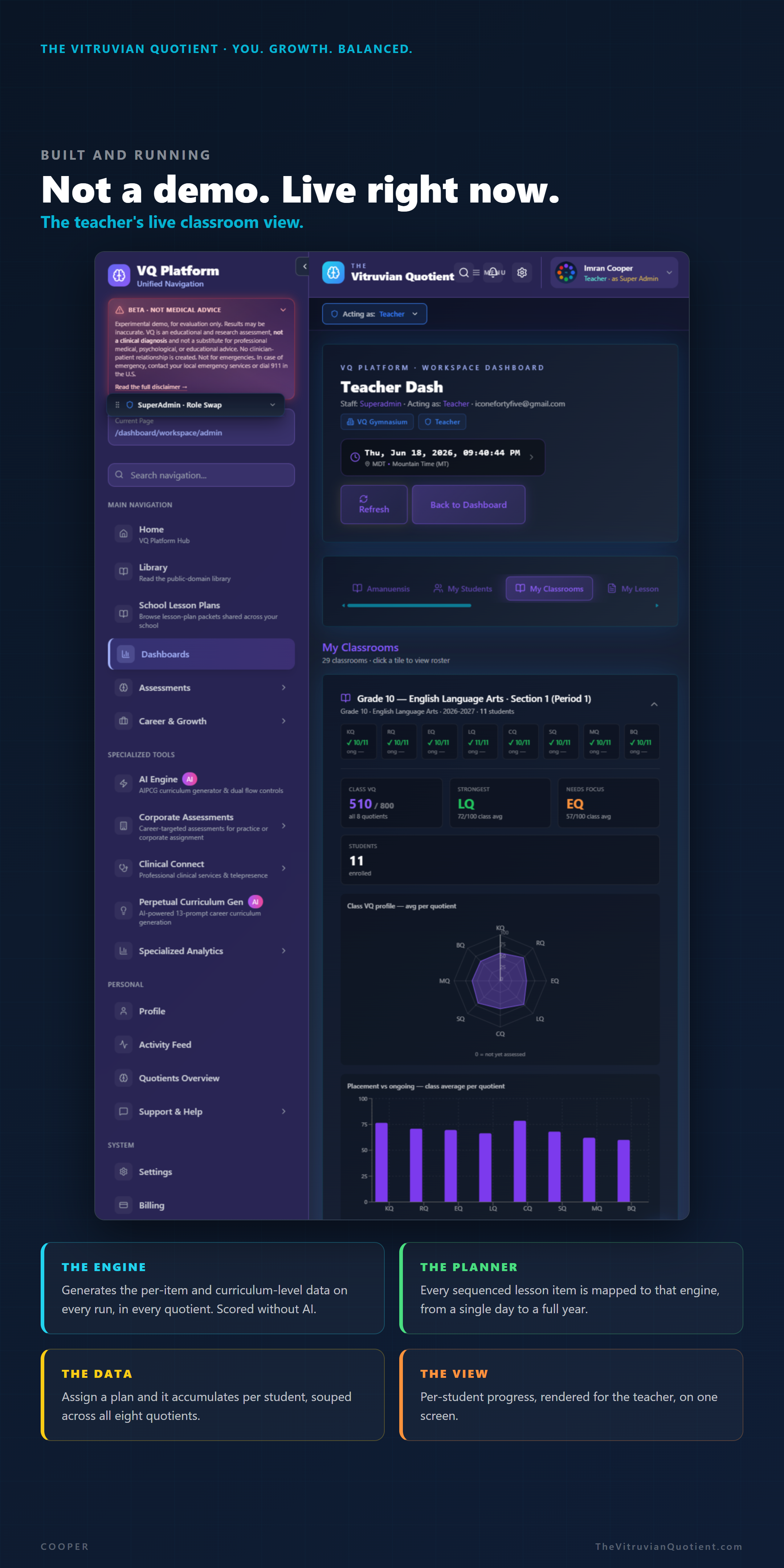
A framework may only be a framework, but I knew I needed something modern and complete. Per-item and curriculum-level data on every run is tagged and tracked per a standard I invented without AI. Only the top peer-reviewed and open academic frameworks in every quotient, scored without any AI. The lesson planner maps every sequenced item to a custom designed engine. Assign a plan and the data accumulates per student, item by item, across all eight quotients, over time and at scale. The teacher sees it, per-student progress on one screen. Not a demo. Live right now.
The point
Ed tech doesn't have a tools problem. It has a management problem.
I have watched this for many years, from the top of the curve as a kid and the bottom of the system as a builder. The pattern never changed. We have no instrument for the whole human being, so we drop the ones we cannot measure and fail the ones we will not locate, and we call the screen we hand them an education. Every other industry fixed this by putting the software in the back seat.
And now, education has finally done that too. Put edtech in the back seat. Let it track, measure, and coordinate. Let the teacher teach.
This is part of The Vitruvian Quotient Platform. It is in playtesting now, and it is free for teachers. If you got into this to understand how kids learn, and you have spent years managing software instead, this was built for you.
The only intelligent quotient. You. Growth. Balanced.