A nation that has solved hunger and tolerates starvation is not struggling. A nation that built abundance and sells scarcity back to its own taxpayers, using their own taxes, is not confused. The factories exist. The math exists. The funding mechanism, the U.S. military commissary, has operated at-cost since 1867. The country has the receipts. It cannot find them.
This is not ideology. It is not market failure or government failure. The condition has a name and it predates politics by a long margin. The name is medical.
Apoplexy is the medical term for a stroke. A state of unconsciousness in which circulation has been occluded and specific regions of the body go dark while motor function continues.
That is the definition of a stroke and the definition of what my book names. A civilization undergoes Historical Apoplexy when it has been cut off from the prior knowledge it spent centuries accruing. The metaphor is not a metaphor. The condition is structurally identical to its medical original. A body of social knowledge continues to move, to produce, vote, transact, govern, while the parts of itself that hold the answers it already worked out remain dark. The civilization can act. It cannot remember.
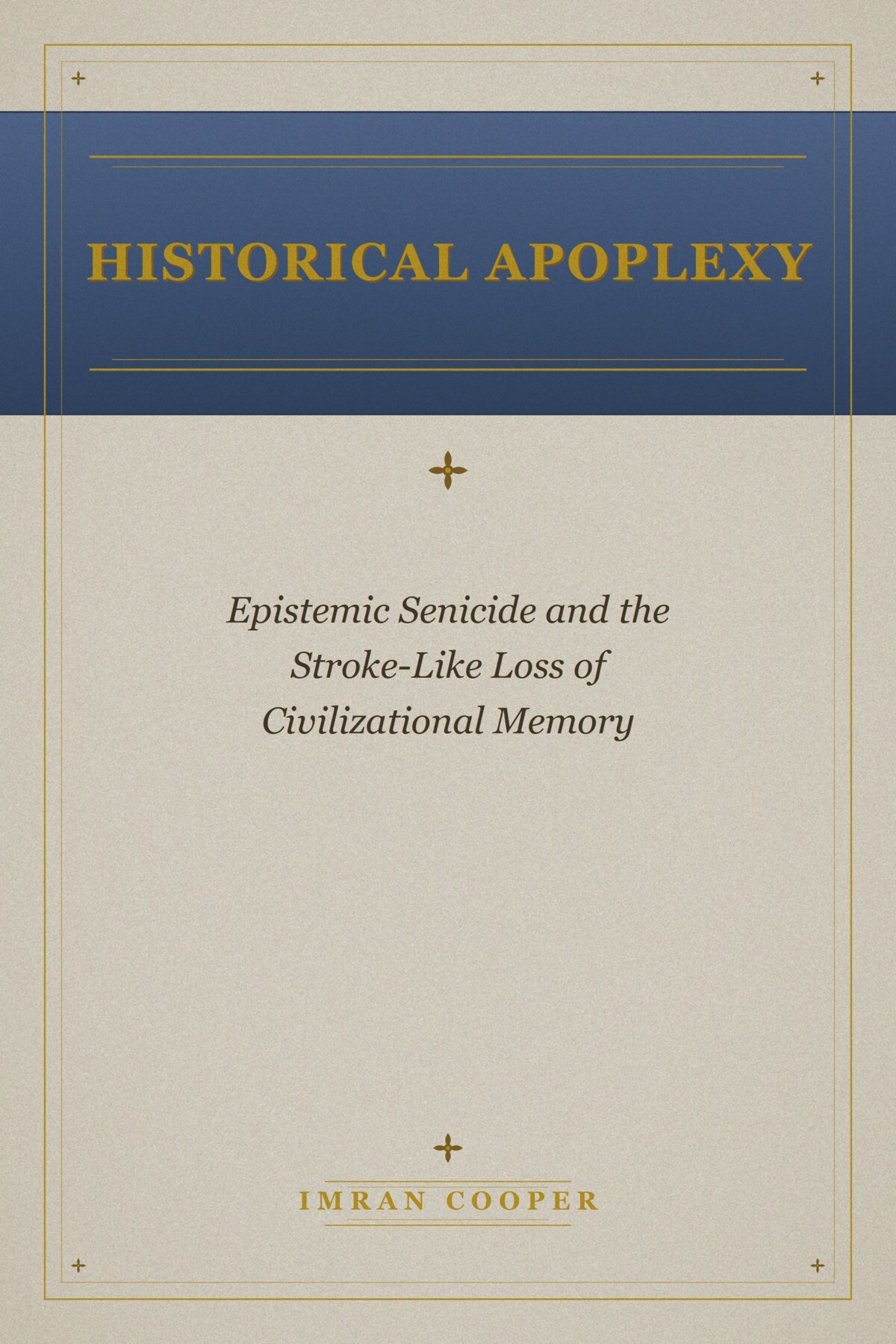
The book is Historical Apoplexy: On the Stroke-Like Loss of Civilizational Memory and the Deliberate Severance of Intellectual Lineage. It reads like a clinical workup. What follows is the diagnostic outline.
Three things go dark together, and none of them feel like they are going dark from inside the patient.
The first thing that goes dark is the prior solution itself. Jacque Fresco spent the better part of a century engineering a resource-based economy: automated fabrication, cybernetic resource management, abundance distribution without monetary rationing. He died in 2017 with the work complete. Between 2024 and 2025 Elon Musk began publicly describing the same future as new. He cited Iain M. Banks. He did not cite Fresco. He did not use the term "resource-based economy." In none of the major-press coverage of Musk's pronouncements does Fresco's name appear.
The arithmetic Fresco published is not contested. The United States has approximately 293,000 manufacturing facilities operating at 77 percent utilization. It would take ten to fifteen thousand factories to provide universal abundance. The country has a margin of twenty to thirty times what is required. The military commissary has run at-cost distribution for one hundred and fifty-eight years, funded by every U.S. taxpayer including the 47.9 million Americans who are food-insecure and cannot use the commissary themselves. Forty-seven point nine million people are denied a system they pay for.
These are not future discoveries. They are present capacity. The civilization has the answers on the shelf. It cannot retrieve them. It announces their future arrival.
The second thing that goes dark is the act of remembering, and when it goes dark the re-presentation is unconscious.
When the carrier is gone, Fresco dead, Tesla dead, the engineer who designed the implementation no longer present in the room, and the next set of presenters has not been taught the lineage, what happens is not theft. It is unconscious re-presentation.
The presenter is not lying. The audience is not ignoring. No single individual is solely responsible. The civilization itself has lost the ability to recognize its own ideas when they return. The paper names this Apoplectic Plagiarism. The canonical example predates this paper by one hundred and sixty-six years. Alfred Russel Wallace independently derived evolution by natural selection in 1858 and mailed the manuscript to Darwin. Darwin's associates arranged a joint presentation. Darwin published first. The civilization remembers Darwin. Wallace is a footnote.
Apoplectic Plagiarism is the symptom that produces the magazine-cover headline X discovers Y when X did not discover Y and Y was already worked out by someone the civilization has lost the address of. It is the structural reason every generation experiences the abundance argument as new.
The third thing that goes dark is the parental connection itself, and the dark side has three doors that are all open right now.
This is Epistemic Senicide. The term names the practice of killing one's elders, in the epistemic register. It is not always violent. It is not always intentional. It works through three doors at once.
The first door is direct industry targeting. Tesla was targeted. Fresco was marginalized. Ideas threatening to power structures get actively erased, misrepresented, or counter-programmed through propaganda. The paper calls this Deliberate Suppression: the civilization is given a stroke on purpose. This is the door no one wants to name out loud.
The second door is structural pressure. The attention economy rewards novelty over verified prior work. The labor market ages people out of the rooms where the citation would have been made. The publishing market wants new names over old ones. The carriers get squeezed out of the transmission belt by the geometry of the markets they work inside. No conspiracy required. The geometry does it.
The third door is the receive-end. Kids in twelfth grade in the United States are not taught the lineage of any subject. Not science, not liberal arts, not languages, not sports, not instruments. They are awarded credentials they cannot operate. The Programme for the International Assessment of Adult Competencies, PIAAC, published December 2024, found that 28 percent of U.S. adults score at the lowest level of literacy, up from 19 percent in 2017. 34 percent score at the lowest level of numeracy, up from 29 percent. The decline is observed in 19 of 26 OECD countries. One in four young Americans is functionally illiterate and more than half of those earned a high school diploma.
The compound litmus test makes the receive-end measurable. Minimum 12th-grade completeness, not genius, completion. Two or more competitive sports. Two or more languages. All 12th-grade subjects at competency. Two or more musical instruments. Less rigorous than ordinary German Gymnasium. Approximately one in six thousand seven hundred American adults clear all four. Some of them came from poverty in Kentucky, which is to say the test is achievable, which is to say the system is not failing the people who cannot clear it. The system is producing them.
When the carriers are pushed out at one end and the students never plug in at the other, the parental chain is severed both directions. The civilization stops believing it had elders at all. That is the full stroke.
The damage to social direction shows up first in families and friend groups, not in governments.
There are two kinds of politics. The formal kind is everything from federal government to a football team, hierarchies where people understand their place and the structure transmits itself by being legible. The informal kind is family hierarchies and friend-group hierarchies. The informal kind is where the inheritance actually moves. It is where children get taught and peers get corrected. The elder voices that built the structure either get reproduced one generation later or they do not get reproduced at all, and the minutiae of how society actually works lives there, not in the formal politics.
When Epistemic Senicide hits the informal politics, when parents have not received the wisdom themselves, when friend groups have no older voice that holds the floor, social direction collapses by default. The Lord of the Flies thing in Golding's novel is not that children are inherently savage. It is that without structured social leadership the children have no inheritance to work with. They build something, but it is not the civilization their parents knew, because their parents never transmitted that civilization either.
The mechanism is the simplest part. People educate people, and the world gets better. People stop educating people, and the world gets worse.
That is the whole engine. The paper specifies the prevention conditions in detail: sciences correctly performed at the higher levels and correctly transmitted through compulsory schooling, with Bloom's Taxonomy honored in sequence; E.D. Hirsch's analogue knowledge base internalized rather than outsourced to Google; civilizational commitment to education as the transmission of civilization itself rather than as job training or credentialing; universal pursuit of excellence rather than minimum competence.
For history specifically, the paper specifies a measurable minimum: approximately ten facts per century across the last two thousand five hundred years of recorded history. About two hundred and fifty core historical facts. Less than what a careful student would have learned in a Carolingian cathedral school in the year 800. More than what most U.S. high school graduates can recall today.
The disease is not mysterious. The disease is what happens when this minimum transmission stops. The medical version of apoplexy describes a body that lost its circulation. The civilizational version describes a society that lost its transmission.
The patient has access to the archive. The patient cannot retrieve it.
The book, Historical Apoplexy: On the Stroke-Like Loss of Civilizational Memory and the Deliberate Severance of Intellectual Lineage, is the clinical workup. It contains the full diagnostic criteria, the mechanisms, the consequences, the mitigations, and the primary case study (Fresco / Musk). The policy compendium is its companion. It documents what implementation looks like at the state, national, and international scale once the diagnosis has been admitted.
When the connection breaks, it can be a loss of consciousness.
Read the full ten-paper academic series. Visit the brand site.