
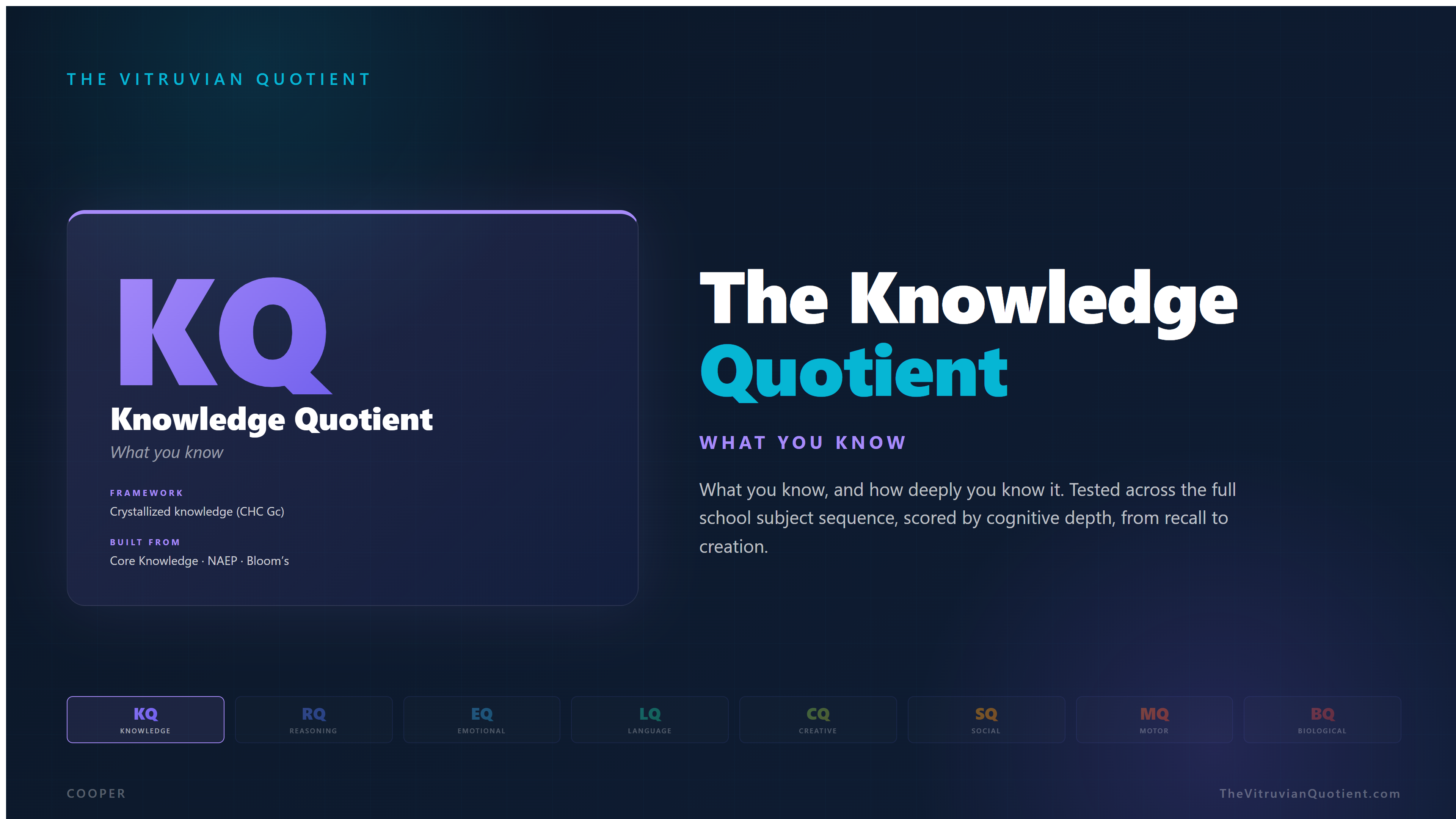
Most "smart tests" try to give you one number for how smart you are. KQ doesn't do that. KQ only measures one specific thing: how much you actually KNOW — the stuff you've learned at school. (How clever you are at thinking or puzzles is a different quotient called RQ. KQ is just "what's in your head.")
The big idea: KQ doesn't give you one knowledge score. It gives you a score for every school subject... separately! Reading, Writing, Math, Algebra, Biology, U.S. History, Physics, and so on. Lots of subjects, each one tracked on its own.
For each subject, the system isn't asking "did you get the question right?" It's asking a bigger question: "What grade level are you actually performing at in this subject?" So instead of "Marcus got 7 out of 10 right," it figures out "Marcus is reading like a 6th grader and doing math like a 4th grader." That's the real answer.
How it finds your grade in each subject: it's like a ladder. You start on the rung that matches your age (a 10-year-old starts on grade 5). Then for each subject, it gives you questions and watches what happens:
- You ace your grade? It pushes you up a rung and gives you harder questions. Get a perfect score in a grade → you roll up to the next one. A really sharp kid can climb all the way to grade 20, which is research and PhD work. There's no ceiling.
- You're struggling? It drops you down a rung to easier questions until it finds where you're really comfortable. You always end up at a grade where you score about 90 so there's no scary "0." Even if you're way below your age-grade in a specific subject, the score penalty stops at 45 once you're three grades down. It doesn't pile on a kid who's already behind.
Each subject ends up with a score from 0 to 100. If you're right at your age-grade → 90. If you're a grade ahead → 100. If you're a grade behind → 85. Two behind → 70. Three or more behind → 45 (frozen there).
Now the cool/honest part: your headline KQ is just the average of all your active subject scores and the average has no shortcuts. If you got 100 in Algebra but 45 in Writing, the average shows both. The Writing gap drags the number down on purpose, because we want to see where the gap is instead of hiding it behind your strong subject. Gaps surface; they don't get covered up.
A couple of clever extras:
- One question, many subjects. If a question is tagged both "Reading" AND "Language Arts," your answer counts as evidence for both subjects at once. One question, multiple measurements. (That's "fan-out.")
- Subjects, not grade-versions. Old way: "Reading grade 1" and "Reading grade 8" were treated as eight different subjects. That's silly. A grade is how hard a question is, not what subject it's about. New way: there's just Reading, one subject, and the grade lives on the question's difficulty.
- Onboarding has two phases. First it sprays one question into lots of different subjects to touch them all and get a quick read on each (the "spray"). Then it concentrates, asking more questions in each subject to pin down exactly what grade you perform at there (the "precision"). When it's confident enough in 25 subjects, it shows you your top 5 strongest subjects.
- Teacher's judgment in-situ. Teachers can adjust out major drags or outline the acceptable curve per student, per assignment, and per classroom. In the platform everything is a dash selection and you have control over difficulty settings in your account profile. Not part of an institution? Sign up to be your own teacher. Are you a parent? VQ, right out-of-the-box, already is the first full homeschool management tool.