
June 26, 2026
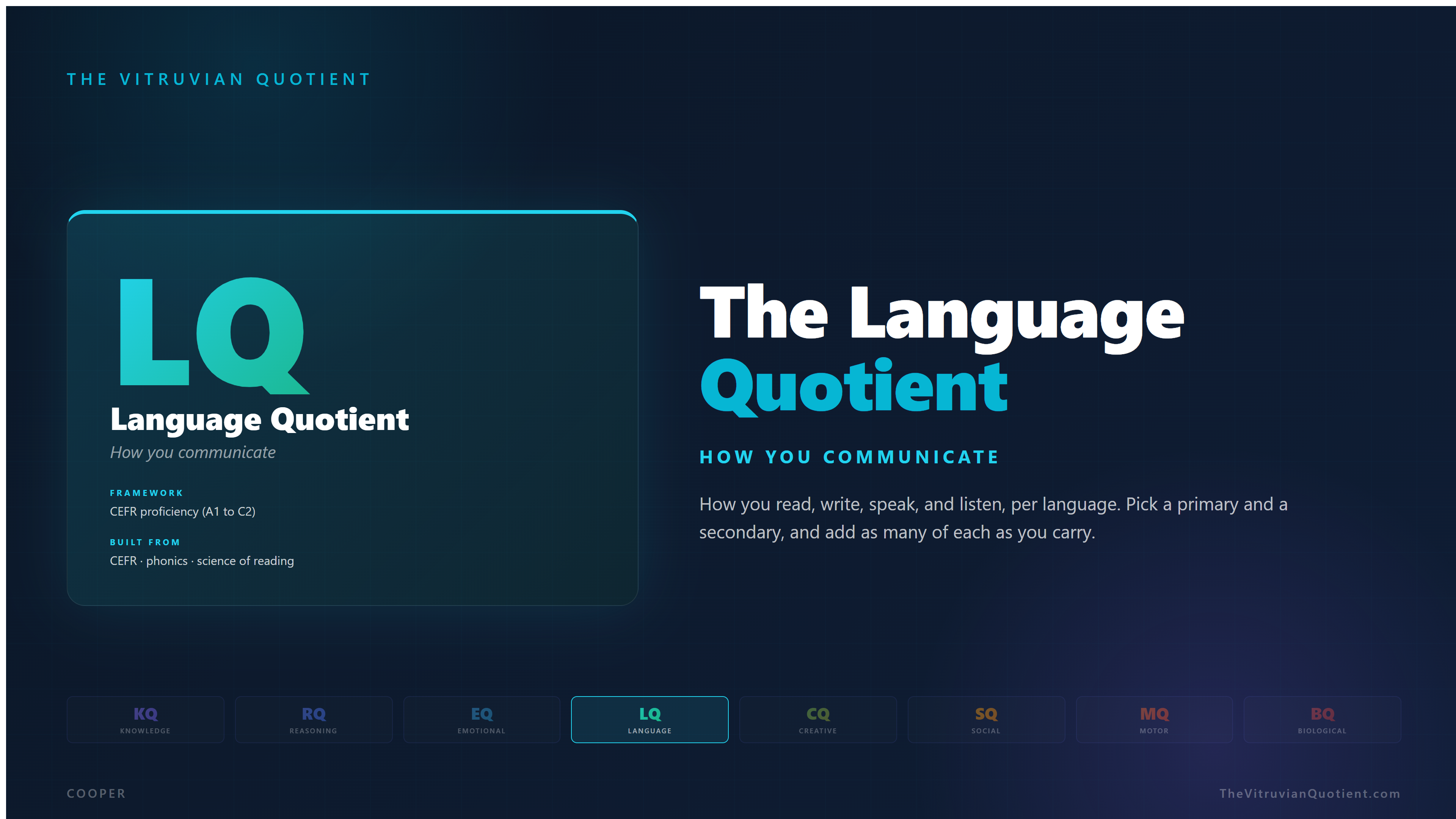
Most language tests check whether you picked the right word on a worksheet. LQ doesn't do that. LQ measures one thing: how well you actually USE a language, out loud and on the page. (How clever you are at thinking is a different quotient, RQ. What facts you've memorized is KQ. LQ is just "can you communicate, and how well?")
The big idea: LQ doesn't give you one "language score." It gives you a score for every language you speak... separately! English, French, Spanish, Armenian, anything we can assess. Each language gets its own score, its own level, its own history. Native English speaker learning French? Two different journeys, tracked separately, and neither one hides the other.
For each language, the system isn't asking "right or wrong." Language doesn't work that way. It lives on a sliding scale, from "just starting out" to "basically native." So instead of marking answers, LQ asks a bigger question: what level are you actually performing at in this language? It places you on the CEFR scale, the international standard that runs A1 (beginner), A2, B1, B2, C1, up to C2 (near-native).
How it finds your level: it reads what you actually produce, the words you write and, where speech is supported, the words you say out loud, the way a skilled language teacher would. It places you in a band, and inside that band it rates four things: how smoothly it flows (fluency), how clearly it's pronounced (pronunciation), how rich the words are (vocabulary), and how well it holds together (grammar). Those four decide where in the band you land. (Pronunciation only counts when there's real spoken work to read. On writing alone, it sits out.)
Each language ends up with a score from 0 to 100. The CEFR level picks the range: A1 is 0 to 20, A2 is 21 to 40, B1 is 41 to 60, B2 is 61 to 75, C1 is 76 to 90, C2 is 91 to 100. The four ratings decide where inside it you sit. A confident B1 lands near the top of 41 to 60. A shaky one lands near the bottom.
Now the honest part: every language stands on its own, and nothing gets papered over. If you're a 95 in English and a 30 in French, you see both. The French doesn't hide behind the English, and the English doesn't get dragged down by the French. Each language tells you the truth about that language. You and your teachers choose what languages your primary VQ scores show. Gaps surface; they don't get covered up.
A couple of clever extras:
- Speaking counts, not just writing. Some items ask you to talk: you get a prompt and say your answer out loud. The system transcribes your speech privately, and where it's clear enough to read, it places your spoken language on the same scale as your writing. Reading, writing, and speaking all aim at one scale.
- The library. LQ can show you a real book, a public-domain classic, and ask you about it. Where the reading sits changes what's being tested. Read the passage first and then answer, and it's checking comprehension and recall. Keep the passage next to the question, and it's checking close reading, how carefully you handle the actual words. Read a whole book and take a 10-to-20 question quiz, or upload a written assignment and have it scored.
- One answer, two measurements. Here's the neat part: whenever you write a real answer anywhere, a science explanation, a history paragraph, that same writing is ALSO language evidence. The system reads it twice: once for what you knew, once for how well you said it. You never sit a separate "language test." Your language shows up in everything you write. (That's "fan-out.")
- No ceiling, just more languages. Within one language the scale tops out at C2. But there's no limit on how many languages you carry. Add a fifth, a sixth, and each one starts its own journey with its own score. Most tests hand a polyglot one number. LQ hands them a map.
- Fair by design. The system makes room for context like age, test anxiety, or a disability, so a younger or nervous learner is met where they are, not punished for it. XQ modifiers and screenlocking are available to teachers, students, parents, and whole institutions.
Here's the part I most want teachers to hear: you can go back to pen and paper.
For years there was one real reason to drift away from handwritten work. Thirty kids turning in handwritten pages every day is a grading mountain. You cannot read, level, and track thirty different hands every single day and still have time to teach. So the page lost ground to the worksheet and the screen. Not because writing by hand was worse for the kid. Because no one human could keep up with it.
VQ changes that math. Have the kids write by hand, scan or photograph the pages, and the system reads them. And it doesn't read them for language only. One handwritten assignment gets read across the quotients at once: what you knew (KQ), how well you reasoned it out (RQ), how well you wrote it (LQ), the thinking and the values inside the argument, even the fine-motor control in the handwriting itself. The same page, many honest reads, all landing on the student's record.
That is the NetSuite idea pointed at a worksheet. The teacher does the teaching and assigns real work on paper. VQ sits in the back office as the system of record, reading and tracking every page so nobody has to grade thirty hands by hand or carry thirty reading levels in their head. The paper goes back to being paper. The measurement still happens, in the back office, where it belongs.
And this is worth doing for the kids, not only for the teacher. Writing by hand helps children learn and remember in ways typing does not, and it gets them off the screen while they do it. Until now, choosing the page meant giving up the tracking, so the page kept losing. You don't have to make that trade anymore. The work stays on paper, off the screen, and the data still shows up on your dashboard the next morning.
One note on how those pages get scored: a scanned handwritten page is the single format where AI does the actual scoring, and it's worth knowing why. Every other format hands the system something it can score by a fixed rule first, with no AI involved: a multiple-choice box is either ticked or it isn't, a typed answer gets checked against accepted answers and keywords, a spoken answer becomes a transcript with clear markers. That plain, rule-based score runs first, and only then can AI come in as a second pass on top of it if you even have an AI authorized account. A photo of handwriting hands the system none of that. No boxes, no typed text, nothing machine-readable. The ink has to be read and understood before any score can exist, and reading freeform handwriting is the one job a fixed rule cannot do. So this is the one place AI leads instead of following, and the system is straight with you about it.
And it's all built on open, public science: the CEFR from the Council of Europe, ACTFL's proficiency guidelines, DIBELS for early literacy. No proprietary black box deciding whether you can speak. Just a clear, honest read of how you actually use each language you know.
Not part of an institution? Sign up to be your own teacher.
Are you a parent? VQ already works as a full homeschool management tool, right out of the box, in every language your family speaks.
Big tech will copy our small operation. Who will you support?