
June 7, 2026
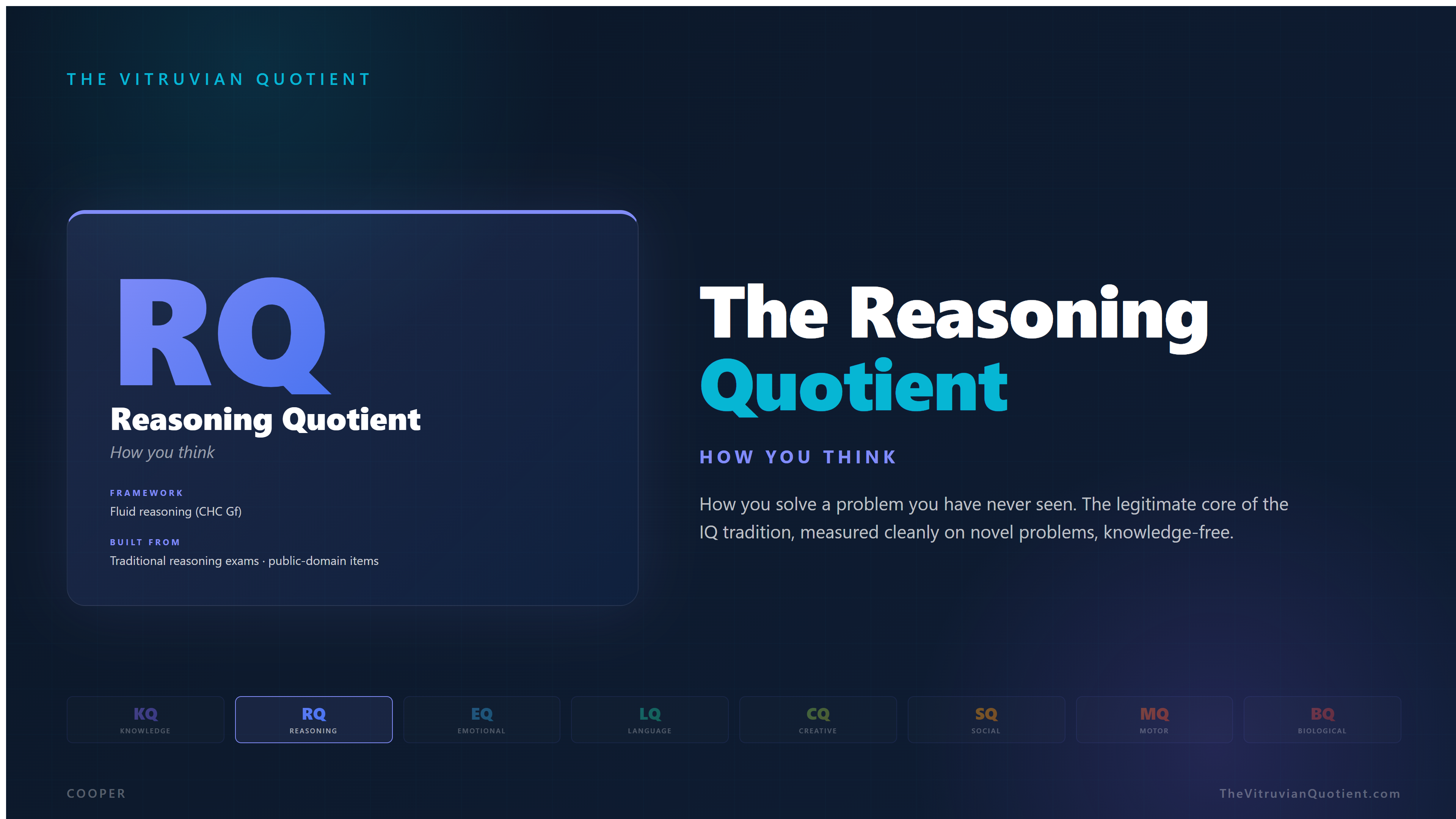
Most "smart tests" want to give you one number for how smart you are. RQ measures the thing those tests are reaching for. It does it honestly, and it does more.
Here's the plain version: everything people call "IQ" lives in RQ. Logic, patterns, problem solving. That's this quotient. So yes, you can still get an IQ score right out of RQ. We just don't stop there.
(The "what you KNOW" part, your facts and school subjects, is a different quotient called KQ. RQ ignores what you've learned. It looks at how well you think.)
The big idea: RQ is knowledge-free on purpose. Every question is built so you can reach the answer by reasoning. You don't need to have studied anything. You need to figure it out. A pattern to continue. A rule to spot. A "which one doesn't belong." A shape turned around in your head. An if-then chain with one right end. If you could Google it, it isn't an RQ question.
It doesn't hand you one flat number, either. RQ reads your thinking in five kinds and scores each on its own:
- Logical: deductions, and spotting the flaw in an argument.
- Mathematical: number patterns, ratios, sequences. The reasoning, not the arithmetic facts.
- Spatial: rotating and folding shapes in your mind.
- Verbal: analogies, word relationships, odd-one-out.
- Working memory: holding several moving parts in your head at once.
- Processing speed: a sixth read, for how fast you reach a right answer.
Here's where the scoring is honestly different from a school test: it takes "right or wrong" out of it and scores you on logical difficulty. It isn't counting how many you got. It measures how hard a problem you can solve, and puts that on a 0 to 100 scale. There's no ceiling. A sharp reasoner just keeps climbing.
And "hard" never means an obscure fact buried in the question. Hard means more steps. An easy item takes one inference. A hard one makes you chain several together without losing the thread. The test gets harder by asking for more thinking, never more trivia. (It's also why RQ doesn't care what grade you're in. A sharp 10-year-old can out-reason an adult, and RQ will say so.)
RQ also measures a second thing: what kind of reasoner you are. You know the thinking-type quizzes a lot of places give you, the four-letter personality tests, the "what kind of thinker are you" stuff. We built our own version and set it next to your IQ score:
- Analytic or intuitive: do you grind it out step by step, or leap to the answer?
- Sequential or random: do you work in order, or jump around?
- Concrete or abstract: do you stick to the specifics, or work in ideas?
- Convergent or divergent: do you hunt for the one right answer, or throw out many?
- Visual or verbal: do you think in pictures, or in words?
- Collaborative or independent: do you think best with others, or on your own?
Plus a read on your confidence: how steady and sure you are as you go.
But here's the honest rule: the personality read does NOT count toward your score. It's a picture of how you think, sitting beside your reasoning number, and it never moves that number. Two people can have the same reasoning strength and think in completely different ways. RQ shows both.
A few more things worth knowing:
- One answer, many measurements. RQ is the lane you can't turn off. Every question in the whole assessment, whatever else it's testing, also reads your reasoning: the choice you made, how long you took, how sure you were. Turn off the camera, the microphone, and the heart-rate strap, and RQ is still in every answer.
- Confidence against correctness. RQ watches the gap between how sure you were and whether you were right. Sure and right is mastery. Sure and wrong is a blind spot. Unsure but right is someone who knows more than they think. That gap is its own kind of intelligence.
- Built on open science. RQ runs on public-domain reasoning puzzles (the ICAR item bank) and the open science of fluid reasoning. It isn't a locked, branded IQ test. You get the IQ-style measure with no black box.
- It adapts as you go. Do well on a kind of reasoning and it hands you harder puzzles there. Struggle and it eases off until it finds your real level. You come out with a true map of where you're strong and where you're still building.
- Teachers keep control. Set the difficulty and the pace per student, per assignment, or per classroom, all from a dropdown. Not part of a school? Sign up as your own teacher. A parent? The Vitruvian Quotient ships as a full homeschool management tool out of the box.
Knowing a lot and thinking well are two different things. RQ is the part that measures the thinking. And it's where your IQ lives.