
Originally written May 29, 2026
Most tests skip this one. The few that try just ask you to grade yourself. "I am a good listener. Yes or no?" That tells us what you think of you. It does not tell us how you really are.
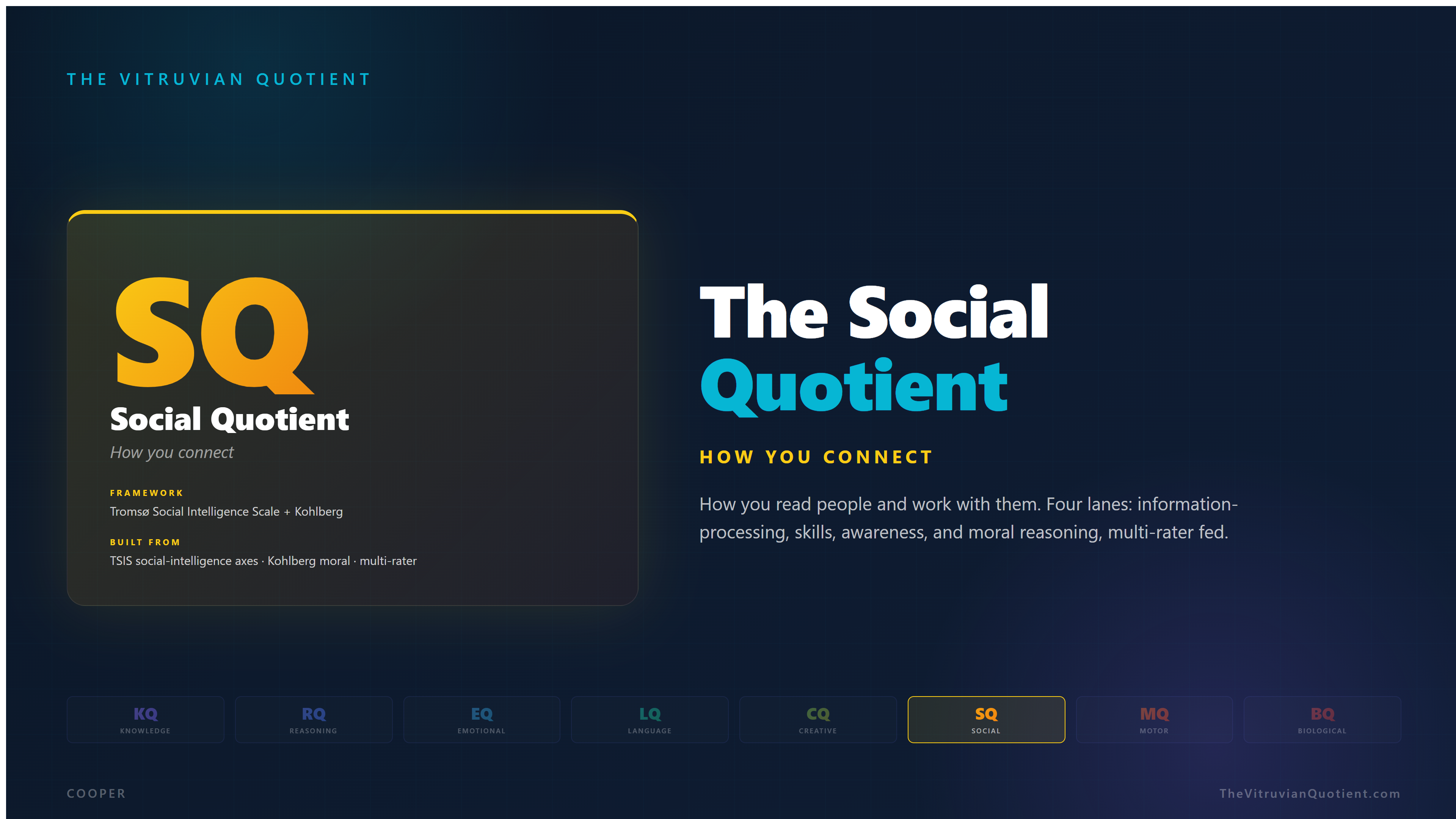
The big idea: SQ looks at four things, and it keeps them apart.
- Reading people. Can you tell how someone feels?
- What you do. Handling a fight. Working with others. Speaking up.
- Reading the room. Knowing the mood of a group, and knowing when it changes.
- Right and wrong. How you think it through when the answer is not easy.
There is no answer key. Real life does not come with one. So SQ never marks you right or wrong. It looks at how you think.
"I would help because they would owe me one."
"I would help because it is fair."
Both are real answers. The second one shows older thinking. SQ can tell them apart.
Here is what makes SQ fair: other people rate you too. Friends. A teacher. A parent. You are not the only one who sees how you act, so SQ does not pretend you are.
All four parts count the same. None of them can hide behind another. If you read people well but freeze when it is time to act, the score shows both. A weak part pulls your number down, and that is the point. We would rather find the gap than paper over it.
Take Maya. She is a senior. She reads people well. She handles herself well. Reading the room is about average, and so is thinking through right and wrong. Her score lands a bit above the middle. Her report names the one thing to work on. Not one flat number with nothing to do about it.
You do not need a screen for any of this. A coach watching how a kid takes a bad call is seeing SQ. So is a teacher watching who holds a group project together. The best way to measure this is to watch what someone does around people.
A teacher or counselor can rate what they see and set what is fair for each student. Not part of a school? You can sign up as your own teacher. Parents can run the whole thing at home.
Where this comes from: the TSIS model (Silvera, 2001) and Kohlberg's stages of moral thinking. Both are open science. Anyone can look them up.