Imran Cooper - February 2026
I, like many others, stay convicted to Carl Sagan's original ideas on Venus colonization and balloon aerostats. I would like to share some of my contributing ideas on this "matter."
Four Devices, Four Phases
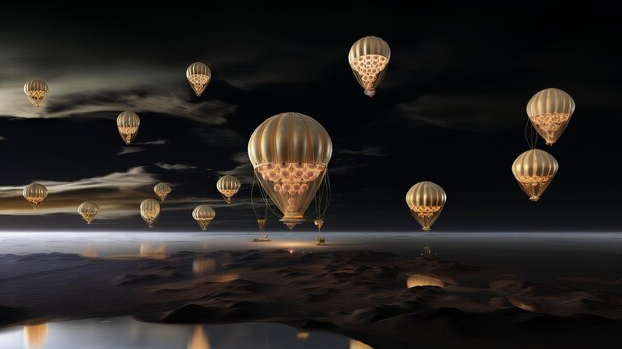
The Venus Aerostat Bioreactor isn't one design. It's a family of at least four devices, each purpose-built for its phase of the colonization timeline. They share a common architecture - PTFE balloon above, bioreactor disk below, tethered processing beneath. But the engineering changes dramatically as the program scales.
Phase 1: The Explorer (~540 kg) A 6-meter PTFE sphere carrying a 0.5 m³ Azolla cultivation tank. Imported helium and hydrogen provide 2.8× the lift of in-situ gas, giving precise altitude control and easy access for human or robot engineers at higher altitudes. Small fission reactor. No water processing. This is proof-of-concept: can Azolla grow on Venus? 3-5 units only.
The He/H₂ decision is deliberate. Day-one systems need maximum control. H₂ does double duty - lifting gas AND Bosch feedstock. One kilogram of hydrogen produces nine kilograms of water via the Bosch reaction. You're not wasting the gas. You're using it twice.
Phase 2: The Spreader (~1,667 kg) An 18-meter PTFE sphere at 53 km. EVER electrolysis replaces imported gas and splits Venus's CO₂ atmosphere into CO + O₂ (average molecular weight 29.3 vs CO₂'s 44) for buoyancy. Less lift per cubic meter, but no imports means you can build hundreds. A 0.5-meter PEEK processing pod hangs on a 3-km winched tether below, running Bosch reactions at ambient Venus temperature.
The Spreader has a 50-kg lift deficit at 55 km. This is by design. It self-corrects to 53-54 km equilibrium where denser atmosphere gives +284 kg surplus. No altitude control system needed. The atmosphere holds it where it belongs.
Phase 3: The Harvester (~2,480 kg) Ten-unit clusters sharing infrastructure. Each unit: a 22-meter sphere with a 3.5 m³ bioreactor running Azolla and Chlorella co-culture. The cluster shares a 15-km processing tower reaching down to 40 km - three PEEK modules (Bosch, Sabatier, acid recovery) on a shared tether. Cost per unit for the deep infrastructure: ~96 kg instead of carrying the full tower individually.
Output per unit per day: 4-6 kg oxygen, 3-5 kg water, 0.8 kg protein biomass, 50-80 g fixed nitrogen.
Phase 4: The Sovereign (~11,037 kg) A 40-meter sphere with four 5-meter helium bladders at the equator - fill/dump for precision altitude control. Return to He/H₂ because at this scale, you need the control back. Below: a 16m × 16m gondola carrying crew module, manufacturing bay, drone bay, 14-meter bioreactor disk, and a fusion reactor. Below that: a 25-km triple-bundle tether reaching four processing modules at 50, 45, 38, and 30 km altitude.
The Sovereign has a 1,296-kg lift deficit at 53 km. It operates at 50 km baseline where atmospheric density gives it +5,225 kg margin. For docking at 60+ km, it dumps water ballast and inflates bladders. After descent, the processing tower refills the water. The planet provides the ballast.
Not Every Balloon Carries Every System
Here's the insight that cuts 21% off your fleet mass: specialization.
A Phase 2 fleet of 100 identical Spreaders at 1,667 kg each totals 166,700 kg. Every unit carries a Bosch pod, seed kit, enhanced sensors - systems that sit idle on most units while being critical on a few.
Strip those redundancies. Sixty units become lightweight bioreactors at ~1,200 kg. The other forty become specialists:
- 60 Standard Bioreactors: Azolla + EVER, nothing else (~1,200 kg)
- 10 Water Producers: Enhanced Bosch, 100L reservoir, supplies neighbors (~1,400 kg)
- 8 Acid Crackers: H₂SO₄ → water + sulfur + O₂ from the clouds (~1,500 kg)
- 5 Power Stations: Thermal gradient + lightning + wind shear (~1,600 kg)
- 5 Navigation/Mapping: High-grade cameras, LIDAR, fleet beacons (~1,300 kg)
- 4 Acoustic Arrays: Seismic and atmospheric monitoring (~1,250 kg)
- 3 Surface Probers: Expendable probes to the surface (~1,400 kg)
- 3 Distillation Columns: Atmospheric chemistry collection (~1,350 kg)
- 2 Comms/Power Relays: Orbital link, big batteries, recharge station (~1,800 kg)
Specialized fleet: ~131,000 kg. Savings: 35,700 kg (21%).
More critically: reliability goes up. A bioreactor with no moving parts except atmospheric intake valves and the EVER cell has fewer failure modes than one carrying a Bosch reactor, a winch, and a probe system. Fewer components means longer unserviced lifetime. Longer lifetime means lower attrition. Lower attrition means faster fleet growth.
The Plumbing That Makes It Work
Specialization only works if products move between units. That requires a universal transfer system.
Three interface types. One threading standard. Any cartridge fits any port.
Gas Cartridge Interface (GCI): Pressurized PEEK-CF cylinders - 0.5L, 2L, or 10L - rated to 200 bar. Functions like a CO₂ cartridge in a soda machine. Snap in, fill, snap out, transport. Carries O₂, H₂, He, CO, CH₄, N₂.
Liquid Bottle Interface (LBI): Steel-lined PEEK bottles - 1L, 5L, or 20L - with threaded caps and pour/pump adapters. Nalgene-style: robust, reusable, chemically inert. Carries water, nutrient solution, sulfuric acid, biomass slurry.
Snap-Together Structural Interface (SSI): Pin-and-socket quarter-turn lock. 500 kg per connection pair. Any component that snaps together without tools is a component a robot or a gloved astronaut can assemble.
All three share M20 × 1.5 metric threading with PTFE gaskets.
Three delivery methods:
- Drones (0-2 km): PEEK-CF quadrotors, 2 kg payload, 45-min flight, wireless induction recharging at any Power Station.
- Tethered hose (0-100 m): Flexible PEEK conduit, 10mm bore, 20 L/hour. A Water Producer parks near a bioreactor, connects the hose, pumps for hours, disconnects, moves to the next customer.
- Free-float canisters (0-50 km): A small PTFE balloon carrying a cargo rack, released into the super-rotating atmosphere. Drifts with the wind. Tracking beacon. Intercepted by any downstream aerostat. The planet's own wind is the delivery system.
The Arc
Explorer → Spreader → Harvester → Sovereign. Imported precision → in-situ scaling → clustered industry → imported precision at maturity. 3 units to 280 to thousands to crew-capable stations with manufacturing on board.
The fleet evolves modularly. When a better Bosch reactor is developed, only the 10 Water Producers need upgrading - not all 100 units. When a new camera arrives, only the 5 Navigation specialists receive it. The fleet iterates without full-fleet retrofit.
Biology is the replicator. Azolla seeds each new unit. The manufactured envelope and hardware are the bottleneck - not the organism.
Citations
Venus Atmospheric Environment
Seiff, A. et al. (1985). "Models of the Structure of the Atmosphere of Venus from the Surface to 100 Kilometers Altitude." Advances in Space Research, 5(11), 3-58. — Temperature, pressure, and density by altitude. Source for all buoyancy calculations: CO₂ density at 55 km (~0.92 kg/m³), 53 km (~1.06 kg/m³), 50 km (~1.74 kg/m³).
Taylor, F.W. & Grinspoon, D.H. (2009). "Composition of the Atmosphere of Venus below the Clouds." In Encyclopedia of the Solar System, 2nd ed., Academic Press. — 96.5% CO₂, 3.5% N₂. The atmosphere that provides both feedstock and buoyancy medium.
Aerostat Heritage and Habitability
Sagdeev, R.Z. et al. (1986). "Overview of VEGA Venus Balloon in situ Meteorological Measurements." Science, 231(4744), 1411-1414. — PTFE balloon flight ON Venus. VEGA 1 and 2, 1985. 46+ hours at ~54 km. The flight heritage that makes the envelope a proven component.
Landis, G.A. (2003). "Colonization of Venus." AIP Conference Proceedings, 654, 1193-1200. — Venus cloud-level habitability: 27°C, 0.5 bar at 55 km. The foundational case for atmospheric habitation that all four device phases build on.
Buoyancy and Lifting Gas Physics
Lee, G. et al. (2025). "EVER: Exploring Venus with Electrolytic Replenishment." 56th Lunar and Planetary Science Conference, Abstract #2187. — In-situ CO₂ electrolysis for balloon buoyancy. CO+O₂ product gas (MW 29.3) vs CO₂ (MW 44). Lift: 0.29 kg/m³ at 55 km vs He at 0.80 kg/m³. The 2.8× lift advantage of imported gas over EVER cited in Explorer and Sovereign sections.
Hecht, M.H. et al. (2021). "Mars Oxygen In-Situ Resource Utilization Experiment (MOXIE)." Science, 375(6578), 1180-1184. — CO₂ → CO + O₂ solid-oxide electrolysis demonstrated on Mars. Heritage technology for the EVER system that powers Phase 2-3 fleet expansion.
Chemical Processing
Sabatier, P. & Senderens, J.-B. (1902). "New Synthesis of Methane." Comptes Rendus de l'Académie des Sciences, 134, 514-516. — Original Sabatier reaction (CO₂ + 4H₂ → CH₄ + 2H₂O). Foundation for the atmospheric processing modules on Harvester and Sovereign.
NASA Marshall Space Flight Center (2019). "Series-Bosch Reactor Development." NASA Technical Reports Server. — Bosch reaction (CO₂ + 2H₂ → C + 2H₂O) achieving >90% oxygen recovery. The reaction running in Spreader PEEK pods, Harvester processing towers, and Sovereign modules. Source of solid carbon byproduct (structural material, carbon fiber feedstock).
Krasnopolsky, V.A. (2007). "Chemical Kinetic Model for the Lower Atmosphere of Venus." Icarus, 191(1), 25-37. — H₂SO₄ thermal decomposition in Venus atmosphere. Chemistry behind the Acid Cracker specialist units producing water from the clouds.
Materials
Victrex plc. (2023). "VICTREX PEEK 450G Datasheet." — PEEK continuous working temperature (260°C), sulfuric acid resistance to 70% concentration. Enables all tethered processing modules from the Spreader's 0.5m pod to the Sovereign's 25-km processing tower.
INTAMSYS Technology Co. (2024). "FUNMAT HT Enhanced — Industrial PEEK 3D Printing." Product specifications. — PEEK-CF 3D printing at 410°C nozzle. Manufacturing Specialist units printing replacement components and drone fleet on Venus.
Biology
Lumpkin, T.A. & Plucknett, D.L. (1980). "Azolla: Botany, Physiology, and Use as a Green Manure." Economic Botany, 34(2), 111-153. — Azolla doubling time (2-5 days), protein content (15-30%), nitrogen fixation via Anabaena symbiosis. The organism that seeds each new unit — biology as the fleet's replicator.
Brinkhuis, H. et al. (2006). "Episodic Fresh Surface Waters in the Eocene Arctic Ocean." Nature, 441(7093), 606-609. — The Azolla Event. Geological proof that this organism edited a planet's atmosphere. The precedent that justifies deploying it on Venus.
Speelman, E.N. et al. (2009). "The Eocene Arctic Azolla Bloom: Environmental Conditions, Productivity, and Carbon Drawdown." Geobiology, 7(2), 155-170. — Quantified Azolla carbon drawdown rates. Informs the biological output calculations cited for Harvester and Sovereign phases.
Reactor and Power Systems
Gibson, M.A. et al. (2018). "Kilopower Reactor Using Stirling Technology (KRUSTY) — Fission Power for Science and Exploration." NASA Technical Memorandum. — Small fission reactor heritage. The "small fission reactors" referenced in Phase 1 Explorer and the baseline nuclear capability across all phases.
Modular Connector Standards
ISO 261:1998. "ISO General Purpose Metric Screw Threads — General Plan." International Organization for Standardization. — M20 × 1.5 metric thread standard. The universal threading shared across GCI, LBI, and SSI connector interfaces.
Fleet Architecture and Self-Replication
von Neumann, J. (1966). Theory of Self-Reproducing Automata. University of Illinois Press. (Edited and completed by A.W. Burks.) — Theoretical foundation for self-replicating systems. The fleet's biological self-replication (Azolla seeding each new unit) achieves what von Neumann described for machines — on day one, not mid-century.
NASA (1980). "Advanced Automation for Space Missions." NASA Conference Publication 2255. — Self-replicating factory proposals. The industrial counterpart to Azolla's biological replication. Fleet evolution from biological replicator (Phase 1-3) supplemented by robotic manufacturing (Phase 3-4).