LinkedIn Article Version - Condensed from Paper VIII Author: Imran Cooper - February 2026
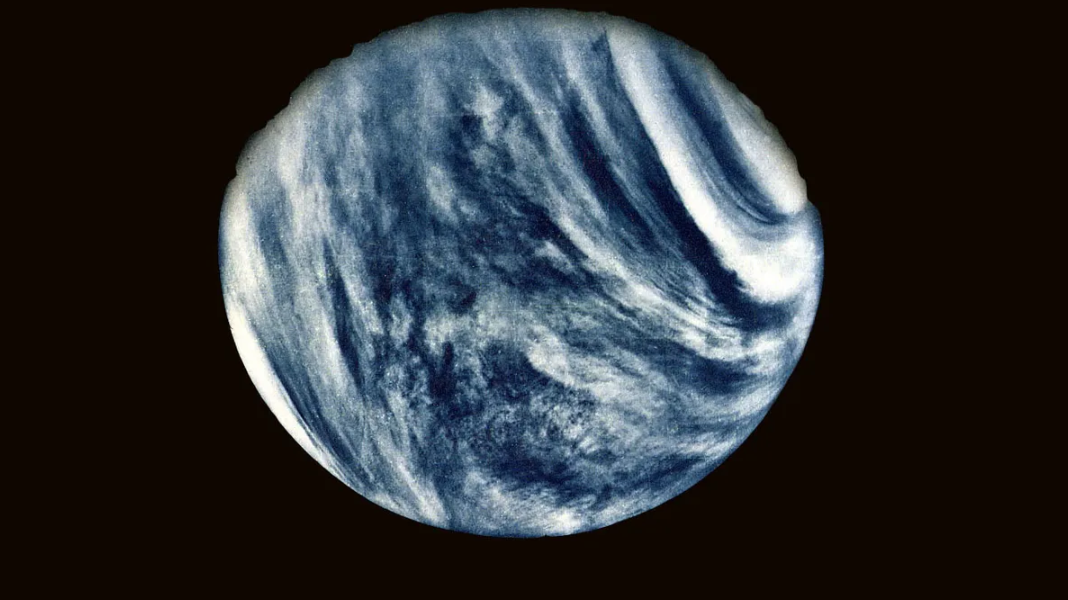
"Our posturings, our imagined self-importance, the delusion that we have some privileged position in the Universe, are challenged by this point of pale light. Our planet is a lonely speck in the great enveloping cosmic dark. In our obscurity, in all this vastness, there is no hint that help will come from elsewhere to save us from ourselves." - Carl Sagan (image NASA)
Carl knew duplicating the biosphere to Venus was imperative to us surviving ourselves... do you?
49 Million Years Ago, a Fern Changed a Planet
During the middle Eocene, a small aquatic fern called Azolla covered the Arctic Ocean - which was freshwater at the time - and absorbed so much CO2 that it helped trigger the transition from hothouse to icehouse Earth. It took about 800,000 years. No one engineered it. No one funded it.
A single organism, replicating exponentially on a water surface, edited a planet's atmosphere. The evidence is in the sediment cores, published by Brinkhuis et al. in Nature in 2006.
This is relevant because we now have three independent data points confirming that planetary climates are not fixed - they're editable:
- Biological: The Azolla Event. One fern species. 800,000 years. Planetary climate shift. Natural.
- Industrial: Internal combustion engines. 1.4 billion units over 150 years changed Earth's atmospheric CO2 from 280 ppm to 420+ ppm. Accidental.
- Proposed: A Venus terraformation program applying these demonstrated mechanisms deliberately.
Two of these have already happened. The third applies the proven principles on purpose.
The Organism
Why Azolla specifically? Six properties that no other candidate combines:
- Doubles biomass every 2-5 days
- Fixes its own nitrogen (via symbiotic Anabaena cyanobacteria - no fertilizer imports needed)
- 15-30% protein content (food-grade)
- Floats on water - no soil required
- Growth accelerates in high CO2 environments
- Geological proof of planetary-scale climate impact
Venus has 96.5% CO2 and 3.5% nitrogen in its atmosphere. Azolla treats the CO2 as feedstock. Anabaena handles the nitrogen budget. The organism doesn't need us to prepare the atmosphere first. It processes the atmosphere as-is - enclosed in a controlled bioreactor floating at 55 km altitude where conditions are 27°C and 0.5 bar. Warmer than San Francisco.
The Device
The Venus Aerostat Bioreactor is a dual-component tethered system:
Upper: A PTFE (Teflon) balloon providing buoyancy. Phase 1 uses imported helium and hydrogen for precise altitude control. Later phases use EVER electrolysis - splitting atmospheric CO2 into CO and O2 for in-situ lifting gas. No imports needed.
Lower: A transparent bioreactor disk. Azolla floating on a thin water layer. CO2 intake from the Venus atmosphere (filtered to exclude sulfuric acid aerosol). A greenhouse floating in the sky.
Below that: PEEK (polyether ether ketone) processing modules tethered into the hotter lower atmosphere (110-230°C) where Bosch and Sabatier reactions run at ambient temperature. This is free process heat from the planet itself. Products: water (feeds back to bioreactor), solid carbon (structural material), oxygen (life support).
Every component has independent flight heritage:
- PTFE balloons flew ON Venus in 1985 (VEGA missions)
- MOXIE split CO2 on Mars in 2021
- Photobioreactors operate on the ISS today
- Azolla has been cultivated for over a thousand years
The synthesis is new. The components are not.
The Life Question
Before deploying any terrestrial biology on Venus, we need to determine whether Venus is already alive.
The cloud deck at 48-60 km - the same altitude we're targeting for bioreactors - is one of the most scientifically plausible habitats for existing microbial life outside Earth. The phosphine debate of 2020 (Greaves et al.) showed the scientific community considers Venus cloud life plausible enough to argue about.
So we survey first. Two years minimum. Atmospheric sampling, microscopy, biosignature gas detection, metabolic activity assays. If life is found, we study it before deploying anything. If no life is found after thorough survey, we're cleared.
And if Venus has no native life, we have another tool: directed evolution. Belyaev's fox domestication program showed dramatic physiological changes in 10-15 generations. For Azolla, that's 45-75 days. For bacteria, it's hours. We don't just hope organisms tolerate Venus. We engineer them for it.
The Phase Correction
An earlier paper I wrote placed biological deployment in Phase 4 of the terraformation timeline - years 100-300. That was wrong. I now have a more rapid timeline.
Biology deploys at Phase 1. Day one. The bioreactor is a mission payload, not a terraforming endpoint.
Phase 1 (Day One - Year 10): Controlled precision platforms. Imported helium/hydrogen for altitude control. Small fission reactors. 3-5 bioreactors proving the concept. First biological O2 produced on Venus.
Phase 2 (Years 10-30): Self-sustaining fleet. EVER electrolysis for buoyancy - no imported gas. Each bioreactor seeds the next with Azolla. Biology is the replicator. ~280 units by year 30. Bio-O2 exceeds crew metabolic demand by year 15.
Phase 3 (Years 30-60): Thousands of bio-aerostats in clusters. Venus-adapted Azolla strains emerging from decades of selection pressure. Colony protein self-sufficiency. Fixed nitrogen accumulating for future soil.
Phase 4 (Years 60-150+): Return to controlled buoyancy - He/H2 fill/dump bladders on mature stations. Crew-capable. Manufacturing on board. And when surface water appears: Azolla transitions from enclosed bioreactors to open aquatic deployment. First free-floating organism on Venus. The L1 sunshade transitions from full-umbra cooling mode to partial-transmission regulation - transmitting approximately 52% of sunlight to reduce Venus's 2,601 W/m² solar flux to Earth-equivalent 1,361 W/m². The shade is not temporary. It is permanent climate infrastructure for as long as Venus is inhabited.
Not Every Balloon Needs Everything
The fleet isn't 100 identical, overloaded aerostats. It's 100 specialized units operating as an integrated network:
- 60 standard bioreactors (Azolla + EVER, nothing else)
- 10 water producers (Bosch processing, supplies neighbors)
- 8 sulfuric acid crackers (clouds become water + sulfur + O2)
- 5 power stations (thermal gradient + lightning + wind shear)
- 5 navigation/mapping (high-grade cameras, fleet beacons)
- 4 acoustic arrays (listening to the planet's seismology)
- 3 surface probers (expendable probes to the surface)
- 3 distillation columns (atmospheric chemistry collection)
- 2 comms relays (orbital link, drone recharge, crew station)
Universal snap-together connectors. CO2-cartridge-style gas transfer. Nalgene-style liquid bottles. Any product from any device transfers to any other device. Drones carry supplies between balloons. The planet's own wind carries free-float canisters across the fleet.
Specialization reduces total fleet mass by 21% and dramatically improves reliability - fewer components per unit means fewer failure modes.
Turning Your Worst Enemy Into Your Best Friend
The sulfuric acid clouds are not a barrier. They're a water source.
H2SO4 decomposes thermally into water, sulfur compounds, and oxygen. Venus does this naturally below 40 km altitude. A tethered Acid Cracker device collects cloud droplets at 50 km and feeds them down to a processing module at 38-42 km where catalytic decomposition produces water. No imported hydrogen required. Eight crackers in a fleet of 100 yield 240-400 kg of water per month from the clouds themselves.
Human history is full of this pattern. Seawater was the sailor's enemy until desalination. Petroleum was a nuisance until refining. The clouds of Venus are the same kind of problem - the kind that becomes your most productive resource once you stop fearing it and start processing it.
The Planet Powers the Fleet
Three passive energy sources available to every aerostat:
Thermal gradient: The 163°C temperature difference between 55 km (27°C) and 35 km (190°C) drives a heat engine through a tether-mounted conduit loop. 200-500 W continuous per unit. Free. No fuel. Permanent.
Wind shear: Venus's super-rotation varies with altitude. Differential wind speed between altitude bands creates tension on a tethered drag element. 50-200 W continuous. A parachute on a string with a generator.
Lightning: Venus has confirmed atmospheric electrical activity. Conductive tether arrays collect charge. Lithium-sulfur batteries (sulfur from acid cracking) store it. Wireless induction pads share power across the fleet.
Combined, these passive systems produce 1.25-3.5 kW continuous for every 100 aerostats - before accounting for solar. By Phase 4, the ambient energy portfolio supplements and progressively reduces nuclear dependence for routine operations. The planet itself powers the fleet.
Venus vs Mars (The Biological Focus)
Venus advantages for biology:
- 0.91g gravity (biology evolved at 1g - Mars is 0.38g)
- 2x Earth's solar flux (more light = faster photosynthesis during terraformation; regulated to Earth-equivalent 1,361 W/m² permanently via L1 shade transition post-terraformation)
- 96.5% CO2 atmosphere (the feedstock, not the problem)
- Atmospheric buoyancy (bioreactors float - no surface domes)
- Temperature sweet spot at 50-55 km (27-75°C, no heating needed)
Mars gets Azolla too. In enclosed ground habitats. But Mars is not where the full biosphere scales. Venus has the gravity, the light, the feedstock, and the atmospheric architecture. Mars is training. Venus is the main event.
The Delay Is the Diagnosis
The Azolla Event was published in 2006. Venus aerostat habitability was analyzed in 2003. MOXIE flew in 2021. The EVER concept was presented in 2025. Photobioreactors run on the ISS.
Every piece of this synthesis existed. The paleobotanists knew about the Azolla Event. The aerospace engineers knew about Venus aerostats. The astrobiologists knew about photobioreactors. Each discipline published and moved on - within its own silo.
Twenty years between the Azolla Event entering the peer-reviewed record and anyone writing: "Deploy this organism in an enclosed bioreactor on a Venus aerostat." Not a failure of knowledge. A failure of synthesis.
Carl Sagan proposed seeding Venus with photosynthetic organisms in 1961. He was right about the mechanism, wrong about the delivery - open deployment into sulfuric acid. The correction was one variable: enclose the organisms. It took 65 years.
Biology is not the last step of terraforming. It is the first tool deployed. The organism is ready. The platform is proven. The atmosphere is waiting.
Biology is the replicator. Azolla seeds each new unit. The manufactured envelope and hardware are the bottleneck - not the organism.
Citations
Sagan, C. (1961). "The Planet Venus." Science, 133(3456), 849-858. — The original proposal to seed Venus's atmosphere with photosynthetic organisms. Referenced in the closing section: "Carl Sagan proposed seeding Venus with photosynthetic organisms in 1961."
Greaves, J.S. et al. (2020). "Phosphine Gas in the Cloud Decks of Venus." Nature Astronomy, 5, 655-664. — The phosphine detection that reignited the Venus cloud life debate. Referenced in the Life Question section.
Poughon, L. et al. (2009). "Photobioreactor for the MELiSSA Closed Life Support System." Acta Astronautica, 65(1-2), 29-36. — ISS-heritage photobioreactor development under the ESA MELiSSA program. Supports the claim "Photobioreactors operate on the ISS today."