
What it is, in one breath
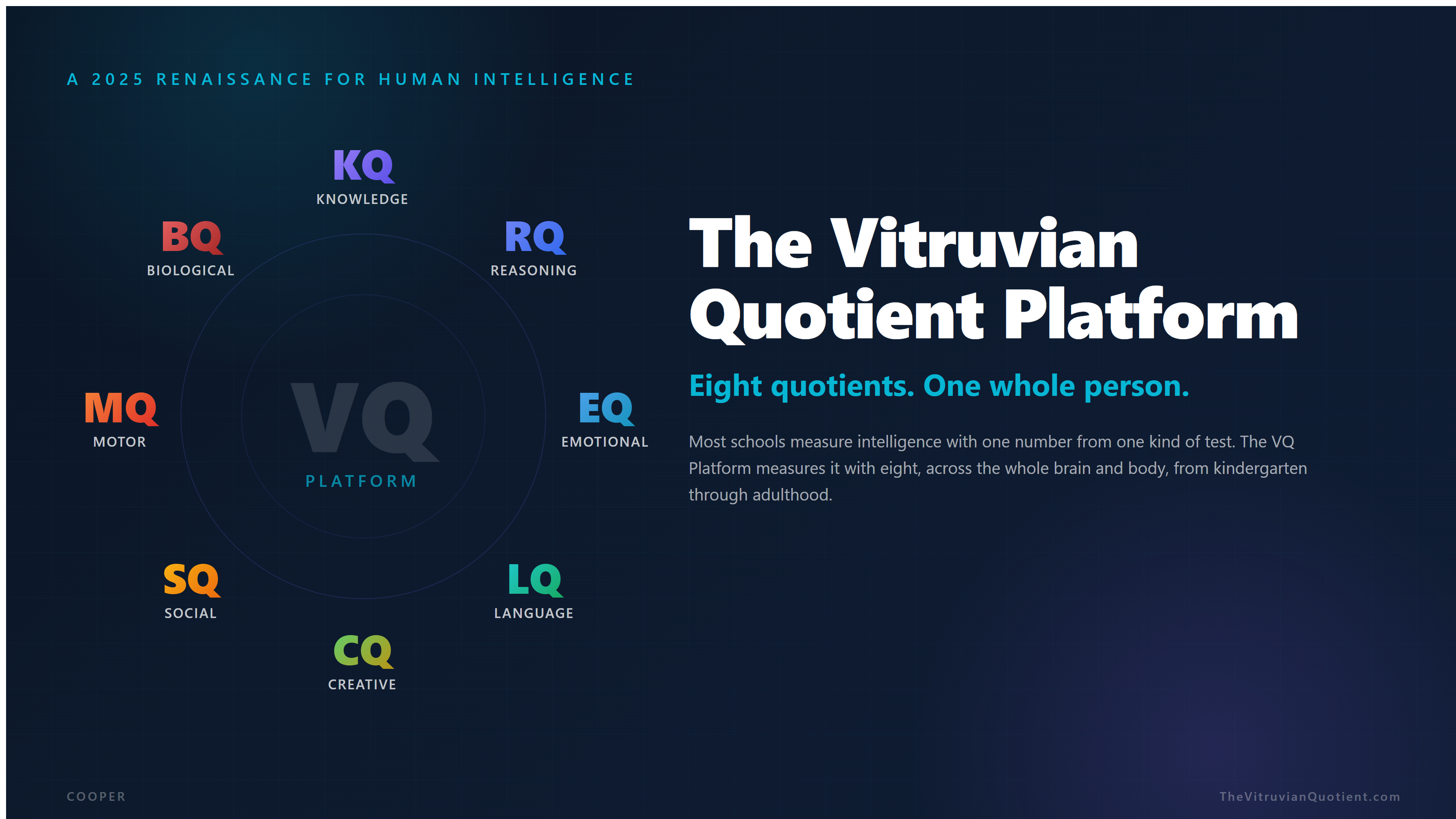
Most schools measure intelligence with one number from one kind of test. The VQ Platform measures it with eight, across the whole brain and body, from kindergarten through adulthood.
The eight quotients
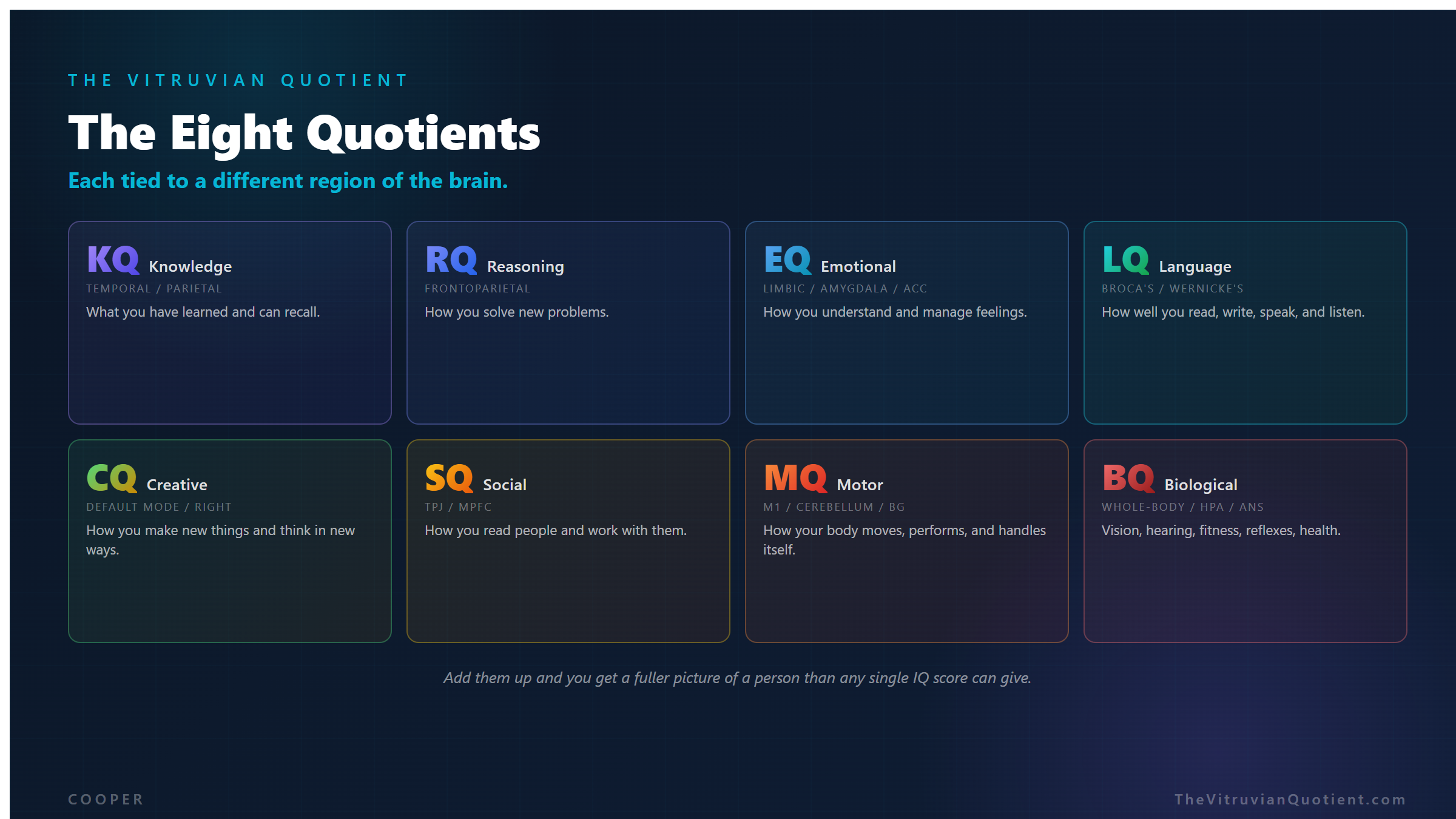
A person's intelligence has eight parts. Each part is tied to a different region of the brain.
- KQ — Knowledge. What you've learned and can recall.
- RQ — Reasoning. How you solve new problems.
- EQ — Emotional. How you understand and manage feelings.
- LQ — Language. How well you read, write, speak, and listen.
- CQ — Creative. How you make new things and think in new ways.
- SQ — Social. How you read people, work with them, and manage them.
- MQ — Motor. How your body moves, performs, and handles itself.
- BQ — Biological. How your body itself is doing. Vision, hearing, fitness, reflexes, health.
Add them up and you get a fuller picture of a person than any single IQ score can give.
Why it works differently than standardized tests
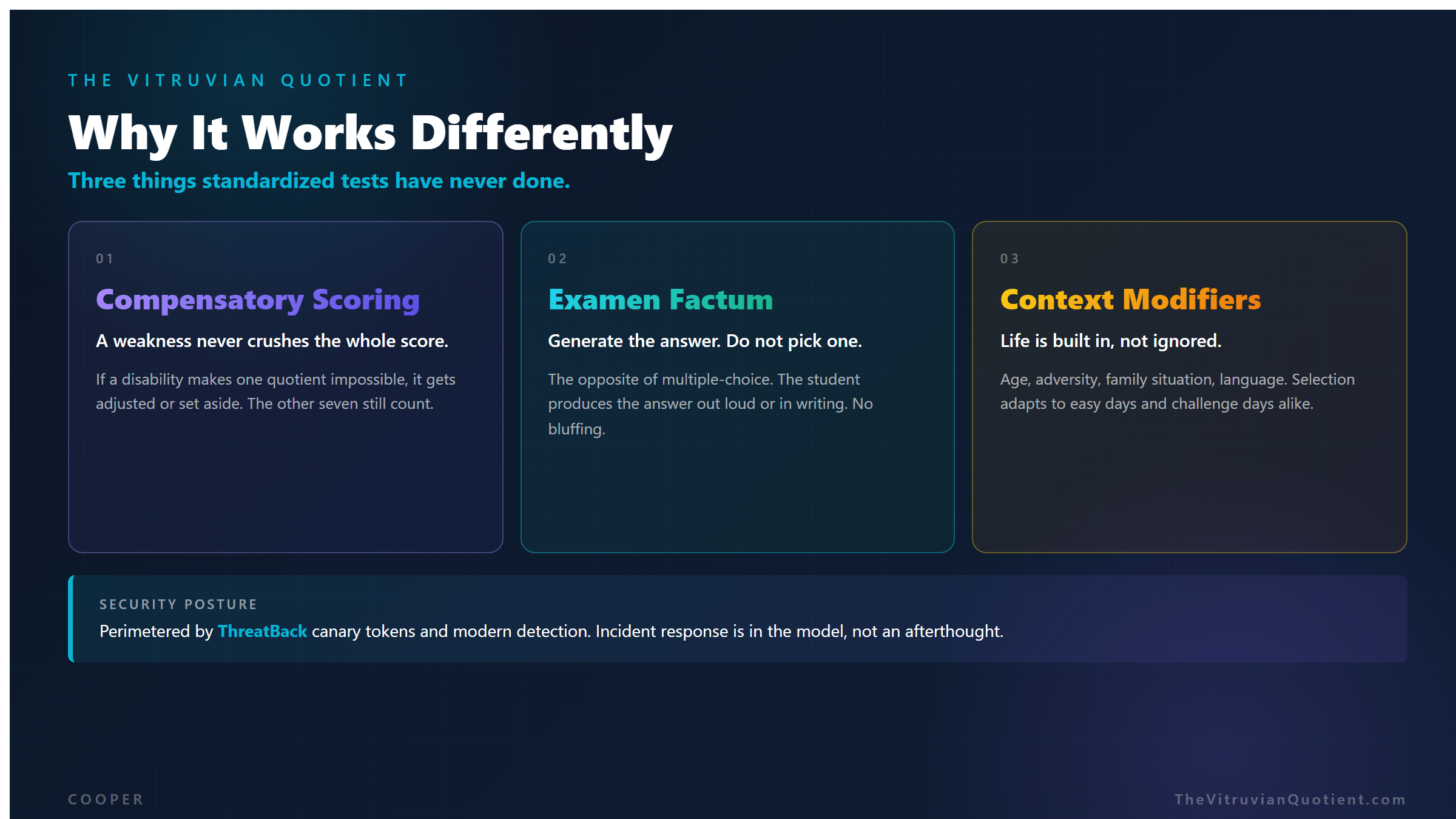
A normal test punishes you for what you can't do. The VQ doesn't. If a student has a disability that makes one quotient impossible, that quotient gets adjusted or set aside through a modifier. The other seven still count. A weakness in one area never crushes the whole score.
One of the core innovations is called Examen Factum. It's the opposite of a multiple-choice question. Instead of picking the right answer, the student has to generate the answer out loud or in writing. You can't bluff your way through it. Either you know the material or you don't.
The system also adjusts for life context. Age, adversity, family situation, language background. These aren't ignored. They're built in.
The system also adjusts on selection for strengths vs weaknesses. Having a bad day? Do some easy ones. Need a challenge? Flip the switch and get tougher tests.
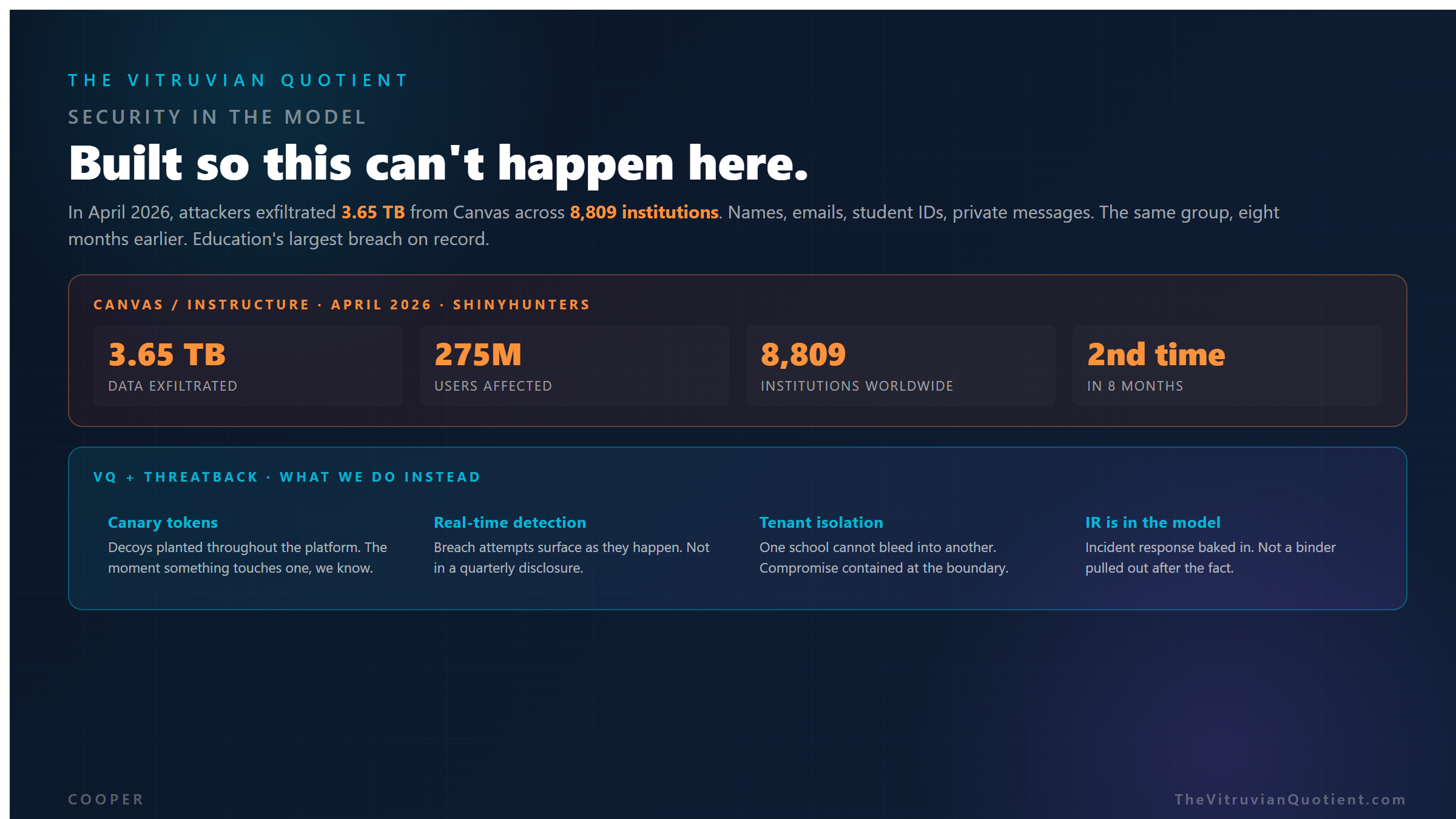
Recent cybersecurity threats got you down? We use ThreatBack so our system is perimetered by canary tokens and other modern security measures. Any breech such as recent ones in the news is real-time detected. Incident response is not an afterthought. Its in the model.
The VQ Platform achieves all of this without AI
How a student uses it
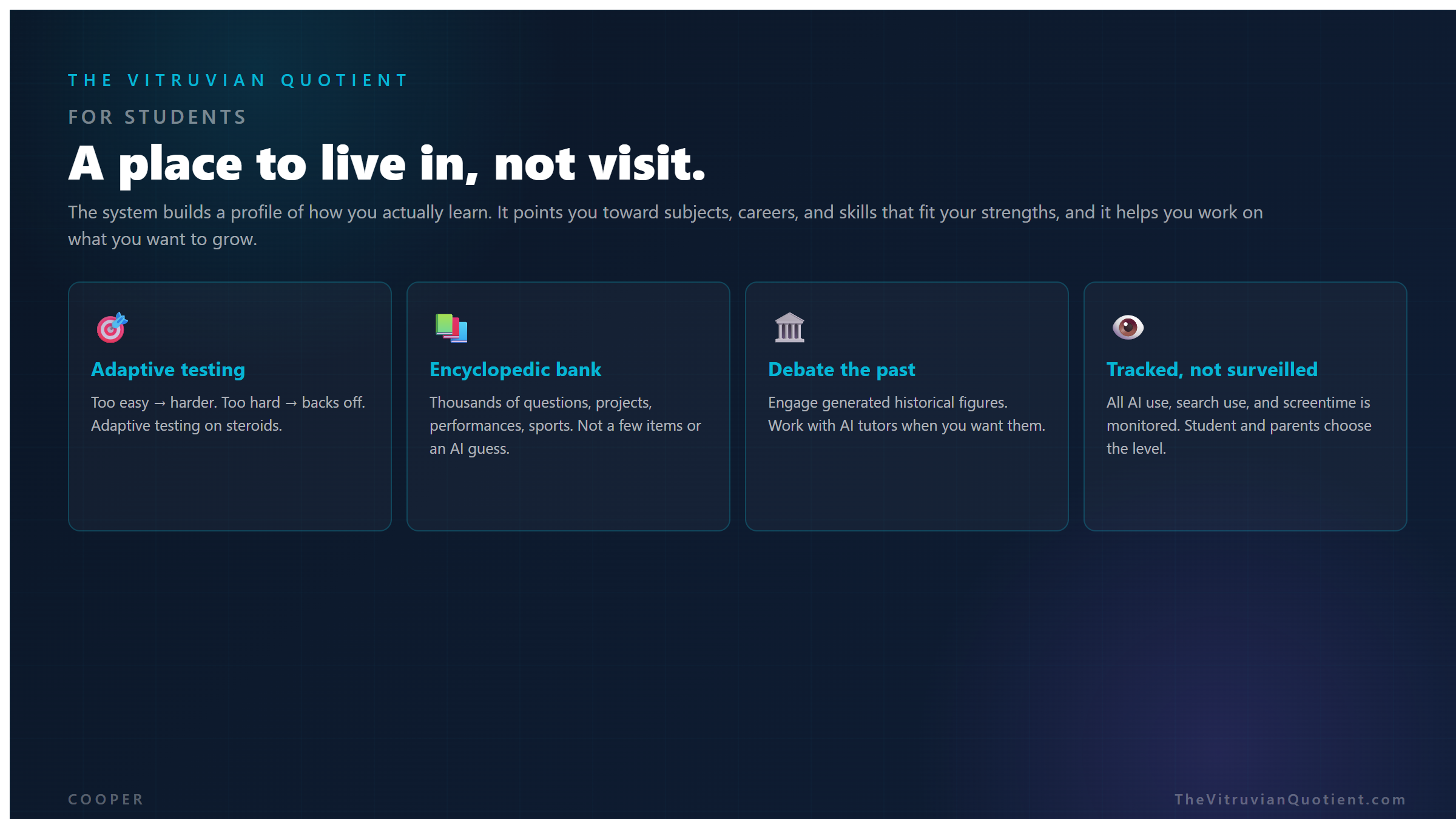
A student logs in and takes assessments one quotient at a time. The system adapts as it goes. If a question is too easy, the next one is harder. If a question is too hard, it backs off. Over time, the platform builds a profile of how that student learns best. It points them toward subjects, careers, and skills that fit their strengths, and it helps them work on the areas they want to grow.
This is non-AI basic computer adaptive testing on steroids connected with an encyclopedia style database of thousands of questions, projects, performances, sports, etc. attached to a program rather than a few little questions or an AI model.
Students can also debate generated historical figures, work with AI tutors, engage with AI scoring, and track their non-AI progress over years through AI if they and their parents chose to. All AI use, search use, and general screentime is monitored and tracked.
The platform is meant to be lived in, not just visited.
How a teacher uses it
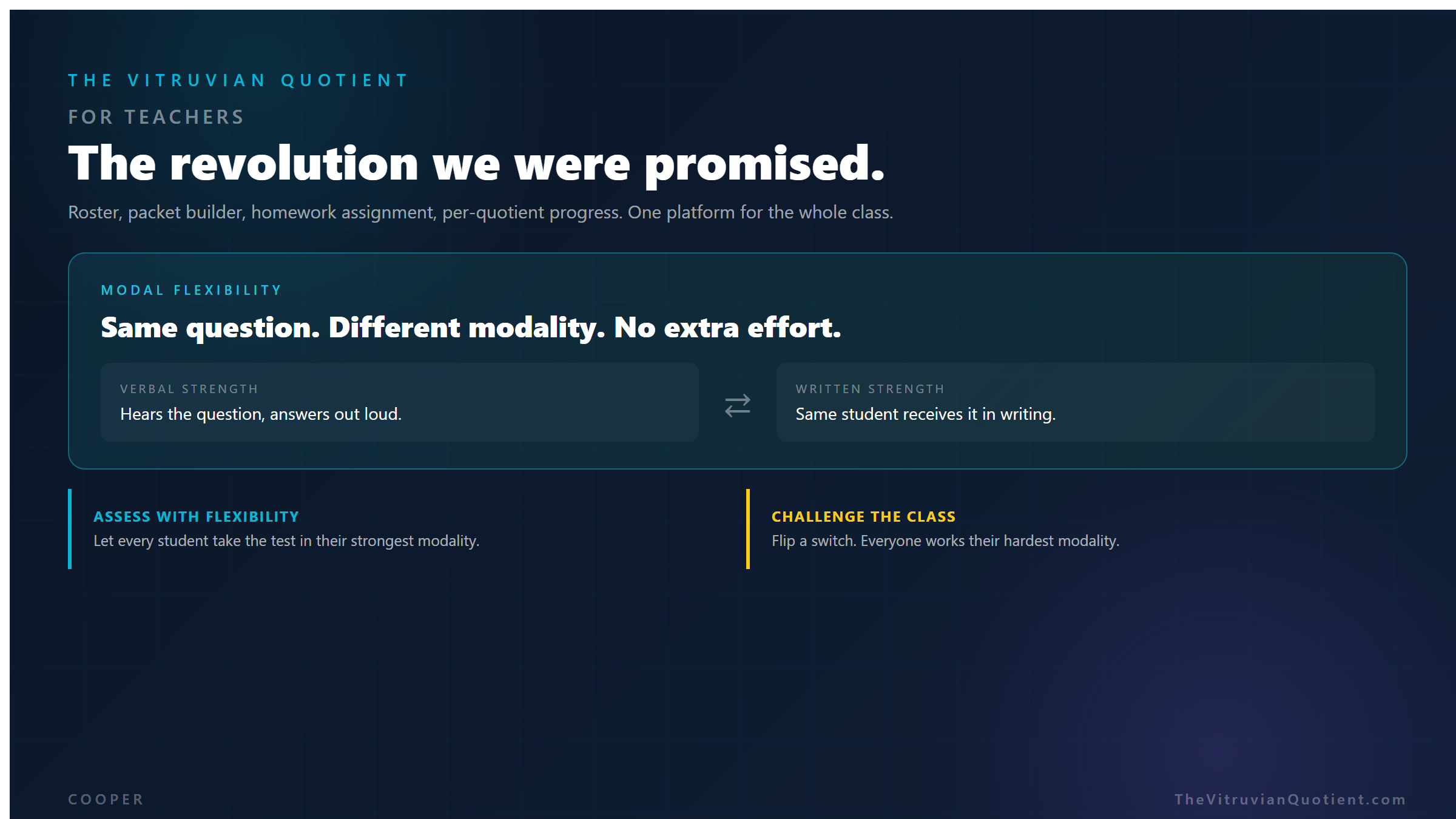
A teacher sees their classroom roster, builds assessment packets from a question bank, assigns homework, and reviews how each student is doing across all eight quotients. They can spot a student who's struggling in one area and assign targeted material. They can also see how the class as a whole is developing over time.
Teachers want to assess with flexibility? Create an exam with modal flexibility so students with verbal strengths are given the same questions verbally as other students with writing strengths receive the exact same question written automatically with no extra effort. This is the revolution in education technology we were all promised decades ago. Teachers want to challenge the class instead? Flip the switch and everyone works their hardest modalities.
How a parent uses it
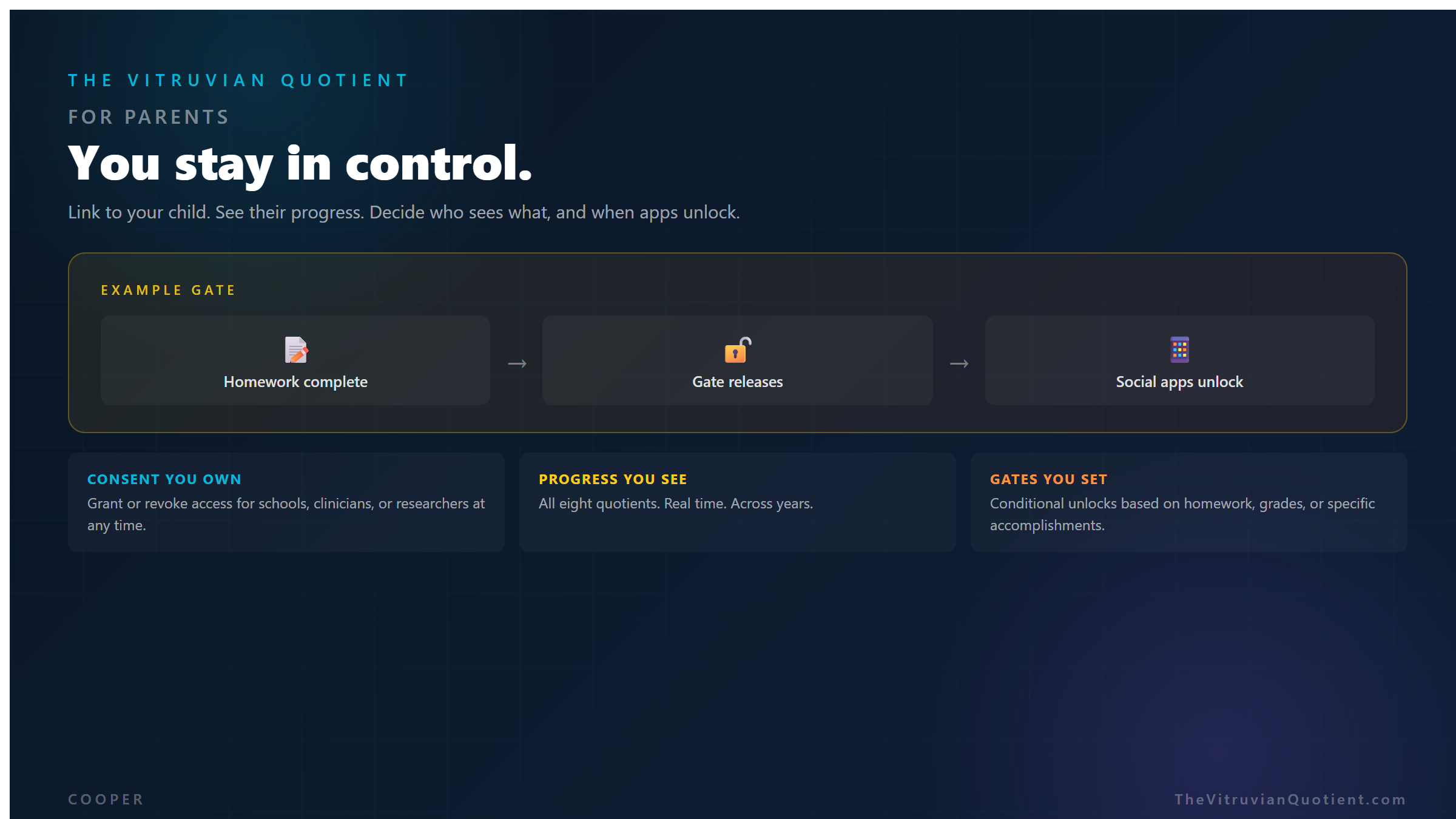
A parent who is linked to their child can see their child's progress. They can grant or revoke permission for the school, clinicians, or researchers to see specific kinds of data. They can also set gates. For example, social apps unlock when homework is done. Parents stay in control of what their child does and who sees what.
Want to take control of your student's data? Want to monitor their AI usage? Want to manage their permission slips with the school in real-time? Need any of that transferred to a doctor or clinician safely? The VQ Platform is a new kind of education technology.
How a principal or school uses it
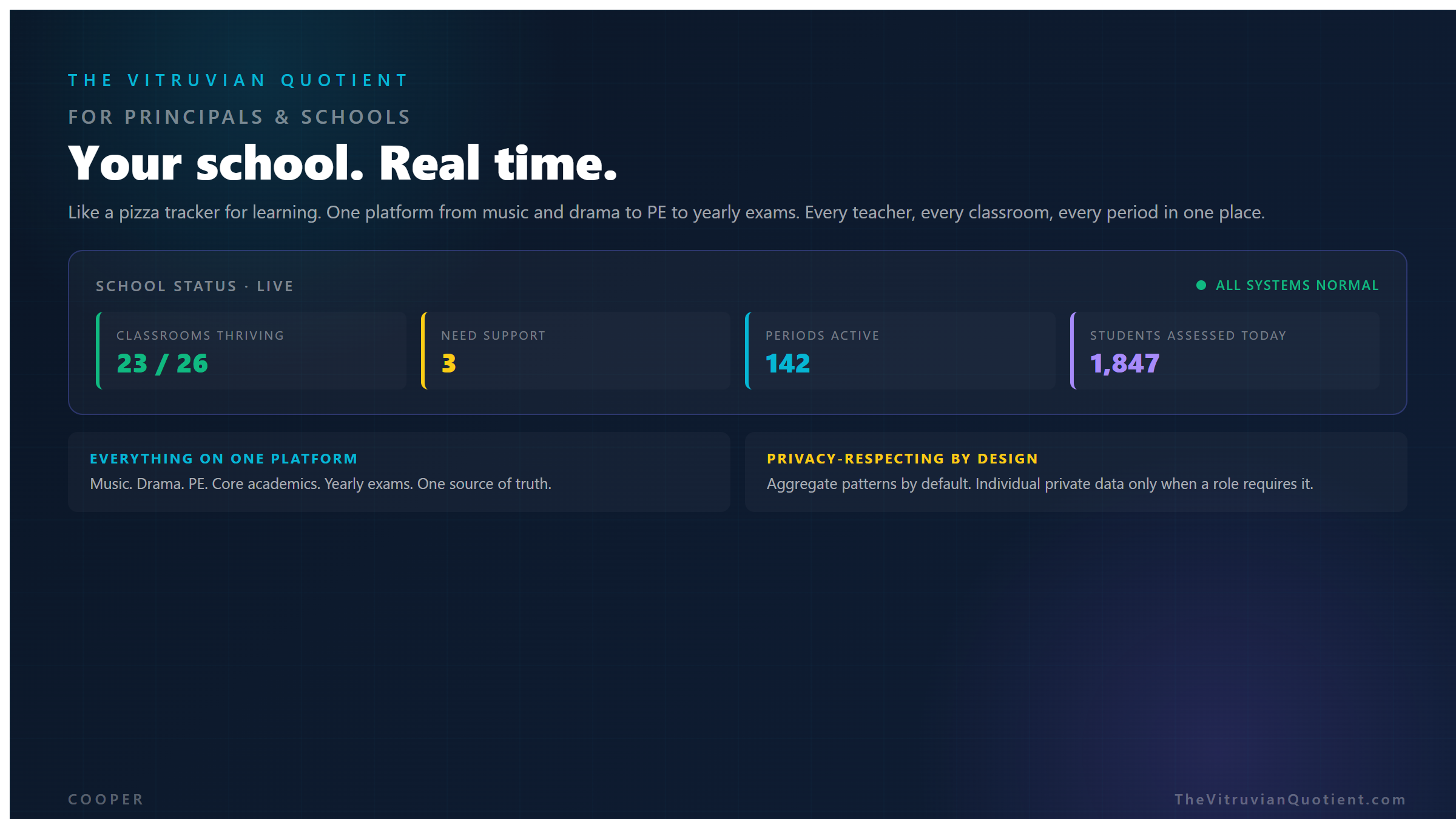
A principal sees the whole school. Which classrooms are thriving, which need support, where the gaps are. The platform respects student privacy laws, so principals see aggregate patterns rather than individual private data unless they have a specific role that requires it.
Principals, need to prove your school is on track at any second of any day like a real-time pizza tracker? This isn't just a documents and syllabus app. Its the entire school on one platform from music and drama class to P.E. to yearly exams. Each teacher, each classroom, each period on the same app. In one place.
The school can also use the platform to handle placements, track student development over many years, and provide records that follow a student to the next school or program.
Where this came from
The VQ framework is the work of Imran Cooper. It's grounded in an academic system and over a hundred peer-reviewed scientific sources. It draws from established names like Howard Gardner, Daniel Goleman, the Wechsler scales, the Torrance creativity tests, and the CEFR language framework. Nothing in it is invented out of thin air.
Where the platform is right now
In May we started the playtesting phase. The platform and brand site is TheVitruvianQuotient.com. The full system rolls out in stages as more testers come on board and as features get hardened.
The short version
Old testing tells you a number. The VQ tells you who you are, what you're good at, where you can grow, and how to get there. It treats a person as a whole human being, not as a score on one slice of one kind of thinking.