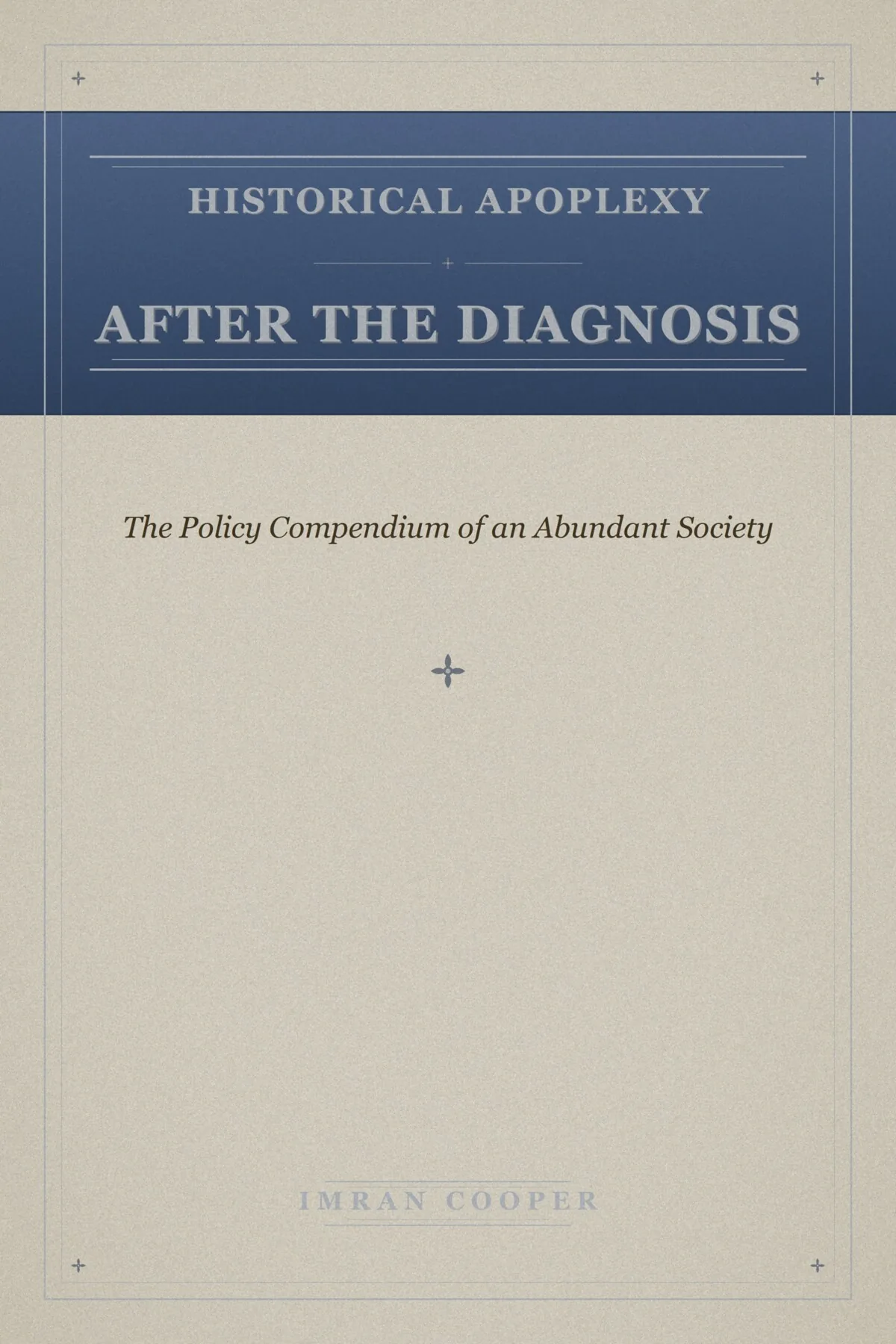
The first book makes the case. This one is what to actually do, where, in what order. One-hundred-plus state-and-country adaptations, beginning with at-cost food assurance and culminating in the closed-loop factory that produces every staple a civilization needs, drawn from documented operational precedent.
Where Historical Apoplexy diagnoses, this companion volume prescribes. Cooper assembles a hundred-plus policy adaptations, drafted state by state and country by country, that translate the diagnosis into executable instruments. The book opens with the same civilizational frame, then turns ninety percent of its weight onto policy work: the food assurance program adapted for thirty-three U.S. states, the follow-on production legislation for self-replicating manufacturing, drone delivery infrastructure, and finally the Fresco-style closed-loop factory that produces clothing, food, tools, and shelter at production cost.
The voice is engineering. Every proposal is anchored in operational precedent, the U.S. military commissary running since 1867, the Roman annona civica from 30 BC, Mondragón's worker-cooperative federation since 1956, Switzerland's Federal Council since 1848. The book does not ask the reader to imagine a different world. It documents the world that already works, then asks why it has not been extended.
Each chapter ends with the legal scaffolding required: which constitutional clause, which existing federal program, which administrative mechanism, and which state legislative committee receives the bill. This is a working manual for the civic infrastructure of an abundant society, written for legislators, policy aides, and citizens who are tired of being told the math doesn't work.
- Doughnut Economics, Kate Raworth
- The End of Poverty, Jeffrey Sachs
- Why Nations Fail, Acemoglu and Robinson
- The Better Angels of Our Nature, Steven Pinker
- Designing Designing, Jacque Fresco
State legislators, policy aides, civil-society organizers, civic engineers, and policy-press readers.
Also in Historical Apoplexy View series →