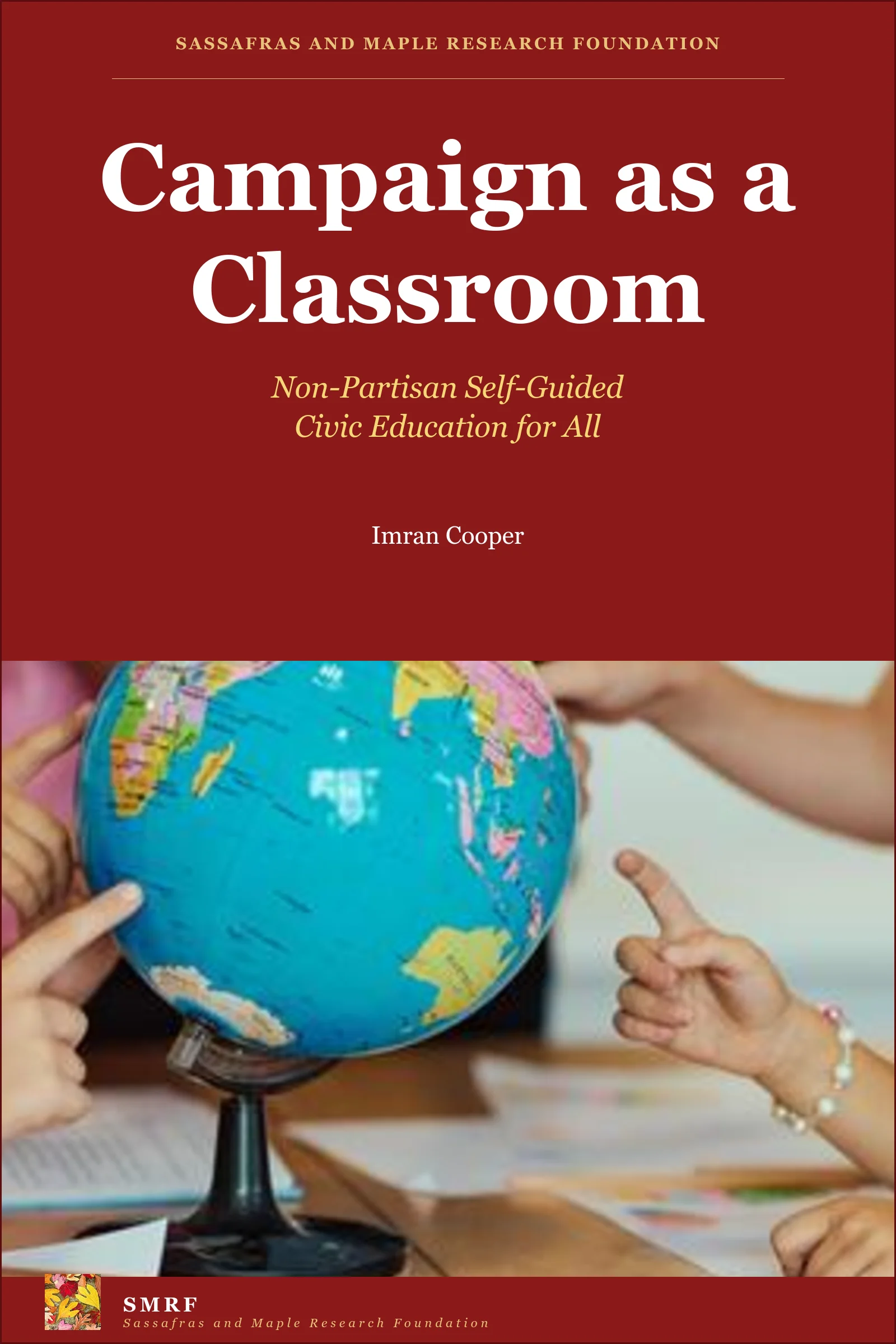
American campaigns are run as marketing operations. They produce voters who can be moved but not citizens who can govern. The political industry is the only major industry in the United States with no trade schools, no occupational review boards, no unions, and no third-party accreditors, the four guiding bodies every certified profession from electrician to nurse to dentist takes for granted. In 2016 Imran Stanton Cooper registered the Sassafras and Maple Research Foundation with the Colorado Department of Higher Education as the first nonpartisan civic-education trade school in the country. Campaign as a Classroom is the field manual that came out of it: run a campaign correctly and the volunteers leave knowing how the machine actually works. Run a school correctly and the students graduate fluent in the procedural literacy that lets them run one.
In 2016 Imran Stanton Cooper registered the Sassafras and Maple Research Foundation with the Colorado Department of Higher Education, Division of Private Occupational Schools, the first nonpartisan civic-education trade school in the United States. Exempt status under §12-59-104(1)(j) C.R.S. was granted September 7, 2016 by Division Director Lorna Candler under Governor John Hickenlooper. The premise: civic incompetence is a curriculum problem, not a personality problem. Citizens who can't read a ballot, can't track an appropriations rider, can't name their state legislators, are not lazy. They are unschooled. The schooling is missing because the institutions that built it sold their seats to consultants who profit when the public stays unschooled.
The book's structural diagnosis is that the political industry is the only mature American industry without the four basic guiding bodies every other certified profession built decades ago: trade schools, occupational review boards, unions, and third-party accreditors. A residential linesman is required to complete 6,000 hours of practical training and certification from an accredited institution before he is allowed to touch a power line, because one wrong action can take down a neighborhood grid. A campaign manager handling a six-figure budget and the procedural literacy of an entire voter base is required to complete zero hours of anything. The mismatch is not accidental. It is the structural condition that produces the political class the public says it cannot trust. SMRF was founded to build the first of the four.
Campaign as a Classroom is the field manual for the alternative. Drawing on Cooper's work running political campaigns that unseated incumbents, his time training volunteers and field staff, and the SMRF curriculum that shipped before the foundation was reduced to a part-time vehicle by the same economic pressures the Apoplexy series diagnoses, the book argues that the most efficient civic-education program in America is a well-run campaign. Volunteers walk in not knowing what a precinct captain is. Six weeks later they can name every county clerk in the district, read a campaign-finance report, and explain to their neighbors what the school board does. The campaign teaches because the campaign needs them to know.
The book is structured as a curriculum, not a memoir. Each chapter is a competency: ballot literacy, appropriations literacy, legislative-tracking literacy, lobbying literacy, election-administration literacy, civic-society-versus-government literacy. Each is taught the way SMRF taught it, through the operational task that requires it. Field assignments. Real precincts. Real bills. Real records requests. The reader finishes the book knowing how to run the next campaign and how to teach the campaign after that to do the same. That is the recursion this country has been missing for forty years.
- Rules for Radicals, Saul Alinsky
- How Democracies Die, Steven Levitsky and Daniel Ziblatt
- The Spirit of the Laws, Montesquieu
- Democracy in America, Alexis de Tocqueville
- Cultural Literacy, E. D. Hirsch Jr.
Civic-education readers, political-science students, campaign staff and volunteers, school-board candidates, foundation funders looking for what civic infrastructure actually costs, anyone who watched the 2024 and 2026 cycles and concluded that voter ignorance is engineered rather than emergent.
Also in SMRF, Sassafras and Maple Research Foundation View series →