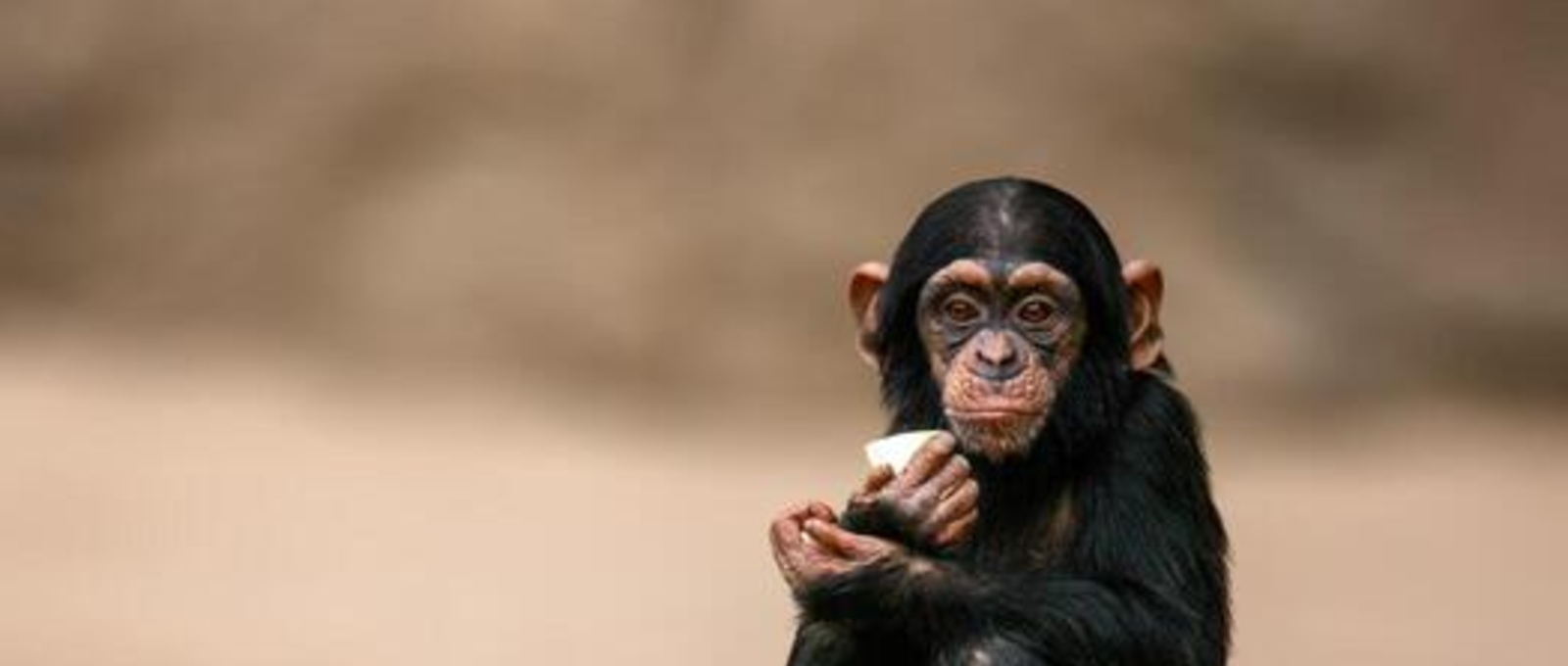
Great apes are the clearest case for the whole program. They are our closest relatives, already use tools in the wild, already hold regional culture, and can acquire symbolic communication under the right conditions. The flagship experiment is a wild gorilla population that learns to build a better shelter and keeps sign language across generations. Wild gorillas already use branch tools; chimpanzees hold group-specific traditions of nut-cracking and ant-dipping. Baboons are the founding-thesis species: Robert Sapolsky's savanna baboon troop, studied in the Maasai Mara region of Kenya, held a peaceable culture that persisted and was adopted by males who joined the troop years after the original members were gone. That troop is instructive as evidence and cautionary as access: it lives inside a protected community-and-government reserve, so any hands-on program near it would proceed only as a state-sanctioned arrangement with Kenyan authorities and Maasai consent, and the proposal states that access honestly rather than assuming it.
This track confronts directly the strongest objection to its premise. Every documented case of ape symbolic language, Washoe, Koko, and Kanzi, emerged only under intensive human rearing sustained over years, and none has emerged in a wild troop. The scientific literature attributes this to the rearing conditions themselves: sustained attention, provisioning that removes the foraging burden, one-on-one scaffolding, and safety. This is precisely the condition set on which the whole program rests, stated in the vocabulary of primatology, and it vindicates the program's diagnosis rather than refuting it. What is missing in the wild is the conditions, and captivity has been the only means so far used to supply them. The program advances a specific reinterpretation on which its ape work depends: the wild, or feral, state is not a cognitive deficiency, because the wild animal's capacity is committed to the continuous demands of survival, a real load though not readily visible. A captive animal can attend to a symbol system only because that load has been lifted. It follows that the enabling conditions can be supplied without removal from the wild, by relieving the survival load around an intact group in place, which preserves the wild social fabric that removal destroys. The whole social unit is treated together, and no single member is removed, because a removed and returned member comes back altered and marked by human contact and the group distrusts it. The conditions are brought to the group and held in a protected in-situ enclave maintained against the surrounding wild. The model accepts a longer timescale, over more generations, than concentrated captive rearing has required, on the reasoning that the slower path is the one capable of holding in a wild lineage.
The founding thesis of Intelligensicus is that intelligence rises in a population when abundance and stockpiling produce spare time and docility, and with them the room to work problems out. The decisive step comes not from handing animals finished solutions but from scaffolding self-authored capability, so a population improves its own conditions and transmits the gain. The silver-fox domestication experiment shows the shift is fast and heritable within a handful of generations. Robert Sapolsky's savanna baboon troop shows a wild population can adopt and hold a culture, transmitted to newcomers years after the original members are gone. The New York Declaration on Animal Consciousness affirms a realistic possibility of conscious experience across vertebrates and many invertebrates.
1. Can a wild ape group improve a tool, shelter, or foraging technique it already uses, through scaffolding rather than gifting?
2. Does the improvement spread through the group and persist across generations?
3. Can a captive or sanctuary program develop techniques that transfer to wild groups without creating dependence?
To demonstrate scaffolded, self-authored capability in a wild ape or baboon group; to show transmission and persistence; and to develop the sanctuary method-ground and the range-state permitting, treating uplift and conservation as one effort.
Field research with habituated wild groups or reserve and sanctuary populations on documented protocols. Sanctuary and captive apes are an intended deep-study channel, used only where already in good welfare, non-invasively. Interventions provoke the group to author a better shelter, tool, or technique using what it already knows. Strict health and disease-control protocols. Baboons or accessible monkeys serve as the least-fraught proving ground before endangered great apes.
Capability is assessed on the group's terms; the program tracks whether a behavior spreads and persists across the group and generations, the Whiten and Sapolsky success metric. Individual and matriline identification, the standing burden of any multi-year primate study, is increasingly carried by machine vision: open camera-trap classifiers and face and body identification systems now recognize individual apes across a season of imagery, so the transmission-and-persistence signal that defines success is detectable continuously and at lower cost than a human observation season alone could produce.
Mountain-gorilla conservation is a rare success with stable, well-monitored populations, and ape sanctuaries provide an ethical method-ground. Baboons offer an accessible, low-constraint start.
Endangered near-persons. Non-invasive, no new captures, near-person ethic, rigorous two-way disease control, and conservation coordination throughout. Uplift is aimed at wild-autonomous, not human-dependent, capability.
The great-ape track carries a near-person permit burden, second only to the marine-mammal track in weight. Wild field work requires the host nation's wildlife-research and protected-area permits, and every species in scope is listed, so Endangered Species Act consultation and international-trade clearances under CITES apply throughout. Where an ethical sanctuary is used as the method-ground, sanctuary and near-person welfare review governs, on a standard that treats great apes as near-persons rather than ordinary research animals; institutional animal-care review applies under the 3Rs (Russell and Burch, 1959). Rigorous two-way disease-control protocols are a permit condition in their own right, given the transmissibility of human respiratory disease to apes. No new captures are sought. This is a multi-jurisdiction, conservation-coordinated pathway whose lead time is scoped as a program cost.
The great-ape outpost is a field-station unit, not a vessel or a marine-enclosure unit, so its cost is driven by the field season and the cohort, not by ship time. The dominant lines are the land base at or near a habituated wild group or an ethical sanctuary, the graduate and undergraduate cohort running observation and scaffolding, photo-identification and behavioral instrumentation, international travel and per diem, and the near-person permitting and disease-control overhead above. No molded marine rig is required; apparatus is light and field-portable. A fully loaded great-ape outpost-year is modeled at an order-of-magnitude $400,000 to $900,000 per outpost per year in the early production run, above the corvid and domestic land tracks because of the international field logistics, near-person welfare standard, and disease-control burden, but below the vessel-driven marine-mammal track.
Read on the outpost scaling ladder, holding these unit economics constant:
| N = 1 outpost | one wild group or sanctuary | order $400K-$900K / year |
(a single funded field program)
| N = 10 outposts | one primate lineage followed | order $4M-$9M / year |
across several groups and sites
| N = 100 outposts | multi-species primate network | order $40M-$90M / year |
(apes plus the monkeys and baboons that fit the field method)
| N = 1,000 outposts | multi-continent primate program | order $400M-$900M / year |
| N = 5,000 outposts | approaching range saturation | order $2B-$4.5B / year |
| N = 10,000 outposts | the serial, unbounded endpoint | order $4B-$9B / year |
(run continuously and indefinitely -- "times by infinity")
Consistent with the program's non-discrimination rule, a primate outpost does not add whales; it takes on every operable species that fits the field-study conditions, which for this track means monkeys and baboons alongside the great apes. The N = 1 rung is a fundable single-group field program on its own.
Year 1: proving-ground work with baboons or monkeys plus the welfare, legal, and disease frame. Year 2: a stable gorilla or chimpanzee population and first scaffolding. Year 3 onward: transmission monitoring and expansion, gated on demonstrated persistence.
This is a proposed research program. The protected in-situ enclave model, the whole-unit no-single-member-removed rule, and the feral-as-reallocated-cognition reinterpretation that grounds the ape work are the current, reasoned direction of the Principal Investigator, to be refined against field results once in operation.
Breuer, T., Ndoundou-Hockemba, M., Fishlock, V. (2005). First observation of tool use in wild gorillas. PLoS Biology. Sapolsky, R. M., Share, L. J. (2004). A pacific culture among wild baboons: its emergence and transmission. PLoS Biology. Whiten, A., et al. (1999). Cultures in chimpanzees. Nature. Dugatkin, L. A. (2018). The silver fox domestication experiment. Evolution: Education and Outreach. The New York Declaration on Animal Consciousness (2024).