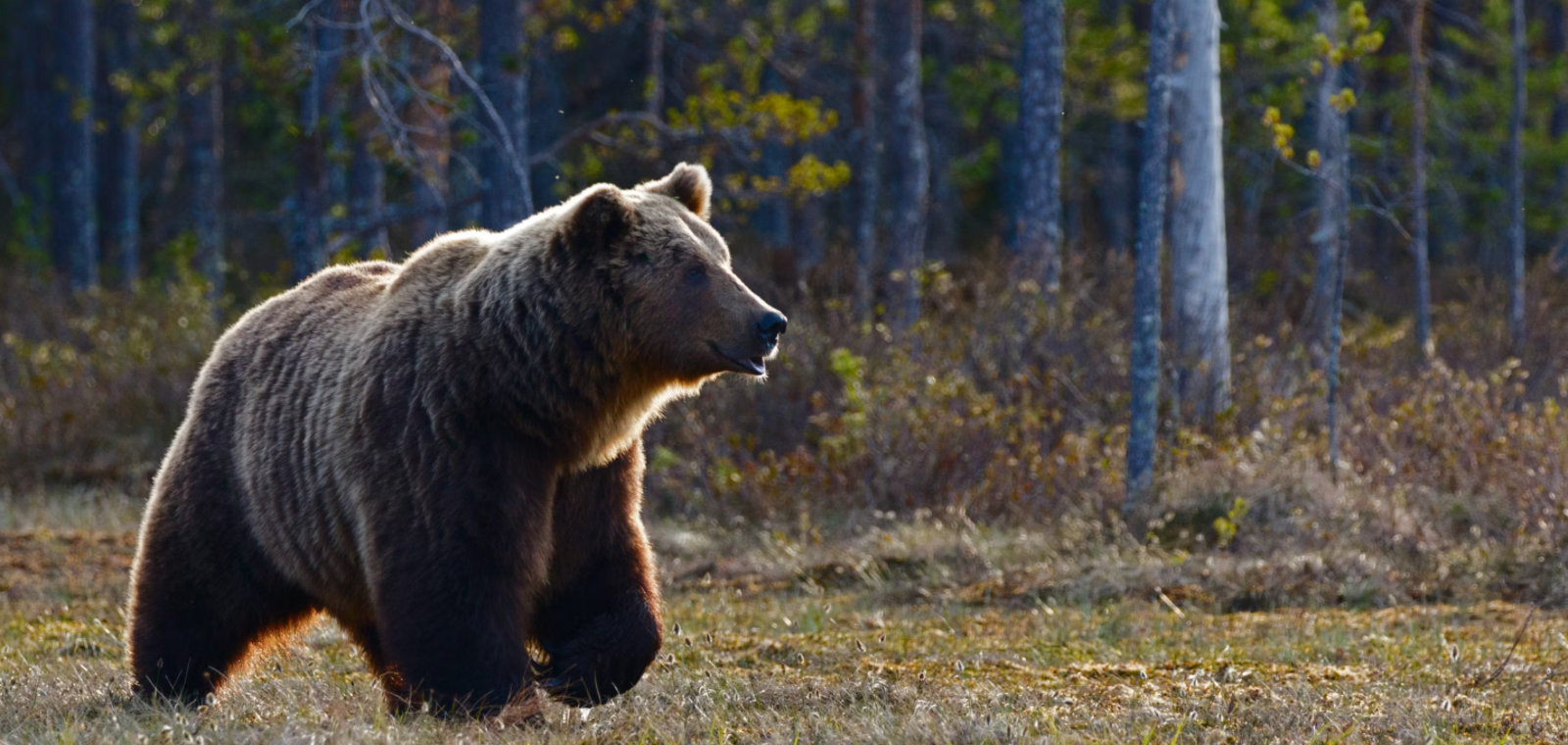
Bears are solitary omnivores with strong problem-solving, numerical discrimination on touchscreen tasks, and detailed foraging memory across huge ranges. Transmission runs mother-to-cub. At habituated sites such as Katmai, dozens of wild brown bears tolerate close human presence while remaining wild-foraging, which gives ideal study access. The bear is a standalone track because a single constraint inverts its entire operating model: a bear rewarded with human food becomes a problem bear and is often killed, so no human-food reward is ever used, and uplift is directed away from human-food dependence rather than toward a human-delivered meal.
The founding thesis of Intelligensicus is that intelligence rises in a population when abundance and stockpiling produce spare time and docility, and with them the room to work problems out. The decisive step comes not from handing animals finished solutions but from scaffolding self-authored capability, so a population improves its own conditions and transmits the gain. The silver-fox domestication experiment shows the shift is fast and heritable within a handful of generations. Robert Sapolsky's savanna baboon troop shows a wild population can adopt and hold a culture, transmitted to newcomers years after the original members are gone. The New York Declaration on Animal Consciousness affirms a realistic possibility of conscious experience across vertebrates and many invertebrates.
1. Can a wild bear improve a natural foraging or problem-solving skill through scaffolding, with no human-food reward?
2. Does a mother's improved skill pass to her cubs and persist?
3. Can uplift be aimed at better natural foraging that reduces human dependence and conflict?
To demonstrate scaffolded, self-authored natural-foraging capability in a wild bear, transmitted mother-to-cub, aimed at conflict-reducing, human-independence-raising skills.
Field research at habituated-but-wild sites and with secure black-bear populations. Interventions stage natural-foraging problems and enrichment that provoke a self-authored technique, with no human-food reward and no human-food association. Any provisioning is natural food placed so it is not linked to people.
Capability is assessed on the bear's terms; the program tracks whether an improved skill passes to cubs and persists, the maternal-transmission metric. Following individual bears and their cubs across a range and across seasons is the study's hardest data problem, and it is one the current generation of camera-trap classifiers and individual-recognition models is built to solve, so the maternal-line signal that defines success here becomes trackable without capture or collar where the imagery supports it.
Habituated brown-bear viewing sites and abundant, secure black-bear populations offer study access without taming or feeding.
Welfare-first with an absolute no-food-conditioning rule, since food-conditioning is lethal to bears. Serious safety protocols, human-bear-conflict coordination, and permits. Polar bears are excluded as a climate-crisis species, conservation-only.
The bear track runs under a moderate permit burden, lighter than the near-person and marine-mammal tracks but with one non-negotiable operating rule. Field work with American black bears and habituated brown bears requires state and federal wildlife-research permits and protected-area authorizations; institutional animal-care review applies under the 3Rs (Russell and Burch, 1959). The defining condition is the absolute no-food-conditioning rule: because a food-conditioned bear becomes a problem bear and is killed, every protocol, and its authorization, is written so that reward never comes from human food. Habituation to observer presence on the Katmai and Brooks Falls model is permissible and is in fact the study-access mechanism; food-conditioning is forbidden. Serious human-safety and human-bear-conflict-coordination protocols are permit conditions. Polar bears are excluded as a conservation-only, climate-crisis species and carry no research-take proposal here.
The bear outpost is a field-station unit sited near a naturally feeding, observer-habituated population, so its cost is driven by the field season, the cohort, and safety infrastructure, not by ship time or marine fabrication. The dominant lines are the land base near a habituated population, the graduate and undergraduate cohort running observation and no-food-reward scaffolding, cameras and tracking instrumentation, travel and per diem to remote sites, and the safety and conflict-coordination overhead the species demands. Because transmission runs mother-to-cub rather than group-wide, the design tracks maternal lines, which lengthens the observation window but does not add capital. A fully loaded bear outpost-year is modeled at an order-of-magnitude $250,000 to $600,000 per outpost per year in the early production run, a mid-range land track: above corvid and domestic because of remote-site logistics and safety infrastructure, below the near-person ape and elephant tracks.
Read on the outpost scaling ladder, holding these unit economics constant:
| N = 1 outpost | one habituated population | order $250K-$600K / year |
(a single funded field program)
| N = 10 outposts | one species followed across | order $2.5M-$6M / year |
several populations and ranges
| N = 100 outposts | multi-population bear network | order $25M-$60M / year |
(black and habituated brown bears)
| N = 1,000 outposts | range-wide bear program | order $250M-$600M / year |
| N = 5,000 outposts | approaching range saturation | order $1.25B-$3B / year |
| N = 10,000 outposts | the serial, unbounded endpoint | order $2.5B-$6B / year |
(run continuously and indefinitely -- "times by infinity")
Every rung inherits the no-food-conditioning rule as an absolute design constraint, not a cost line to trade off. The N = 1 rung is a fundable single-population program on its own.
Year 1: no-food-conditioning welfare and safety frame plus a habituated proving ground. Year 2: scaffolding and maternal-transmission monitoring. Year 3 onward: expansion at secure sites.
This is a proposed research program. The absolute no-human-food-reward rule and the habituated-but-wild study-access model are the settled operating constraints of the Principal Investigator; the specific scaffolding protocols are the current reasoned direction, to be refined against field results once in operation.
Sapolsky, R. M., Share, L. J. (2004). A pacific culture among wild baboons. PLoS Biology. Whiten, A., et al. (1999). Cultures in chimpanzees. Nature. Dugatkin, L. A. (2018). The silver fox domestication experiment. Evolution: Education and Outreach. The New York Declaration on Animal Consciousness (2024).