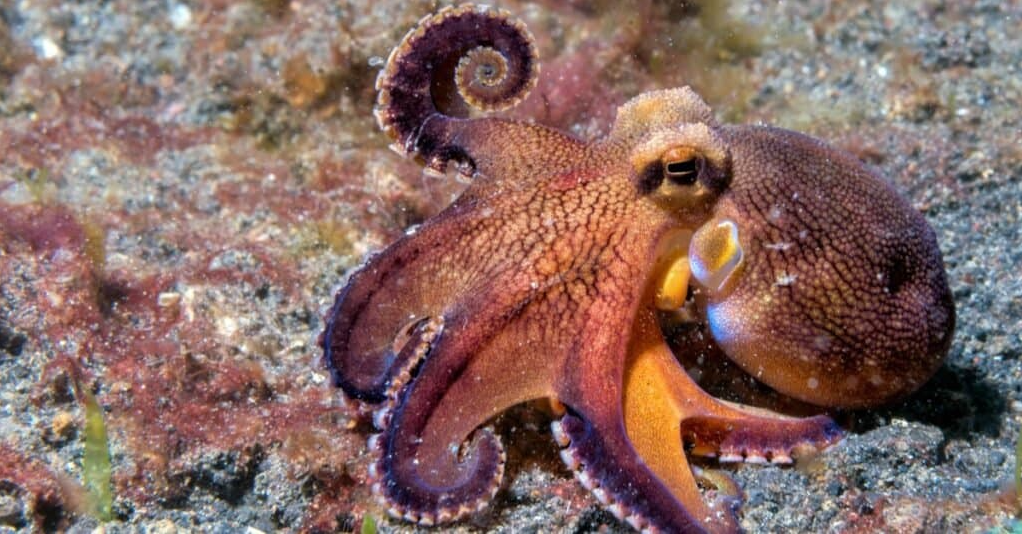
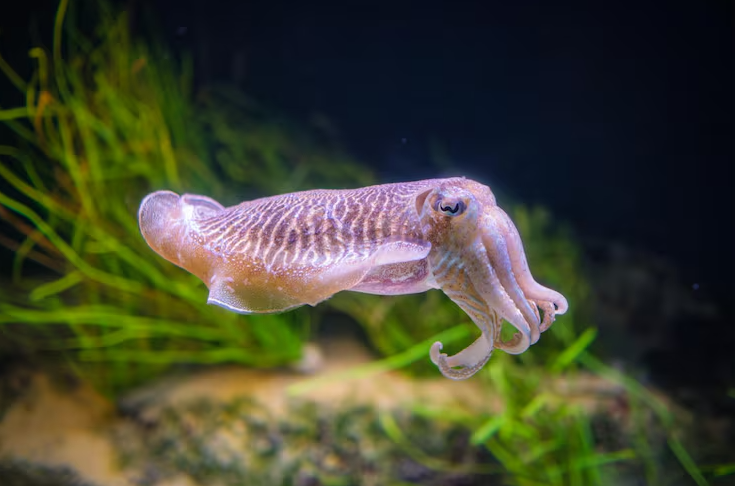
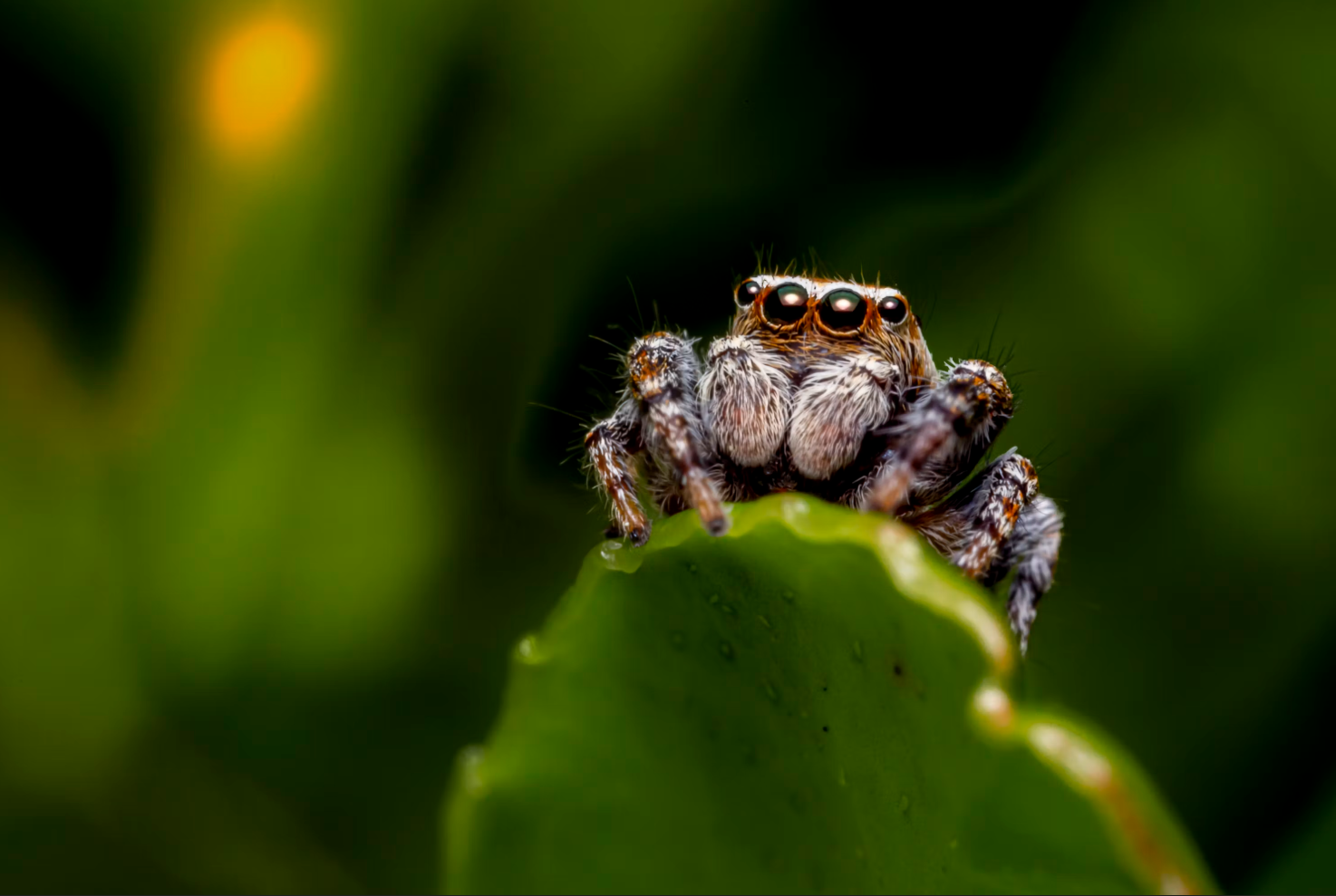
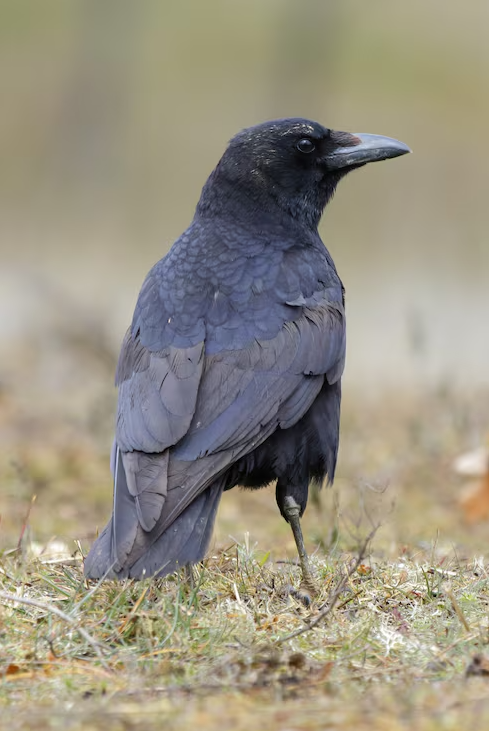
Three of the Intelligensicus tracks share one mechanical method and are proposed together here: the marine invertebrates and coastal fishes, the insects and small invertebrates, and the corvids. Each is small enough to work in a stationary clear enclosure or a small intricate rig, humane and short-session, with the animal released after it earns its reward. The octopus and the cuttlefish lead together as paired flagship subjects: the octopus with five hundred million neurons, two thirds in the arms, documented tool use and maze-solving, and an active dreaming-like sleep; the cuttlefish waiting for a better meal in a delay-of-gratification test. The jumping spider is a top-tier flagship of the same rank as the octopus, dolphin, great ape, baboon, and corvid, not a modest insect: the genus Portia executes pre-planned detours that lead away from and out of sight of prey, solves novel confinement problems by retained trial and error, and chooses opponent-specific deceptive signals, planning of a kind documented in mammals and birds, in a brain the size of a poppy seed, driven by the predatory niche rather than by sociality. Corvids match great apes in flexible planning, solve multi-stage puzzle sequences, use the water-displacement trick of Aesop's fable to raise a floating reward, and remember individual human faces and carry the memory across generations. The eusocial insects, the fungus-farming ants and the honeybee, are a separate and more modest line in which the unit of intelligence is the colony and the realistic lever is amplifying a behavior the colony already performs.
The founding thesis of Intelligensicus is that intelligence rises in a population when abundance and stockpiling produce spare time and docility, and with them the room to work problems out. The decisive step comes not from handing animals finished solutions but from scaffolding self-authored capability, so a population improves its own conditions and transmits the gain. The silver-fox domestication experiment shows the shift is fast and heritable within a handful of generations. Robert Sapolsky's savanna baboon troop shows a wild population can adopt and hold a culture, transmitted to newcomers years after the original members are gone. The New York Declaration on Animal Consciousness affirms a realistic possibility of conscious experience across vertebrates and many invertebrates.
1. Can a wild individual acquire a new, wild-useful capability through a scaffolded rig task, without harm and without dependence on people?
2. For the socially transmitting species (octopus, cuttlefish, corvids, cichlids), does an acquired capability spread to untrained peers and offspring in the wild?
3. For low-transmission species (many puffers, solitary invertebrates), does capability rise at the individual level, and does population effect follow from scale rather than teaching?
4. Which rig designs, difficulties, and reward schedules most reliably provoke a self-authored improvement?
To establish the shared box and small-rig method across cephalopods, coastal fishes, insects, and corvids; to demonstrate scaffolded, self-authored capability in each; to detect transmission and persistence where the species transmits; and to validate the repeatable-mold rig fabrication that lets the program scale to many outposts at falling unit cost.
Stationary clear marine-grade acrylic enclosures for the aquatic subjects, sited in the animal's own water so it sees its home environment throughout; small intricate mazes, foraging arenas, tandem-running tracks, and visual route-planning rigs for insects and spiders; aviary and field provisioning rigs for corvids. The task battery draws on the standard maze paradigms of the learning-and-memory literature, graded in difficulty. The simple mazes come first: the T-maze and Y-maze, which test working and reference memory through alternation and win-stay or win-shift rules. The spatial mazes follow: the radial arm maze, the Barnes maze, the cheeseboard maze, and for the aquatic subjects a submerged-platform maze in the manner of the Morris water maze, each separating egocentric route memory from allocentric map learning. The complex mazes come last: the Hampton Court, honeycomb, and hex mazes that ask for a real cognitive map. Levers, tools, and mechanical puzzles fill out the battery. Movement is scored with video tracking. Rigs are produced from repeatable molds so unit cost falls with volume, and the whole program runs under the 3Rs of animal research: replacement, reduction, and refinement. Submerged surfaces carry habitat texture so the structures recruit marine life. Sessions are short and end in release at point of capture.
Each animal is scored on its own cognitive terms for the ability the rig exercises. Beyond the individual, the program tracks whether a capability spreads and persists in the local population across seasons. Spread and persistence in the wild population are the definitive measures; individual scores are the leading indicator.
The boxed-species program is the cheapest and least legally constrained entry to the whole Intelligensicus method. Corvids and near-shore marine work are abundant, accessible, and permit-light, which makes this the natural pilot to prove the full loop of condition, scaffold, transmit, and persist before the expensive field-study tracks.
Welfare-first to a published standard, reviewed as animal research. Short enriching sessions, humane local capture, release at point of capture. A precautionary welfare posture for sentient invertebrates consistent with the New York Declaration. The jumping spider, being solitary, is a subject of high individual capability and thin social transmission, so its population effect is expected through the number of individuals worked rather than through teaching. Every deployment carries its conservation response, including replenishment where uplifted foraging could deplete a local food source.
The boxed-species program carries a light permit burden, because its invertebrate and small-invertebrate subjects fall outside the heavy vertebrate and marine-mammal regimes. Local scientific-collecting permits cover humane capture and release of the marine invertebrates, insects, and jumping spiders in scope; institutional animal-care review applies on a precautionary invertebrate-welfare standard consistent with the New York Declaration on Animal Consciousness (2024) and the 3Rs (Russell and Burch, 1959). Marine invertebrate work near shore adds routine coastal-siting clearance for any fixed rig, and any listed species would trigger the ordinary endangered-species checks, which for the common invertebrates in scope do not typically apply. There is no marine-mammal, near-person, or vessel-take permitting. This is a permit profile a single host can clear on a short timeline.
The boxed-species outpost is among the cheapest units in the program, because its subjects are worked in small molded rigs with no vessel and no field station. The rigs are boxed puzzle and maze apparatus fabricated as repeatable molded units, so the marginal build falls with volume toward a material floor of a few hundred to a few thousand dollars per rig set. The dominant recurring line is cohort labor plus instrumentation for behavioral and transmission monitoring. A fully loaded boxed-species outpost-year, covering rig amortization, cohort labor, instrumentation, permitting, and local travel, is modeled at an order-of-magnitude $120,000 to $250,000 per outpost per year in the early production run, in the same low band as the corvid and domestic tracks because the vessel and heavy-permitting lines are absent.
Read on the outpost scaling ladder, holding these unit economics constant:
| N = 1 outpost | one rig cluster, one or two sites | order $120K-$250K / year |
(a fundable low-cost pilot)
| N = 10 outposts | one species worked across | order $1.2M-$2.5M / year |
several sites at volume
| N = 100 outposts | multi-species boxed network | order $12M-$25M / year |
(marine invertebrates, insects, jumping spiders)
| N = 1,000 outposts | continental boxed-rig program | order $120M-$250M / year |
(mold economics dominant)
| N = 5,000 outposts | approaching range saturation | order $600M-$1.25B / year |
| N = 10,000 outposts | the serial, unbounded endpoint | order $1.2B-$2.5B / year |
(run continuously and indefinitely -- "times by infinity")
Because the jumping spider's effect runs through the number of individuals worked rather than social teaching, its rungs are read as throughput of individuals rather than transmission through a flock, which the molded-rig production run is built to deliver at volume. The N = 1 rung is a fundable low-cost pilot on its own.
Months 1 to 6: welfare standard, rig designs, and measurement protocols validated at one or two pilot sites. Months 6 to 18: multi-rig, multi-species deployment and first transmission readouts. Year 2 onward: outpost fabrication scales on mold economics and sites multiply, gated on demonstrated transmission.
This is a proposed research program. The shared box-and-small-rig method across cephalopods, coastal fishes, insects, and corvids, and the standing of the jumping spider as a top-tier flagship rather than a minor insect subject, are the current, reasoned direction of the Principal Investigator, to be refined against field results once in operation.
Amodio, P., et al. (2019). Grow smart and die young: why did cephalopods evolve intelligence? Trends in Ecology and Evolution. Franks, N. R., Richardson, T. (2006). Teaching in tandem-running ants. Nature. Galpayage Dona, H. S., et al. (2022). Do bumblebees play? Animal Behaviour. Kabadayi, C., Osvath, M. (2017). Ravens parallel great apes in flexible planning for tool-use and bartering. Science. Loukola, O. J., et al. (2017). Bumblebees show cognitive flexibility by improving on an observed complex behavior. Science. Marzluff, J. M., et al. (2012). Brain imaging reveals neuronal circuitry underlying the crow's perception of human faces. PNAS. Pophale, A., et al. (2023). Wake-like skin patterning and neural activity during octopus sleep. Nature. Rossler, D. C., et al. (2022). Regularly occurring bouts of retinal movements suggest an REM sleep-like state in jumping spiders. PNAS. Schnell, A. K., et al. (2021). Cuttlefish exert self-control in a delay of gratification task. Proceedings of the Royal Society B. Dugatkin, L. A. (2018). The silver fox domestication experiment. Evolution: Education and Outreach. Sapolsky, R. M., Share, L. J. (2004). A pacific culture among wild baboons: its emergence and transmission. PLoS Biology. The New York Declaration on Animal Consciousness (2024). Trut, L., Oskina, I., Kharlamova, A. (2009). Animal evolution during domestication: the domesticated fox as a model. BioEssays.