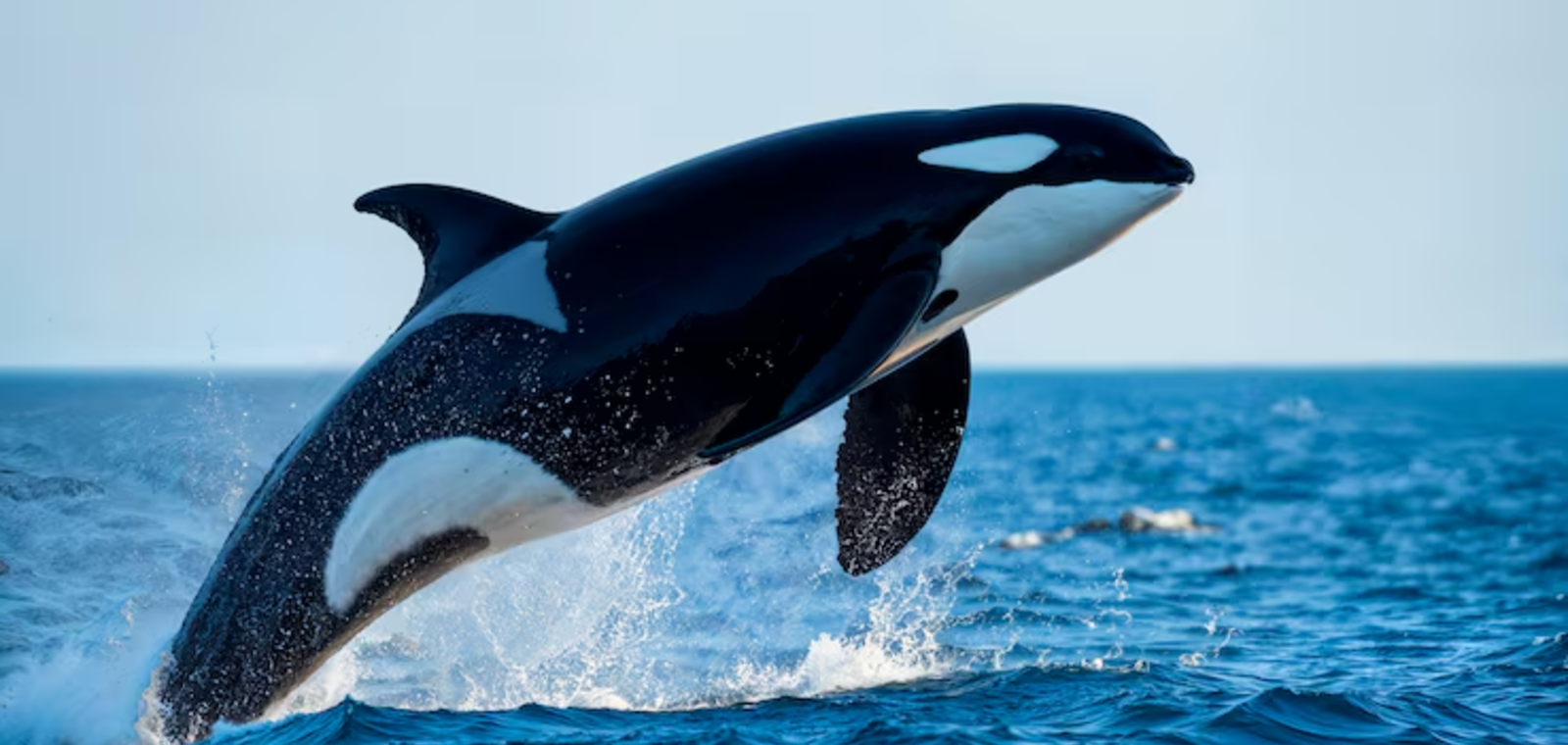
Cetaceans furnish the strongest existing evidence that wild populations acquire and retain learned behavior across generations. Shark Bay dolphins pass sponge-tool foraging down the maternal line as a distinct culture, and orcas hold pod dialects and hunting techniques across matrilines. This track runs as field study in a graduate-research posture and is governed throughout by marine-mammal protection law.
The marine mammals do not admit a single method, and the first structural commitment of this track is that dolphin, orca, and great whale are three distinct approaches, not one subject class. The dolphin approach is a handler bridge, in which trainers experienced with ethically held individuals extend task-based methods to wild pods, and the held animal serves as a training ground and a deep-study partner in its own right. The orca approach is wild-only and pod-cultural, scaffolding and observing dialect and hunting culture in the wild, because captivity is untenable for the species. The great-whale approach is observational and acoustic, reaching the baleen whales through their song-culture, which in the humpback is a real and rapidly transmitted cultural signal, since these animals are not trained and offer no handler bridge.
The founding thesis of Intelligensicus is that intelligence rises in a population when abundance and stockpiling produce spare time and docility, and with them the room to work problems out. The decisive step comes not from handing animals finished solutions but from scaffolding self-authored capability, so a population improves its own conditions and transmits the gain. The silver-fox domestication experiment shows the shift is fast and heritable within a handful of generations. Robert Sapolsky's savanna baboon troop shows a wild population can adopt and hold a culture, transmitted to newcomers years after the original members are gone.
1. Can wild dolphins acquire a scaffolded, wild-useful skill that spreads mother-to-calf and pod-to-pod?
2. Can orca pod-culture and great-whale song-culture be studied and enriched by their own transmission channels rather than by task training?
3. Which wild-useful skills raise foraging success or reduce vessel and gear conflict, and do they persist across generations?
To establish, for each of the three approaches, a lawful and welfare-sound method for scaffolding or studying wild-relevant capability; and to determine whether scaffolded or studied behavior transmits and persists within wild matrilines and pods across seasons.
Cohorts of handler-researchers pair ethically held training and study with wild fieldwork on documented protocols. For dolphins, handlers rehearse task, signal, and welfare protocol with held individuals before any wild work, so no learning occurs on the wild animal. For orcas, work is confined to wild observation and non-invasive scaffolding. For the great whales, work is acoustic and observational. Wild work favors skills useful in the animal's environment and is scoped to what a scientific research or enhancement permit under the Marine Mammal Protection Act can cover. Cetacean work is non-captive in the wild; no new captures for holding; orca work is wild-only.
Individuals are assessed on their own terms; the program tracks whether a behavior spreads and persists in the wild population. Spread and persistence are the measures of success. The acoustic and song-culture analysis this track depends on is now far more tractable than it was even recently: in 2024 Project CETI and MIT researchers proposed a sperm whale phonetic alphabet, showing that the animals' click sequences carry a combinatorial structure of rhythm, tempo, rubato, and ornamentation rather than a fixed repertoire (Sharma et al. 2024), the first work of its kind and a direct demonstration that machine analysis can begin to resolve cetacean communication. The same class of tools, computer-vision individual identification, drone photogrammetry, and machine-learning bioacoustics, supplies the transmission-and-persistence measurement this track requires.
Permitted, structured human-wild-dolphin interaction already exists and is regulated, and a deep captive-handler base already exists for bottlenose dolphins and California sea lions. A pinniped sub-track may prove the field model at lighter legal and logistical cost before scaling to cetaceans.
Welfare-first and near-person. Non-invasive, no new captures, research and enhancement permits under the Marine Mammal Protection Act and the Endangered Species Act where applicable. Orca captivity is treated as a third rail; all cetacean work is wild or with already-held animals in good welfare only.
The marine-mammal track carries the heaviest permit burden in the program, and the cost and schedule are scoped around that fact. All cetaceans are protected under the Marine Mammal Protection Act, so the work requires a scientific-research permit and, for any activity that could constitute a take or a close approach, the corresponding take or enhancement authorization from the National Marine Fisheries Service. Endangered and listed populations add Endangered Species Act consultation and, for cross-border work, international-trade and foreign-waters clearances. Institutional animal-care and welfare review applies on the standard model under the 3Rs (Russell and Burch, 1959). No new captures are sought, which keeps the track clear of the most contested capture-and-display permitting; the handler pathway works with wild pods and already-held animals in sound welfare only. This is a multi-agency, multi-year authorization pathway, and its lead time is a scheduled program cost rather than an afterthought.
The cetacean outpost is the most expensive unit in the program, driven by ship time. Ocean-class research-vessel day rates run to many tens of thousands of dollars per day at the largest classes, and this track requires the months-long voyages that offshore and multi-site pod work demands; smaller regional and coastal craft are chartered where near-shore work allows, and shared UNOLS scheduling is used to bring the vessel line down where possible. On top of sea time sit the handler pathway, the cohort labor, photo-identification and acoustic instrumentation, and the heavy permitting line above. A fully loaded cetacean outpost-year, dominated by vessel days, is modeled at an order-of-magnitude $1,500,000 to $4,000,000 per outpost per year in the early production run, an order above the corvid and field-land tracks because the ocean cannot be worked from shore.
Read on the outpost scaling ladder, holding these unit economics constant:
| N = 1 outpost | one pod, one vessel program | order $1.5M-$4M / year |
(a single funded field program)
| N = 10 outposts | one species followed across | order $15M-$40M / year |
several populations and waters
| N = 100 outposts | multi-species marine-mammal | order $150M-$400M / year |
network across ocean basins
| N = 1,000 outposts | global cetacean field program | order $1.5B-$4B / year |
| N = 5,000 outposts | approaching range saturation | order $7.5B-$20B / year |
| N = 10,000 outposts | the serial, unbounded endpoint | order $15B-$40B / year |
(run continuously and indefinitely -- "times by infinity")
The upper rungs are the reason this track is NOT the program's lead application: at scale it is a multi-billion-dollar annual operation, so it is fielded after the cheap, permit-light tracks (corvid, domestic, near-shore marine box) have proven the method. The N = 1 rung remains a fundable single-pod program on its own.
Year 1: welfare and legal frame, handler pathway, and a pilot population with photo-identification history. Year 2: first scaffolding and transmission monitoring. Year 3 onward: expansion to additional pods and the first months-long voyages, gated on transmission.
This is a proposed research program. The three-approach structure, dolphin handler-bridge, wild-only orca work, and observational-acoustic great-whale work, is the current, reasoned direction of the Principal Investigator, to be refined against field results and the governing permits once in operation.
Mann, J., et al. (2012). Social networks reveal cultural behaviour in tool-using dolphins. Nature Communications. Marino, L., et al. (2007). Cetaceans have complex brains for complex cognition. PLoS Biology. Sharma, P., et al. (2024). Contextual and combinatorial structure in sperm whale vocalisations. Nature Communications. Whitehead, H., Rendell, L. The cultural lives of whales and dolphins. Dugatkin, L. A. (2018). The silver fox domestication experiment. Evolution: Education and Outreach. Sapolsky, R. M., Share, L. J. (2004). A pacific culture among wild baboons: its emergence and transmission. PLoS Biology. Trut, L., Oskina, I., Kharlamova, A. (2009). Animal evolution during domestication: the domesticated fox as a model. BioEssays.