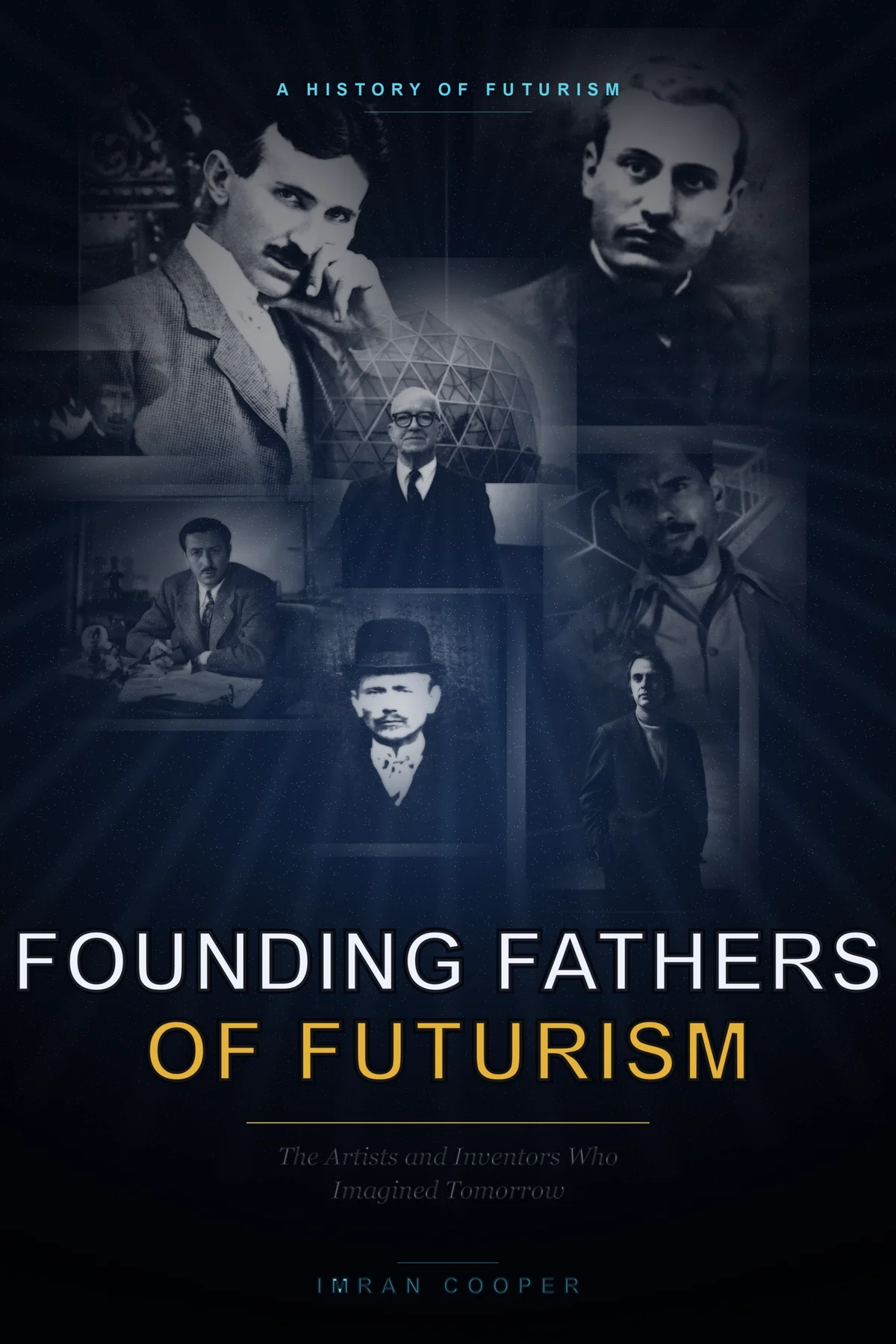
Before the future was a product roadmap, it was an art movement, a workshop, and a basement full of impossible machines. Founding Fathers of Futurism traces the people who imagined tomorrow first, from the 1909 Italian Futurist manifesto and its painters, through the pre-war inventor-visionaries, Tesla, Disney, Buckminster Fuller, Edward Leedskalnin, Jacque Fresco, to the post-war designers who carried the dream to the edge of the Space Age. It is a history of the futurist imagination, and of how each generation forgets the one that dreamed before it.
The book opens where modern futurism began as an aesthetic before it was a technology: with Filippo Tommaso Marinetti's 1909 Futurist Manifesto and the Italian painters and architects who followed it, Umberto Boccioni, Giacomo Balla, Antonio Sant'Elia, who insisted that the machine, speed, and the city were the proper subjects of art. Cooper reads this artistic arc as the first articulation of a recurring human impulse, the drive to render tomorrow before it arrives, and connects it to the recovery argument of the Resuscitation Document in his Historical Apoplexy series: that a civilization's images of its own future are among the first things it forgets it ever had.
Part two crosses from canvas to workbench. It profiles the pre-war figures who built the future with their hands and were, in their own ways, written out of the story they started: Nikola Tesla and the electrified world he sketched decades early; Walt Disney, whose studio turned the future into a place you could walk through; Buckminster Fuller and the geometry of doing more with less; Edward Leedskalnin, the lone Latvian who moved coral-rock megaliths by a method he refused to fully explain; and Jacque Fresco, the industrial designer whose resource-based city plans anticipated the abundance arguments still being rediscovered today. Each is a case study in vision arriving before the vocabulary to receive it.
The final part follows the dream into the post-war decades, from the streamlined optimism of mid-century industrial design through the Space Age, as futurism migrated from manifesto and patent into mass culture, world's fairs, and the screen, up to roughly 1970. Across all three movements, Cooper tracks a single pattern: the future is imagined, then institutionalized, then forgotten, then sold back as new. Founding Fathers of Futurism is both a portrait gallery of the people who dreamed first and a quiet argument for remembering them by name.
- The Futurist Moment, Marjorie Perloff
- Operating Manual for Spaceship Earth, Buckminster Fuller
- Walt Disney: The Triumph of the American Imagination, Neal Gabler
- Tesla: Inventor of the Electrical Age, W. Bernard Carlson
- The Best That Money Can't Buy, Jacque Fresco
- Yesterday's Tomorrows, Joseph J. Corn and Brian Horrigan
Design and art-history readers, history-of-technology and history-of-ideas audiences, futurism and Space-Age-retro enthusiasts, readers of the Historical Apoplexy works following the recovery argument into culture, and anyone who wants to know who imagined the future before it became a brand.
Also in Historical Apoplexy View series →