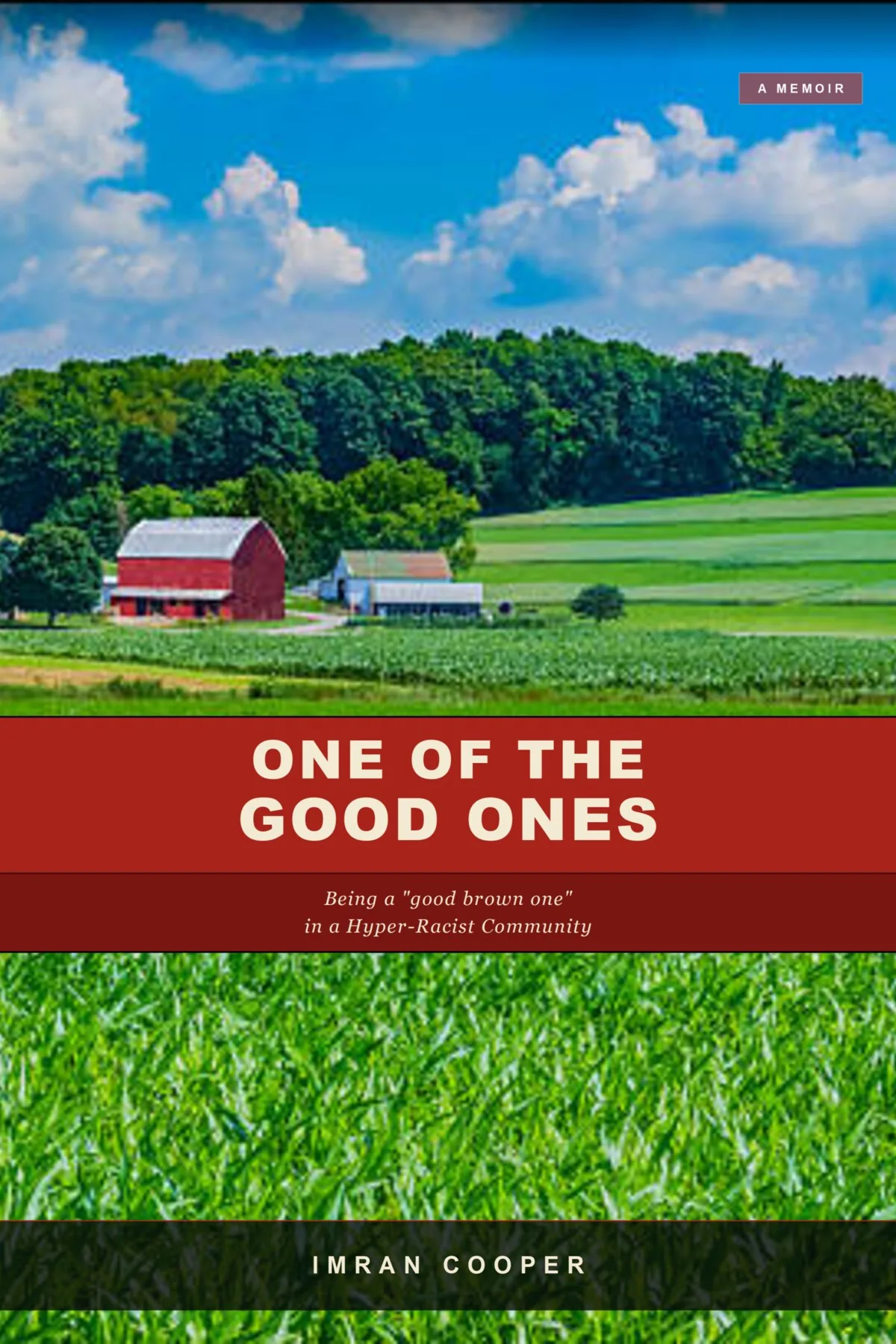
You grow up brown in a community that is happy to assure you it does not see you that way, until the moment something happens, and then it sees only that. This is the memoir of being conditionally accepted by people who needed someone to point at when they were accused of racism: I was the good one.
Cooper writes from inside the specific dynamic of being a brown child raised in a hyper-racist American community where his family was the example. The community would tell him, often unprompted, that he was different, that he was one of the good ones. The book is the long account of what that costs.
The structure follows the cover's design logic: the photo is American pastoral, the title is the cut. The chapters alternate between scenes of Cooper's actual life (the Kentucky childhood, the schools, the church, the particular friend's father who used the phrase out loud) and the cultural-historical context of how the conditional-acceptance script works, how it was built across the twentieth century, how it survived the civil-rights era by becoming politer, and how it is the dominant social form in much of rural and exurban America today.
The book is unsparing and not bitter. Cooper does not let the people who hurt him off the hook, but he also does not let himself off it. He spent most of his life being grateful for the conditional version. The book is the document of when he stopped.
- Between the World and Me, Ta-Nehisi Coates
- The Beautiful Struggle, Ta-Nehisi Coates
- Heavy, Kiese Laymon
- Hillbilly Elegy, J.D. Vance
- The New Jim Crow, Michelle Alexander
Race-memoir readers, literary-memoir audience, readers of conditional-belonging stories.
Also in Memoirs View series →