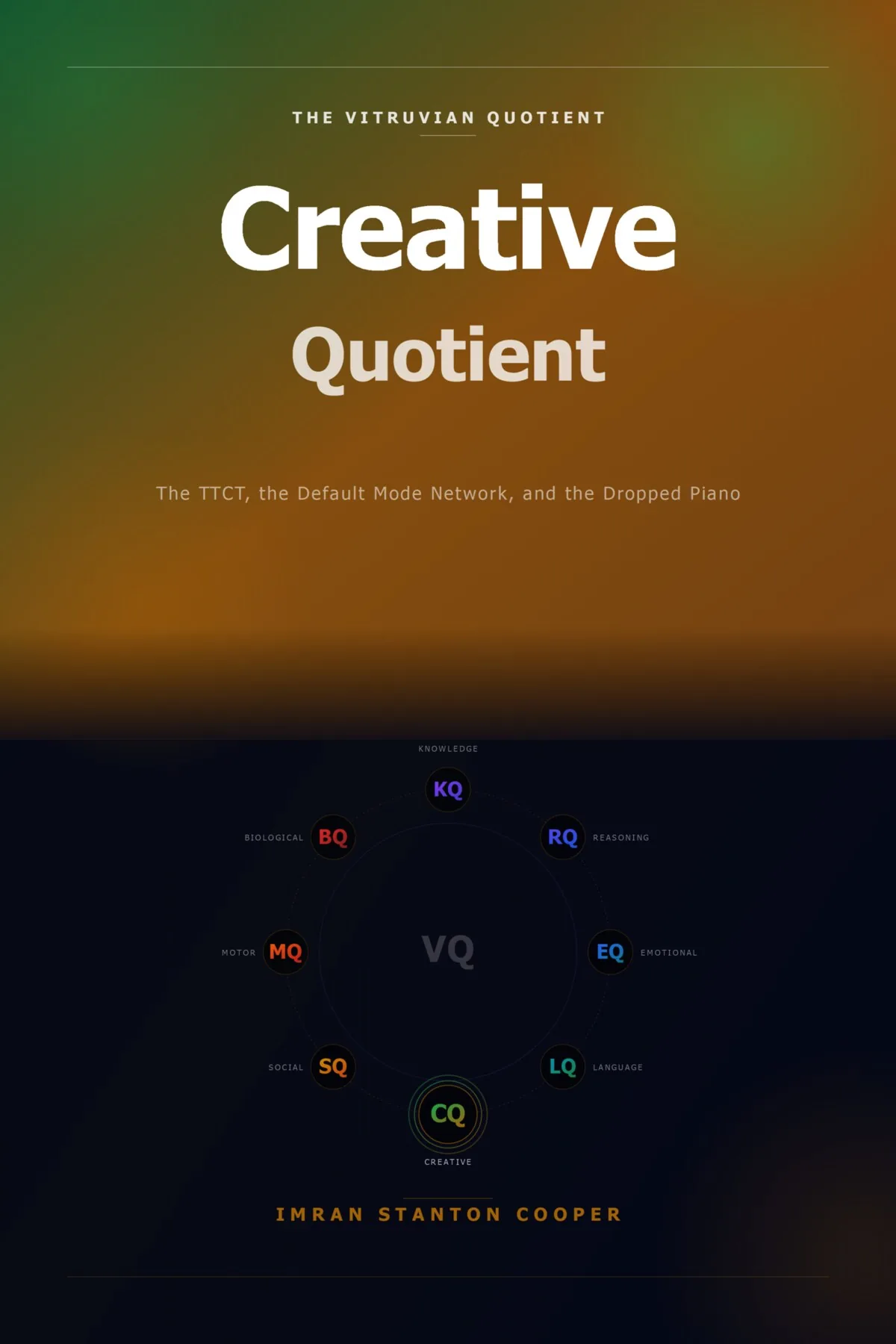
Torrance's tests predict adult creative achievement better than IQ does. The Creative Quotient is what happens when a framework finally treats that finding as the load-bearing claim it is, and how a compensatory model saves the kid who can't afford piano lessons.
E. Paul Torrance's longitudinal data, finalized by Kyung Hee Kim's 2011 analysis, established that the Torrance Tests of Creative Thinking predict adult creative achievement better than IQ does. The finding has not made it into mainstream education or hiring practice. Cooper's Creative Quotient volume argues it should be the headline.
The book pulls on Anna Abraham's The Neuroscience of Creativity for the network-level neuroscience (default mode, executive control, salience), on Csikszentmihalyi's flow research, on McGilchrist's hemispheric framework, and on the working psychometric tradition (TTCT figural and verbal forms, plus the dual-model performance/portfolio assessment). The dual model is load-bearing: the framework counts both divergent-thinking score AND a performance-or-portfolio assessment, and either side can be dropped at forty percent. This is the compensatory move that saves the kid who could not afford piano lessons but can write a poem.
Short volume. Companion to the main VQ-Trade book.
- The Neuroscience of Creativity, Anna Abraham
- Creativity, Mihaly Csikszentmihalyi
- Wired to Create, Kaufman and Gregoire
- The Master and His Emissary, Iain McGilchrist
Creativity researchers, educators, arts-education advocates, organizational-innovation readers.
Also in The Vitruvian Quotient View series →