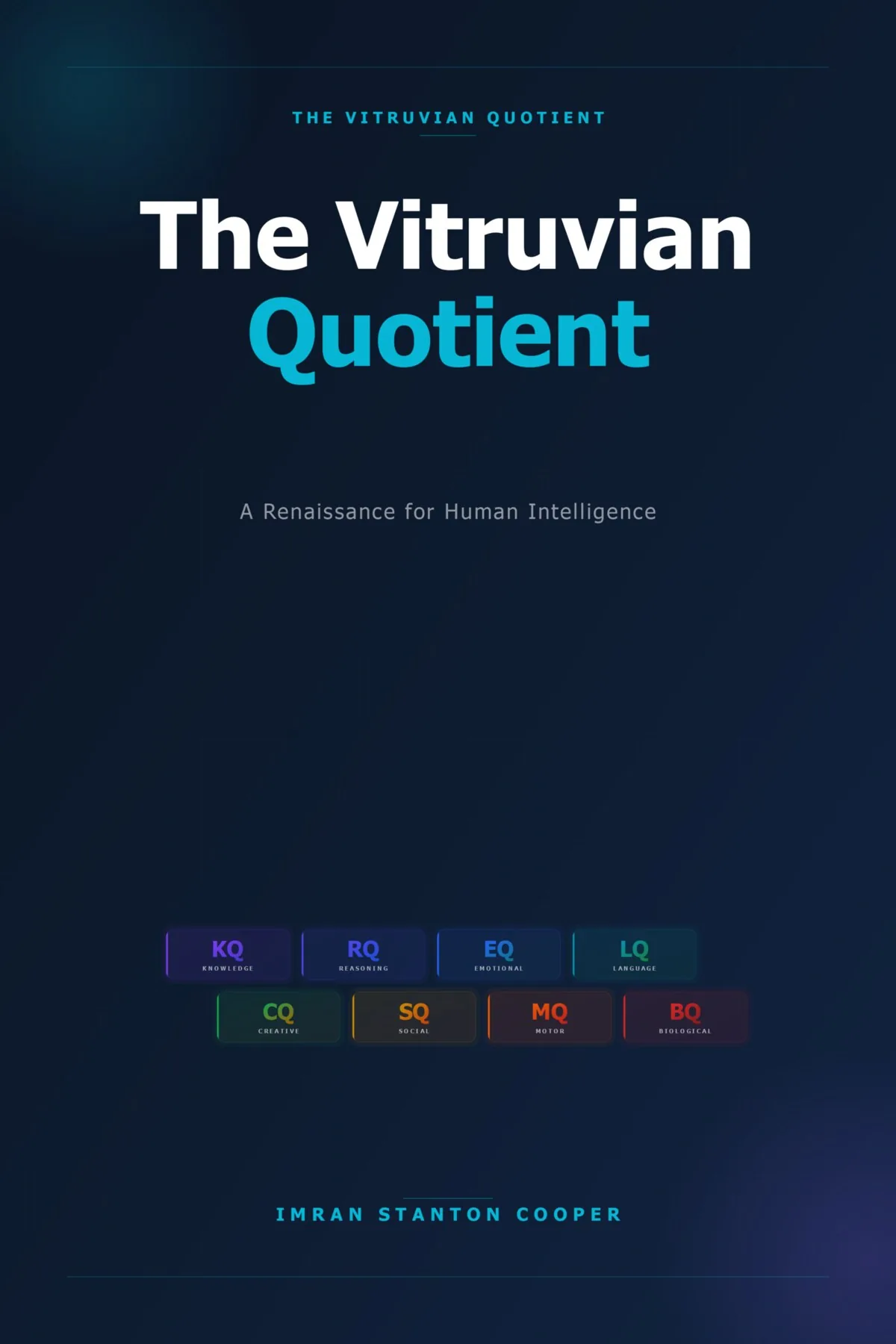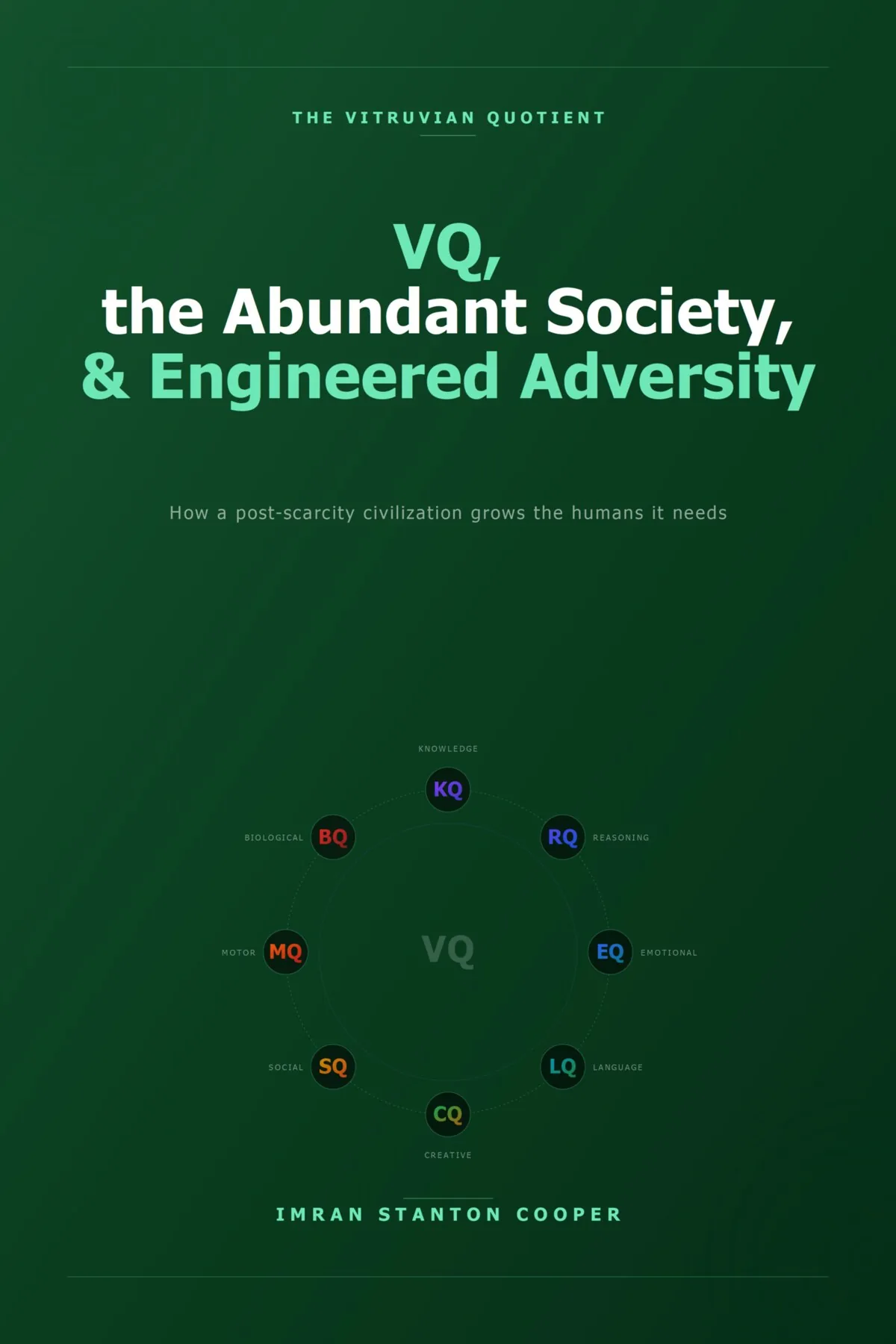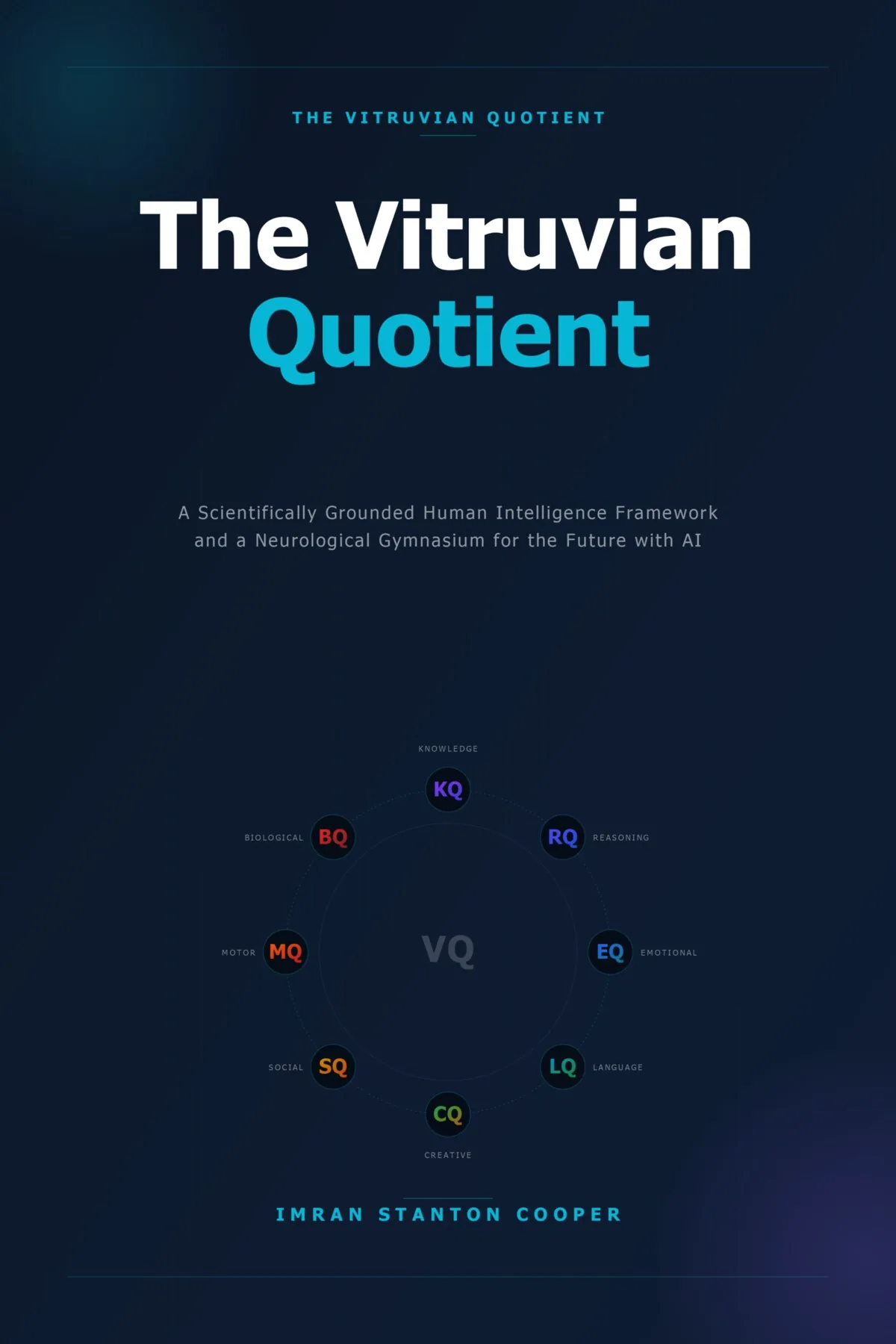
IQ measures one thing. Life requires eight. The Vitruvian Quotient is the scientifically grounded framework, built on peer-reviewed assessments, mapped to specific brain regions, and engineered with no test ceiling, that finally gives the multi-intelligence idea its working instrument.
Howard Gardner published Frames of Mind in 1983 with seven intelligences. He added an eighth (naturalist) in 1995 and floated a ninth (existential) in 1999 without formally endorsing it. Daniel Goleman extended one slice of it in 1995 and hit. Carol Dweck extended a different angle in 2006 and hit. Three decades later, the neuroscience Gardner could not point to in 1983 is mature, and yet the testing infrastructure of every school district, hiring manager, and military intake unit still measures one slice of his domains.
Cooper's Vitruvian Quotient closes the loop. The book introduces an eight-quotient compensatory framework, Knowledge, Reasoning, Emotional, Language, Creative, Social, Motor, Biological, each anchored to peer-reviewed assessment frameworks (WAIS-IV, the Mayer-Salovey-Caruso EI model, CEFR, TTCT, theory-of-mind tasks, CAPL-2/CAMSA, biomarker panels) and each mapped to a specific neural network. There is no test ceiling. Disability becomes a contextual modifier, not a quotient-killer. The platform behind the book runs the actual assessment.
The voice is between Goleman and Dweck, warm narrator opens chapters with stories, researcher-explaining-her-data delivers the framework, Mel Robbins energy closes each chapter with a noticing the reader can take into their week. Eighty- to ninety-thousand words. Front matter signals the copyright (July 2025) on the framework. Back matter signals the platform without becoming a commercial for it.
- Emotional Intelligence, Daniel Goleman
- Mindset, Carol Dweck
- Range, David Epstein
- Frames of Mind, Howard Gardner
- The Body Keeps the Score, Bessel van der Kolk
Popular-psychology readers, educators, parents, organizational-development practitioners, anyone who has felt smart in a way no test could see.
Also in The Vitruvian Quotient View series →