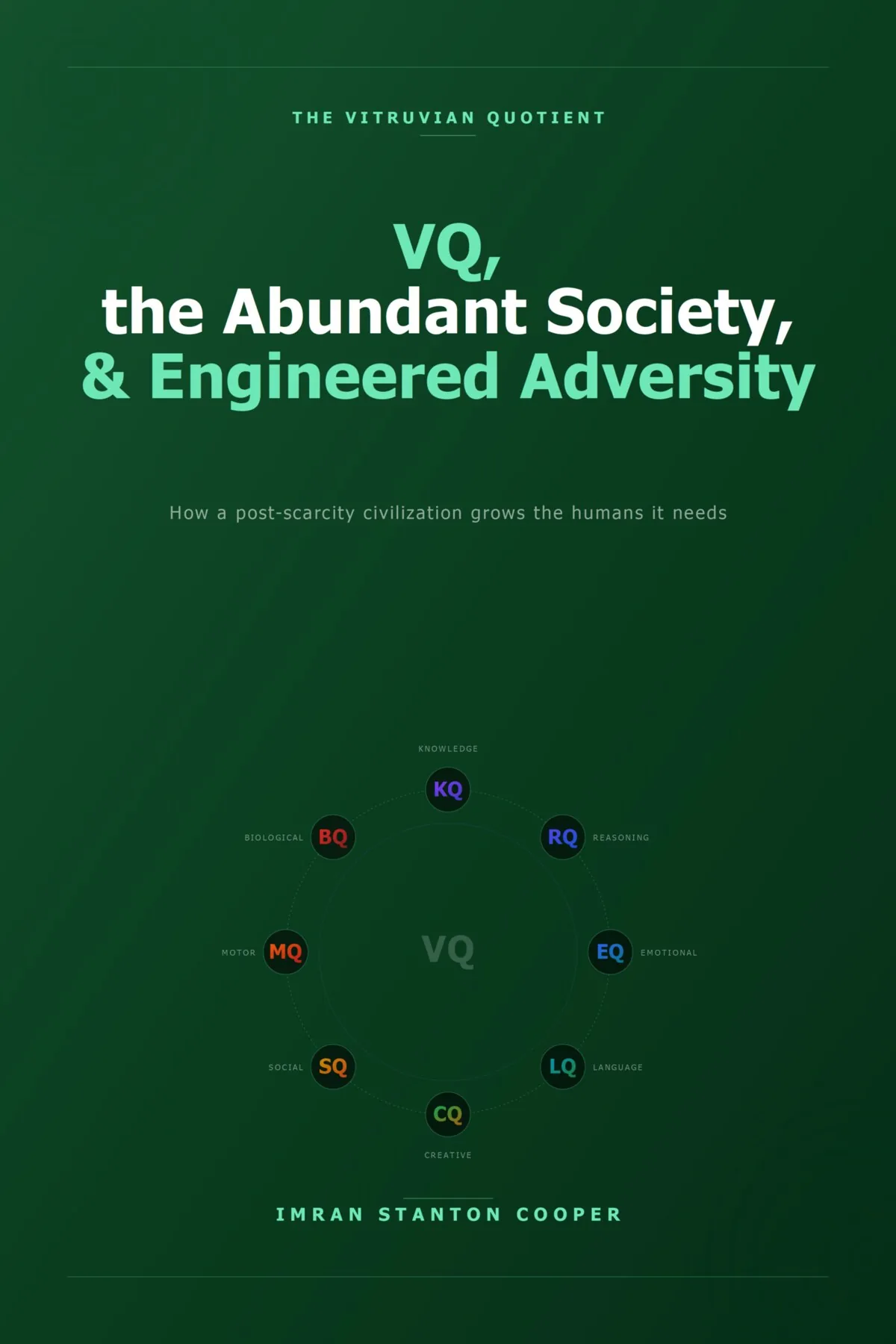
When robots and AI do most of the work, the question stops being how to feed people and starts being how to grow them. This is the case for engineered adversity, citizen service across every public profession, and a civilization that earns its abundance instead of inheriting it.
Cooper's third VQ volume turns from individual measurement to societal architecture. The argument is structural: a post-scarcity civilization that simply distributes abundance gets Calhoun's Universe 25, the famous 1968 mouse colony that collapsed not from lack of resources but from lack of structure. What it needs instead is engineered adversity, calibrated challenge, real work with real consequences, mastery gates, and rite-of-passage architecture, built into the civic infrastructure itself.
The book differentiates from the contemporary citizen-service discourse (Musk, Schneider, the Palantir leadership tier) by extending service beyond the military. In Cooper's framing, post-scarcity makes service society-wide: police, fire, teaching, nursing, infrastructure work, logistics, every public-facing profession rotates through similar service structures because robots and AI are doing so much of the actual work. Specific age groups become controllers of specific positions. People move up through service to access progressively more advanced resources. The floor is non-negotiable: every person receives basic non-starving, clothed, sheltered resources regardless of service status. Service unlocks more, not anything.
The frame is policy-press serious and explicitly future-facing. Pulls on Heinlein corrected, Le Guin, Stapledon, Frank Herbert's faufreluches, and the actual operational precedents (Mondragón, Switzerland, the U.S. military commissary). The book closes with a draft federal-state policy framework legislators could file.
- The Dawn of Everything, Graeber and Wengrow
- Doughnut Economics, Kate Raworth
- The End of Work, Jeremy Rifkin
- Postcapitalism, Paul Mason
- The Dispossessed, Ursula K. Le Guin
Policy readers, futurists, political-philosophy audience, post-work and post-scarcity researchers.
Also in The Vitruvian Quotient View series →