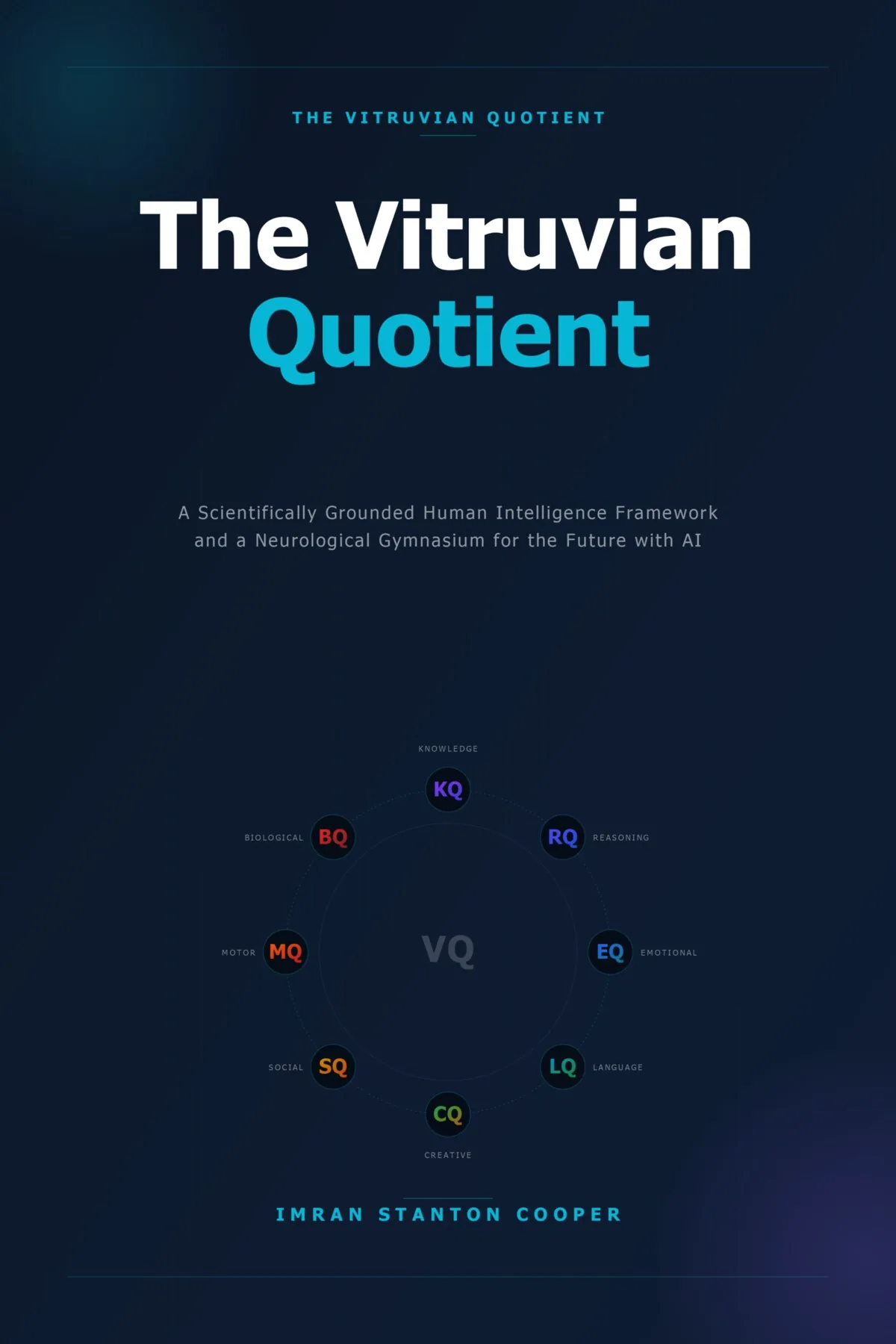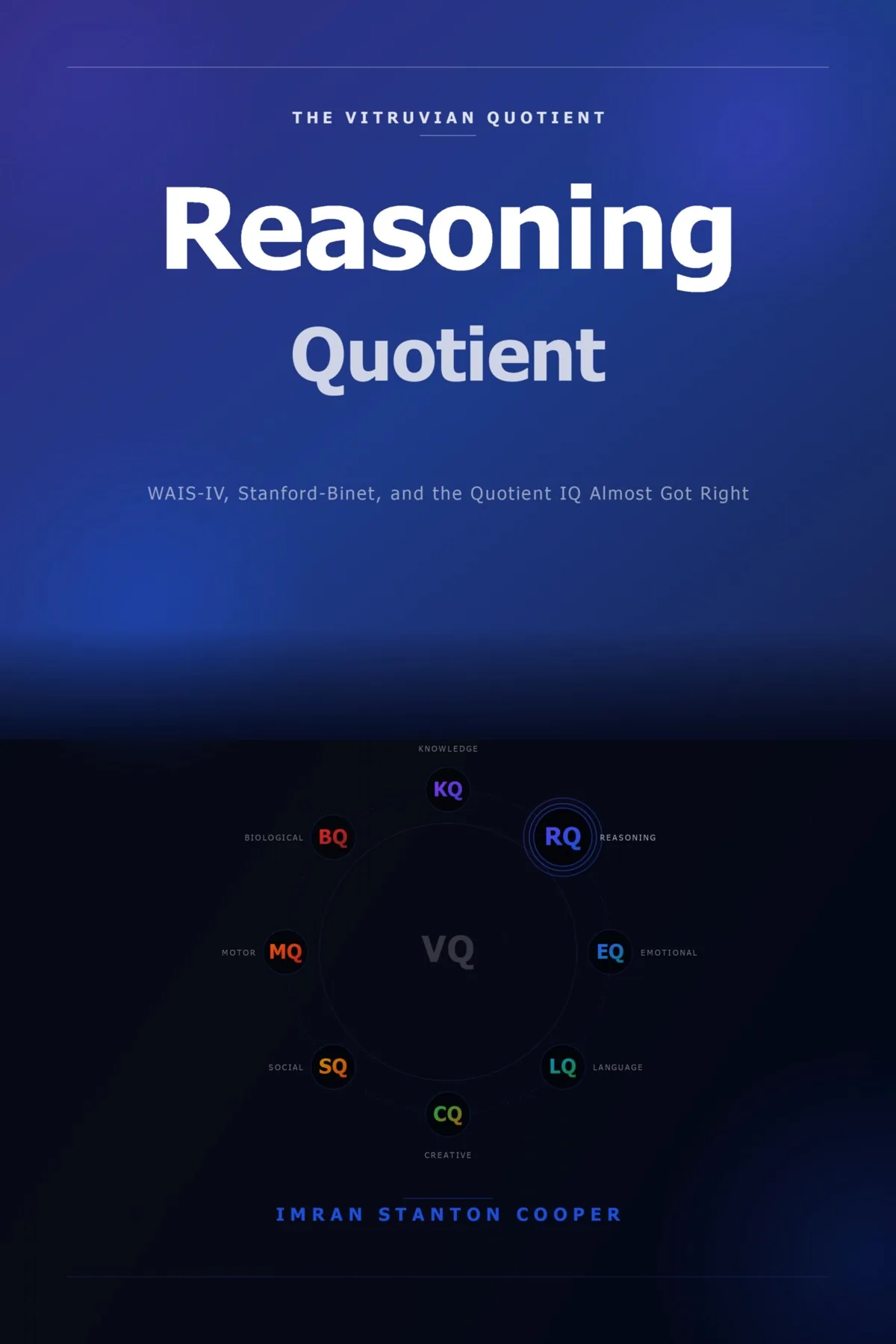
The legitimate part of the IQ tradition, fluid reasoning, working memory, executive function, pulled out of the knowledge-confounded mess that a hundred years of psychometric history made of cognition.
The Wechsler scales and the Stanford-Binet are the legitimate ancestors of the Reasoning Quotient. They measure something real. Their problem was never the measurement, it was the conflation: by treating reasoning and knowledge as the same construct, IQ as a single number became a referendum on cultural capital instead of cognitive capacity.
Cooper's RQ volume reclaims the legitimate piece. The Wason selection task, Kahneman's System 1 and System 2, the Cattell-Horn-Carroll separation of fluid and crystallized intelligence, frontoparietal executive networks. The book treats RQ as one of eight rather than as the standalone IQ replacement, which lets the frame breathe, high RQ paired with low EQ tells one story, high RQ paired with high SQ tells a very different one.
Short volume. Citation-dense. Companion to the main VQ-Trade book.
- Thinking, Fast and Slow, Daniel Kahneman
- What Intelligence Tests Miss, Keith Stanovich
- The Bell Curve, Herrnstein and Murray (as cautionary)
- How We Decide, Jonah Lehrer
Cognitive-science readers, psychometricians, organizational psychologists, hiring managers.
Also in The Vitruvian Quotient View series →