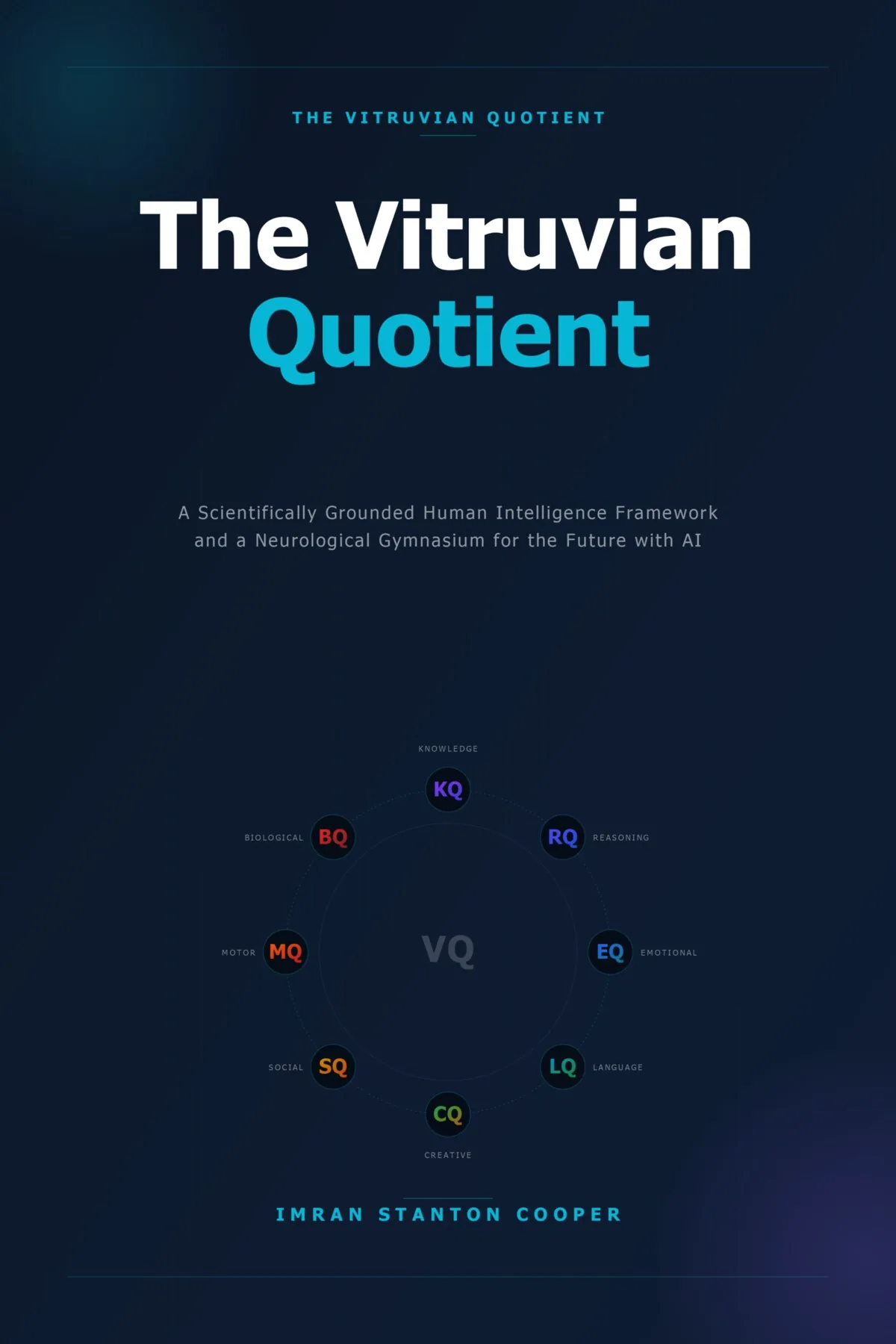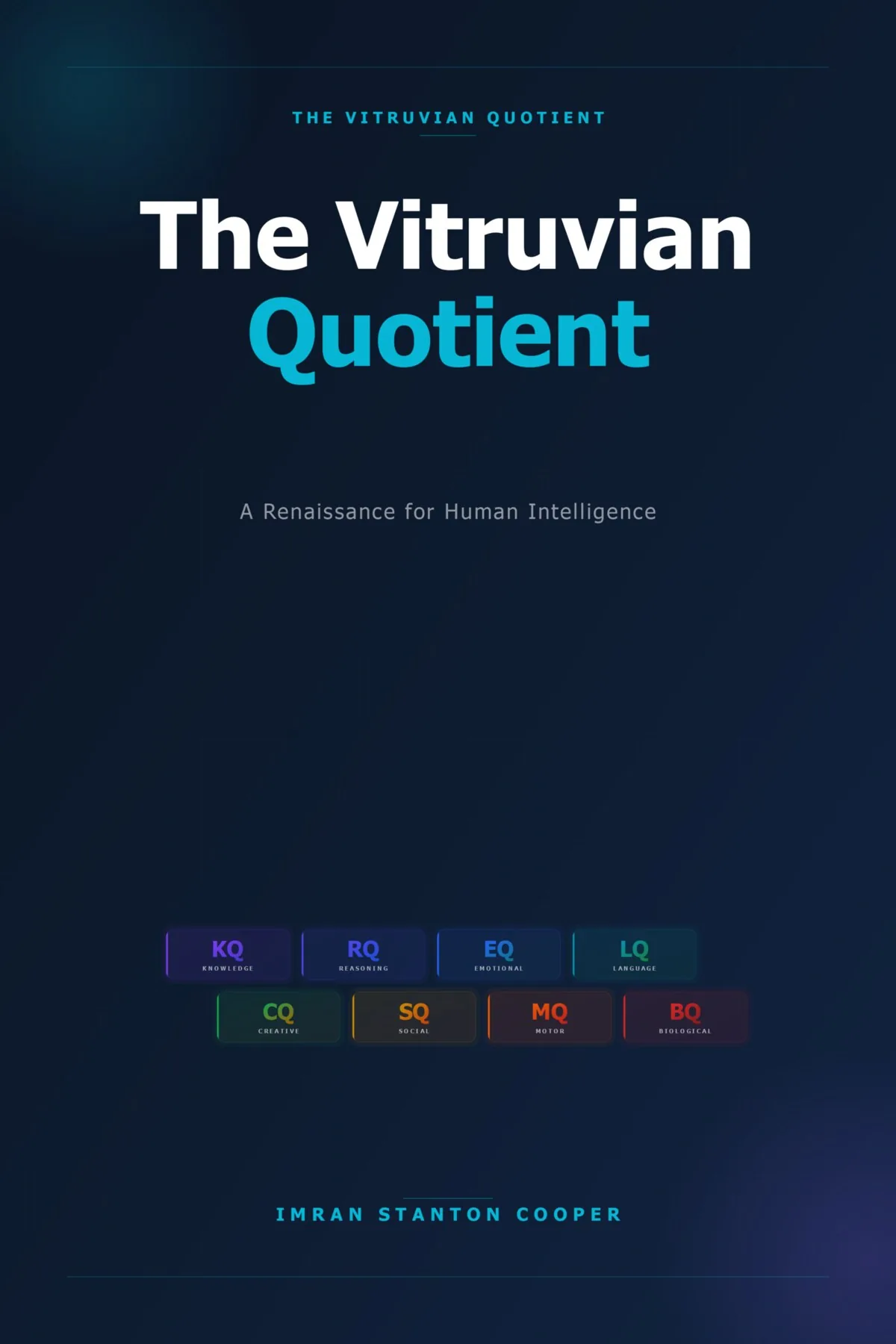
The academic paper that founded The Vitruvian Quotient framework, adapted into a working volume for school districts, principals, teachers, and parents who want to know what an actual VQ classroom looks like.
The academic paper (originally The Vitruvian Quotient: A 2025 Renaissance for Human Intelligence Assessment) demonstrated the framework with a hypothetical worked example, James, a twenty-two-year-old composite case, across all eight quotients. This book takes that demonstration and shows what it looks like in practice: in a classroom, in a school, in a district.
The book is structured around implementation. Per quotient: which peer-reviewed assessments are administered at which grade levels, how the compensatory model handles disability and adversity, what the cross-quotient interdependencies (KQ × RQ, EQ × SQ, the emergent TQ) look like in actual student profiles, and what the assessment cadence (grades 1, 4, 8, 12, 16, 20, with dual academic-plus-career placement at twelve) does to the longitudinal record of a child.
The book argues, gently, with peer-reviewed evidence, that the current testing regime is not just narrow but psychometrically obsolete. The VQ framework is what comes after.
- Mindset, Carol Dweck
- The Schools We Need, E.D. Hirsch
- How Children Succeed, Paul Tough
- The End of Average, Todd Rose
- Disrupting Class, Clayton Christensen
Educators, school administrators, district curriculum officers, parents of school-age children, education-policy researchers.
Also in The Vitruvian Quotient View series →