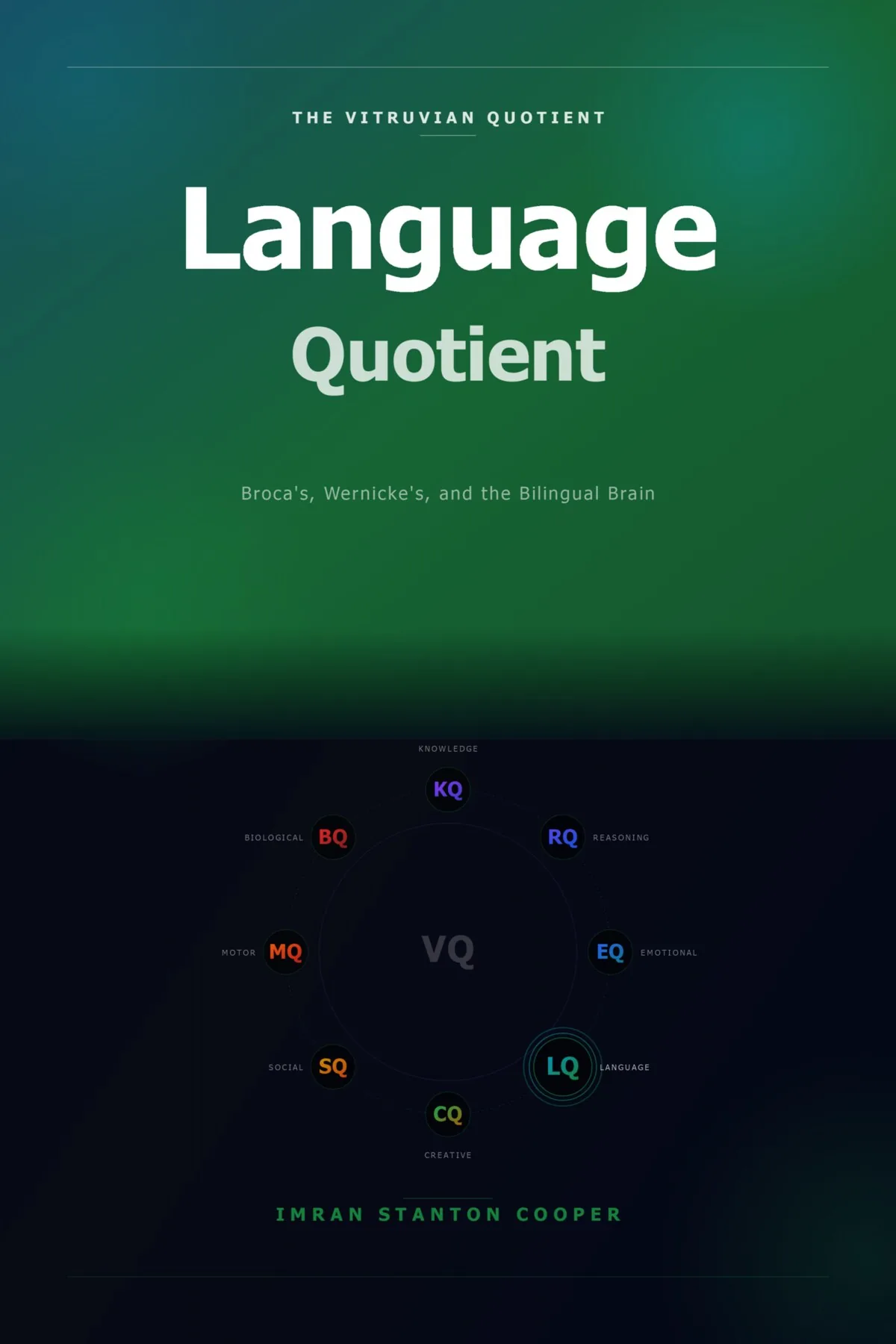
Late bilinguals show spatially separated representations in Broca's area; early bilinguals share the same region. Language Quotient measures what IQ tests miss: the difference between knowing a word and knowing the brain that uses it.
Kim et al.'s 1997 Nature paper on bilingual brain organization is the founding image of Cooper's Language Quotient: late bilinguals (acquired second language as adults) show spatially separated representations in Broca's area; early bilinguals share the same region. Language is not one thing. It is several, and they are visible on fMRI.
The LQ volume tracks the reference frameworks for language proficiency, the CEFR (Common European Framework of Reference for Languages, Council of Europe), ACTFL, and DIBELS, alongside the neural architecture of Broca's area, Wernicke's area, the arcuate fasciculus, and the white-matter pathways that connect them. The CEFR's six-level scale (A1 to C2) is a free public reference; Cooper's framework scores against that continuum with its own VQ-original items, never administering, reprinting, or claiming equivalency to any proprietary language exam, and an LQ result is CEFR-aligned rather than a CEFR certification. The framework counts native fluency, second-language fluency, and pragmatic communication as three separate sub-domains, with the compensatory model letting any of the three carry weight when the others are constrained.
Short volume. Companion to the main VQ-Trade book.
- The Language Instinct, Steven Pinker
- The Language Myth, Vyvyan Evans
- Born to Talk, Lloyd Hulit
- The Stuff of Thought, Steven Pinker
Linguists, language educators, bilingual-development researchers, cognitive-science readers.
Also in The Vitruvian Quotient View series →