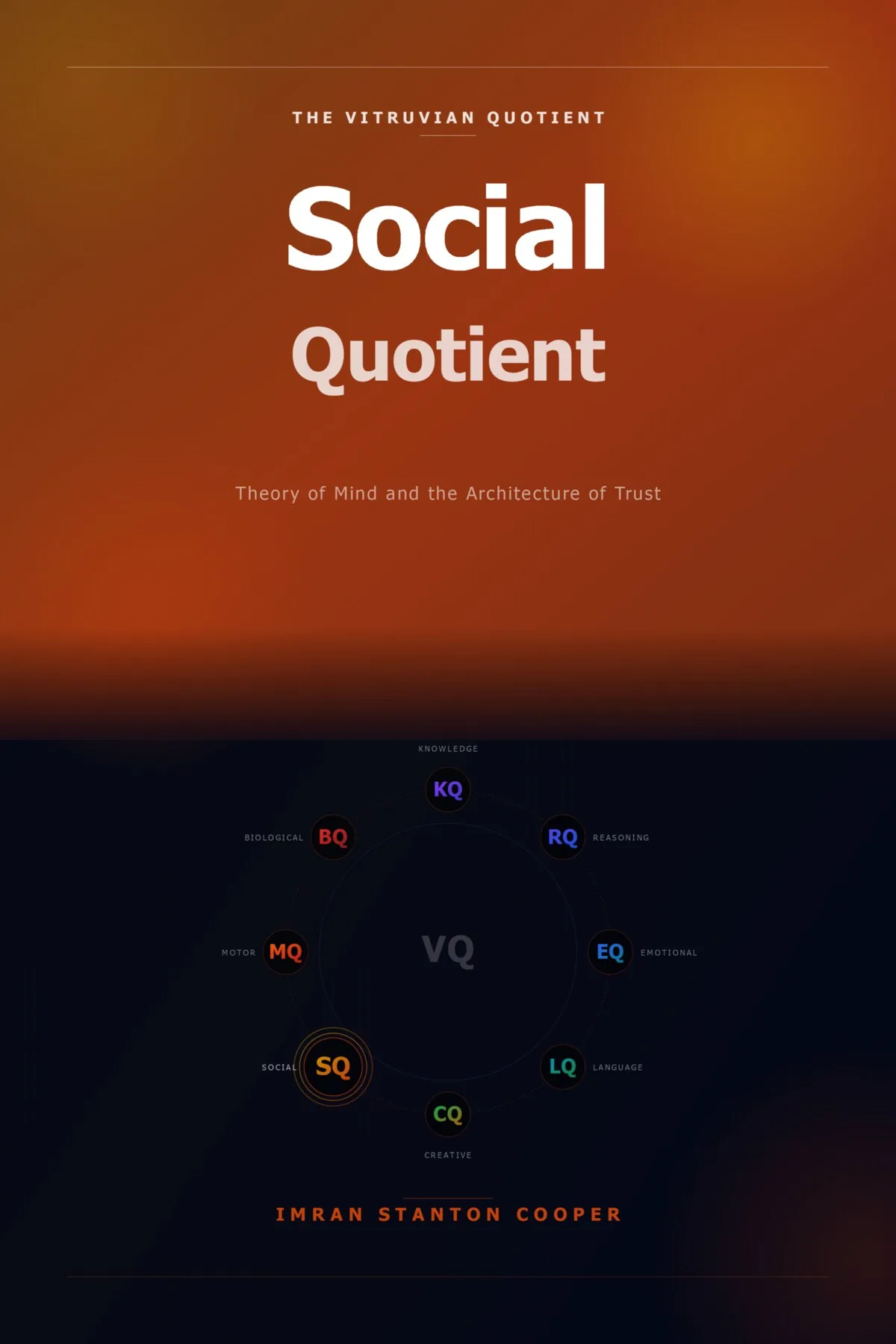
Children pass the Sally-Anne false-belief task around age four. Theory of mind is a discrete cognitive achievement with measurable neural substrate. The Social Quotient finally treats it as the foundation it is.
Theory of mind, the capacity to model what someone else believes, even when their belief is false, is not a personality trait. It is a discrete cognitive achievement with a developmental window (age four for typical children, later for some) and a measurable neural substrate (the temporoparietal junction and medial prefrontal cortex). The Sally-Anne false-belief task is the founding instrument.
Cooper's Social Quotient volume tracks the working assessment instruments, the Tromso Social Intelligence Scale (TSIS), Kohlberg's stages of moral reasoning, theory-of-mind probes, perspective-taking measures, and treats SQ as the substrate of the emergent Trustworthiness Quotient (TQ), which arises from the joint distribution of EQ, SQ, and RQ. Raj Chetty's 2022 Nature finding that cross-class friendships are the strongest predictor of upward mobility anchors the social-capital chapter. Robert Putnam's Bowling Alone and Sebastian Junger's Tribe bracket the cultural reading.
Short volume. Companion to the main VQ-Trade book.
- Bowling Alone, Robert Putnam
- Tribe, Sebastian Junger
- Social Intelligence, Daniel Goleman
- Mindblindness, Simon Baron-Cohen
Social-psychology readers, educators, organizational-development practitioners, parents of neurodivergent children.
Also in The Vitruvian Quotient View series →