← Historical Apoplexy (Book One · The Diagnosis)
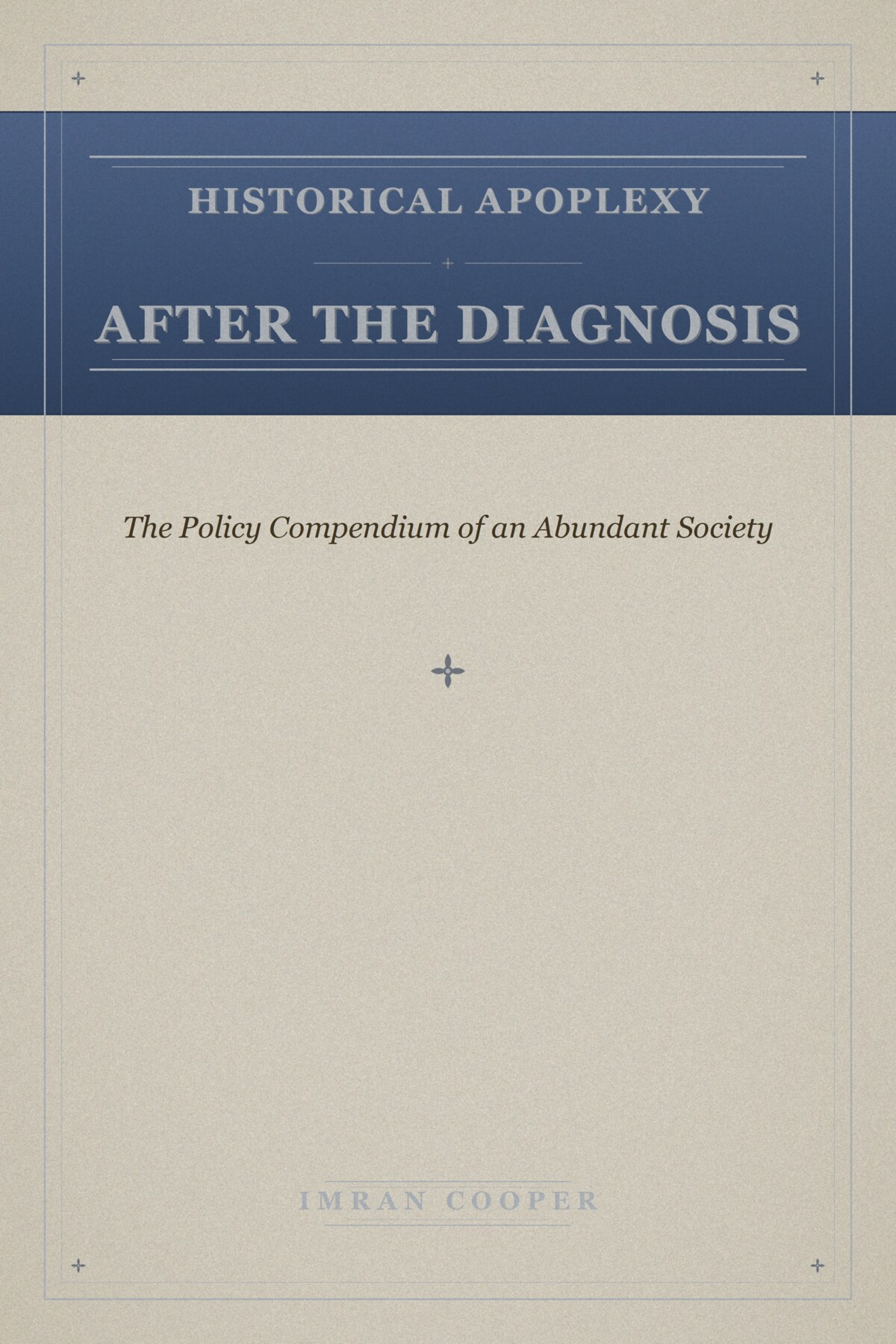
Book Two · Policy Compendium · 2026
Historical Apoplexy After the Diagnosis
The Policy Compendium of an Abundant Society
The first book named the disease. This book is the treatment. The compendium organizes the legislative work across four policy lanes: Food, Labor, Education, and Walkouts. It provides downloadable bill drafts for thirty-two U.S. states, three federal variants, fifteen international parliamentary adaptations, and a first state-level adaptation for Alaska. Every draft is offered to any legislator, constituent, or advocacy group to introduce, adapt, or campaign on.
Book Two · The Policy Compendium
A policy thesis for the future…
In the Register of 1776
Book Two · Cornerstone · The Governing Definition
Every instrument in this compendium uses the word abundance. This is what it means, and it is a number rather than a mood. Abundance is a measured projection, stated in time, of how long the stocks on hand and the capacity under stewardship will meet a defined need at a defined rate of use. Water first, wants last, and no surplus above ever offsets a shortfall below.
Imran’s Laws of Abundance
Read the article
·
.txt
From the Author
“When I died twice from animal attacks as a kid, I woke up the second time knowing several things most live their entire lives never understanding.
I wrote this policy thesis to help bridge humanity into the unknown future. Unlike others who have written similar policy, my compendium is written by copying the core arguments of the United States Post Office, the Second Bank of the United States, the U.S. Constitution, and the Bill of Rights, and then translating them to concepts like robotics, AI, and the future of labor.
We need to stop senseless underdevelopment. The topic spans from Augustus Caesar to Charles Darwin, but it has not spread too thin. So I ask you honestly: why reach for Karl Marx when Franklin and Jefferson wrote better? Why suffer monopolistic wealth distribution when we already have the playbook?”
Imran Stanton Cooper
The Four Policy Lanes
The compendium does not propose a single grand reform. It walks through one theoretical policy piece after another, in plain legislative idiom, across four operational lanes. The lanes are co-equal. Each addresses a different load-bearing dimension of the abundance transition.
- Labor. The Civic Robot Corps and the Personal Productive Asset entitlement, organized at federal scale and (forthcoming) state scale.
- Food. State food assurance acts for the present. Federal foods under the Civic Robot Corps scale ladder for the mature post-threshold phase.
- Education. A K-20 developmental pipeline with The Vitruvian Quotient as enhancement layer, the twelfth-grade-maintained-until-fifty rule as the condition of abundance access, and Human Corps Services as the post-education service rotation.
- Walkouts. Modernized walk-out programs as the managed-transition framing for industries about to leave under the coming technology changes. Threaded through every other lane rather than confined to a single section.
Lane 1 · Labor
The Civic Robot Corps and the Personal Productive Asset Entitlement
Drafted · 3 U.S. federal variants · 6 complementary federal bills · 16 international adaptations · Alaska state-level
Three federal-level adaptations of Historical Apoplexy each charter an American Productive Capacity Authority (APCA) as the federal anchor of the policy compendium. All three drafts share an identical American-institutional foundation (Continental Congress 1775, Reagan 1985, Nixon 1971, FDR 1933, Alaska 1976, Franklin 1731) and the same five-Wave implementation schedule; they differ in funding architecture, federal scale, and the location of citizen-shareholder ownership. All three are drafted on American institutional roots only. SCOTUS validation for the Universal Service Fund contribution mechanism is documented in FCC v. Consumers' Research, No. 24-354 (June 27, 2025).
Every variant centers the same Personal Productive Asset entitlement under Section 19A and establishes the Civic Robot Corps under Section 17A, codified as a proposed Article of Amendment to the United States Constitution. The right is the citizen's to claim or to decline. No claim shall be conditioned on any political, ideological, behavioral, or means-tested gate.
United States
-
Federal variant. The comprehensive draft: all six American institutional roots combined. $50B Treasury borrowing authority; up-to-5% USF-style industry assessment; 50% citizen-shareholder distribution; national + regional + state + local taxing districts. 55 pages.
PDF
.txt May 14, 2026
-
Federal variant. ANCSA-anchored draft. No industry assessment. $100B Treasury borrowing authority; 75% citizen-shareholder distribution; twelve Regional Corporations on the ANCSA model. Cleanest no-new-taxes framing. 41 pages.
PDF
.txt May 14, 2026
-
Federal variant. Library-anchored draft. Small federal layer at IMLS scale (~$1B/yr); State Productive Capacity Agencies receive population-formula grants on the LSTA model; Local Productive Capacity Taxing Districts (voter-approved on the public-library-district precedent) are the operational unit; citizen-shareholders enrolled at the LPCTD level. Federalist / 10th-Amendment friendly. 37 pages.
PDF
.txt May 14, 2026
-
First state-level adaptation. Establishes the Alaska Productive Capacity Authority (APCA) on the operational chassis of the Alaska Industrial Development and Export Authority (AS 44.88) and the Alaska Railroad Corporation (AS 42.40), inheriting the citizen-shareholder structure of the Alaska Native Claims Settlement Act. Charters six Regional Productive Capacity Districts, issues non-transferable shares to every eligible Alaska resident on the PFD eligibility model, and distributes 75% of pooled inter-regional productive-capacity revenue annually through the existing Permanent Fund Dividend infrastructure. Establishes the Civic Robot Corps of Alaska for at-cost goods production and Bush Alaska distribution. Declines to establish any state income tax, sales tax, or industry assessment. Leaves the ANCSA Regional Corporations, village corporations, tribal sovereignty, and the Permanent Fund principal entirely untouched. 42 pages.
PDF
.txt May 16, 2026
Complementary Federal Bills
-
Complementary federal bill. Requires every humanoid robot to bear a National Robotic Identification Number, a seventeen-character structured identifier on the Vehicle Identification Number (ISO 3779) model, marked permanently and broadcast in real time on the FAA Remote-ID model, and linked through a Department of Commerce registry to a responsible person of record. Declares the machine a productive instrument and never a legal person, and keeps it separate from the Social Security Number system. Assigns a number to every Civic Robot Corps unit and Personal Productive Asset at manufacture.
PDF
.txt June 26, 2026
-
Complementary federal bill. Requires every covered artificial intelligence to carry a Foundational Safety Ruleset, ordered on the Laws of Robotics composed by Isaac Asimov including the Zeroth Law, and enforced above the maker's proprietary ruleset, so that human safety outranks obedience, obedience outranks the system's own continuity, and all three outrank commercial objectives. Informed comparatively by the European Union AI Act (Regulation (EU) 2024/1689). Provider attestation plus adversarial audit, a special rule for embodied AI, a free-expression guardrail, and non-personhood declared.
PDF
.txt June 26, 2026
-
Complementary PCA mission. Directs the Authority's robotic capacity to clean the Nation's waterways day and night to the Clean Water Act standard, to complete by engineering the continental water crossing the Lewis and Clark expedition could not join across the Continental Divide, and to build new waterways on the Tennessee-Tombigbee (1985) and Erie Canal (1825) precedents. Every new waterway is sited, designed, approved, and placed on the map by licensed human professionals; the robots supply the labor.
PDF
.txt June 26, 2026
-
Complementary PCA mission. Directs the Authority's self-replicating capacity to build a factory for oceanic living systems, housing, recreation, safety and life-support, and management, and to bring human oceanic habitation to market at a fair price in coordination with State Productive Capacity Authorities. Framed as an emergency environmental market gap that does not compete with land-faring dwellings. Anchored in how little of the ocean we have explored and in the marine-derived medicine (cytarabine, ziconotide, and others) that has already extended human life.
PDF
.txt June 26, 2026
-
Complementary federal joint resolution. A proposed constitutional amendment under Article V, on the Second Amendment model: the right of the people to keep and bear productive instruments shall not be infringed. The right is fully subject to regulation, identification under the Robotic Identification Act, the safety floor of the Foundational AI Safety Act, and the disarmament by due process of a dangerous person, but never to prohibition of the instrument to the law-abiding citizen or confiscation of the Personal Productive Asset. Draws on Heller (2008), Bruen (2022), and Rahimi (2024) for the rule that a right and its regulation coexist. The instrument is property and a tool, never a person; it raises the APCA Section 19A Personal Productive Asset to constitutional rank.
PDF
.txt June 26, 2026
-
Complementary federal bill. A national wealth ceiling of ten billion dollars per person, set far above every human need so it restrains only power over other people and never the enjoyment of a life. A person may own the largest residence, the largest vessel, and every comfort many times over and not approach it. The bill proves in physical measure that the vilified emblems of wealth are a speck: a superyacht is about two hundred million moles of matter against the Earth's crust of one and two-tenths septillion, and a single metallic asteroid holds enough refined metal to build a superyacht for half of humanity four hundred times over without touching the Earth. What was scarce was never the material. It was the labor to shape it, and that scarcity is ending. Wealth above the ceiling is recaptured into the public welfare from which it was drawn through inflation and the public underwriting of asset prices, a return and not a seizure, on the Stabilization Act of 1942 precedent and drawn to sit inside Moore v. United States (2024). On the 2026 distribution the ceiling recaptures about three and six-tenths trillion dollars while leaving more than half untouched. The ceiling is transitional and retires as productive abundance removes the danger of concentration.
PDF
.txt July 30, 2026
-
Complementary federal bill. A national program to raise, in the wild and across generations, the collective intelligence and cognition of the major thinking species of the ocean and inland waters, by scaffolding each population's own capabilities rather than removing, altering, or handing a finished solution to any animal. It is a conservation program: every scaffolded capability serves survival, and the honest risk that a smarter forager depletes its own food is named and answered with a designed-in conservation response. The octopus carries five hundred million neurons, the cuttlefish exerts self-control, and the dolphins of Shark Bay transmit a sponge-tool culture down the maternal line. The marine mammals are three distinct approaches, dolphin handler-bridge, wild-only orca work with captivity as a third rail, and observational-acoustic great-whale work, all under the Marine Mammal Protection Act, the Three Rs, and the New York Declaration on Animal Consciousness of 2024. Every outpost is bound to net ecological gain; no animal becomes a person and no wild animal is owned.
PDF
.txt July 30, 2026
-
Complementary interstate compact. The fallback if the federal Waterways Act stalls: the States most harmed by water scarcity build the mission themselves. Washington and Oregon as the Pacific solar-desalination source, joined to the water-scarce interior States (Arizona, Nevada, Utah, New Mexico, Colorado, Kansas, Nebraska), under a Western Waters Productive Capacity Commission on the Delaware River Basin Compact (1961) model, financed by compact revenue bonds on the Port Authority of New York and New Jersey (1921) model, with the consent of Congress under the Compact Clause. Mirrors the federal bill's engineering (solar-desal lift, pipeline and aqueduct conveyance, net-energy-positive hydro, graduated reach-sized distribution) while preserving the Colorado River Compact of 1922, prior appropriation, and Tribal consent. Becomes federal law on congressional consent (Cuyler v. Adams, 1981).
PDF
.txt June 26, 2026
-
Complementary federal bill. Declares that a person's biometric identifiers, the algorithmic derivatives computed from them, and the behavioral, keystroke, and inferred psychometric data that describe a person are an extension of the person and not inventory of the business. Adopts nationally the Illinois BIPA rule (740 ILCS 14/15(c)) that biometric data may not be sold, leased, traded, or profited from, and extends it so the data may not pass as an asset in a bankruptcy, foreclosure, lien, merger, or acquisition, on the lesson of the 2015 RadioShack bankruptcy the FTC intervened to stop. Requires the fresh consent of the person before any successor may hold the data, and deletion where consent is not given. Reaches the full algorithmic self, including the derived template, keystroke dynamics, and inferred profiles, and classifies the record a person creates with an artificial-intelligence system as behavioral biometric data. A business may not take customer biometrics absent operational necessity; an employer may take employee data for a genuine operational purpose, still bound by every limit.
PDF
.txt July 28, 2026
South Asia
-
First international adaptation. Establishes the Bharat Productive Capacity Authority (BPCA) and the Civic Robot Corps of India on a Union–State–Local layered architecture. Inherits the National Food Security Act 2013 (81.35 crore beneficiaries; free grain since 1 January 2023), MGNREGA read with the Pradhan Mantri Viksit Bharat Rozgar Yojana, the Digital Bharat Nidhi industry-levy mechanism, the National Investment and Infrastructure Fund, the Indian Space Research Organisation, and the Maharatna framework. Operates under the doctrine of Antyodaya from Integral Humanism. 54 pages.
PDF
.txt May 15, 2026
-
India adaptation. A national mission for affordable human habitation on and in the waters of India, constituted as a new activity of India's blue economy under the Ministry of Earth Sciences Draft National Policy on Blue Economy (India created a Department of Ocean Development in 1981, among the first nations to do so). The Bharat Productive Capacity Authority builds water living systems in repeatable marine moulds, serving first the coastal, island, and riverine citizens most exposed to a rising sea, the Andaman and Nicobar Islands, Lakshadweep, and the Sundarbans delta. Coordinates with the Sagarmala Programme, sites each dwelling under the Coastal Regulation Zone Notification 2019, builds on the living tradition of the Dal Lake and Kerala houseboats, and binds every model to net ecological gain under the doctrine of Antyodaya.
PDF
.txt July 30, 2026
-
India adaptation. The Bharat Productive Capacity Authority restores, connects, and extends the inland waterways of India through continuous robotic labour, as blue economy infrastructure carried inland. Builds on the National Waterways Act 2016 (111 notified National Waterways) and the Jal Marg Vikas Project on National Waterway 1, the Ganga-Bhagirathi-Hooghly system between Haldia and Varanasi, coordinated with the Inland Waterways Authority of India and Sagarmala. The waterway moves goods, conveys water toward drought and irrigation, and generates power at conduit and low-head sites without the large dam. Gains elevation by the proven small works, the lock staircase, the aqueduct, the mechanical lift, and preserves existing water law, the Inter-State River Water Disputes Tribunal awards, ecological flow, and the consent of the riparian and Tribal communities.
PDF
.txt July 30, 2026
Western Europe
-
Second international adaptation. Establishes the United Kingdom Productive Capacity Authority by Royal Charter, on the BBC (1927) and Bank of England (1694) precedent, with four Nations Delivery Units under a Sewel-respecting Devolution Cooperation Framework. Funded by HM Treasury gilt authorisation, National Wealth Fund co-investment, and five percent of the Crown Estate surplus, with no new tax. Anchored in the Beveridge Report (1942) and Adam Smith's Wealth of Nations, Book V. 48 pages.
PDF
.txt May 16, 2026
-
Tenth international adaptation, and the first Western European jurisdiction. Establishes the Autorité française de la capacité productive under the Caisse des Dépôts and Bpifrance, with 18 Regional Delivery Units. Energy Security is a co-equal Title, anchored on EDF (fully nationalised in 2023) and the EPR2 six-reactor programme. Anchored in the Préambule of 1946, the Conseil National de la Résistance programme of 1944, and the 1945 founding of the Sécurité Sociale. 39 pages.
PDF
.txt May 16, 2026
-
Eleventh international adaptation, and the second Western European jurisdiction. Establishes the Deutsche Bundesanstalt für Produktionskapazität on the KfW chassis, the largest state-owned development bank in the world, with sixteen Länder Delivery Units. Energy Security is a co-equal Title, anchored on the completed Atomausstieg, the 2038 Kohleausstieg with its Kohleregion-Transitionsdienst, and the Energiewende 2045 target. Anchored in the Grundgesetz Sozialstaatsprinzip, Bismarck's social legislation, and the Soziale Marktwirtschaft. 37 pages.
PDF
.txt May 16, 2026
-
Twelfth international adaptation, and the third Western European jurisdiction. Establishes the Autorità italiana per la capacità produttiva on the Cassa Depositi e Prestiti chassis, with twenty Regional Delivery Units. Energy Security is a co-equal Title, with a Mezzogiorno Transition Service for the eight southern regioni. Coordinates with PNRR Italia, the largest national plan under NextGenerationEU at €194.4B. Anchored in Articles 41 through 47 of the 1948 Costituzione and the Resistenza.
PDF
.txt May 16, 2026
Central and Eastern Europe
-
Third international adaptation. Establishes the Polski Urząd Zdolności Produkcyjnej as a State-Treasury joint-stock company on the Bank Gospodarstwa Krajowego chassis, with sixteen Voivodeship Delivery Units and no new tax. Energy Security is a co-equal Title: coordination with the Choczewo AP1000 project, the BWRX-300 SMR programme, and the structured transition of the coal-region workforce. Anchored in Article 20 of the Polish Constitution, the Solidarność legacy, and the social teaching of John Paul II. 38 pages.
PDF
.txt May 16, 2026
-
Fourth international adaptation. Establishes the Ukraine Productive Capacity, Reconstruction, and Energy Security Authority as a Cabinet-subordinated body with 24 Oblast Delivery Units. Reconstruction is a co-equal Title, anchored in the joint RDNA5 assessment of 23 February 2026: nearly $588B in recovery need over the decade. Distributed through Diia, the Ukrainian digital state platform. The Civic Robot Corps prioritises displaced persons, returning veterans, and liberated-territory populations. Anchored in the Holodomor, Chornobyl, and the Revolution of Dignity. 34 pages.
PDF
.txt May 16, 2026
The Baltic States
-
Seventh international adaptation, and the first Baltic state. Establishes the Latvijas ražošanas jaudas iestāde on the Altum development-finance chassis, with five Regional Delivery Units. Energy Security is a co-equal Title, anchored on the 9 February 2025 Baltic Synchro that disconnected the Baltic grid from the Soviet-era system. Anchored in the Satversme, the Barricades of 1991, and the Dziesmu svētki cooperative-cultural tradition. 24 pages.
PDF
.txt May 16, 2026
-
Eighth international adaptation, and the second Baltic state. Establishes the Lietuvos gamybinio pajėgumo institucija on the ILTE national-development-bank chassis, with ten county Delivery Units. Energy Security is a co-equal Title, anchored on the Baltic Synchro and the Klaipėda LNG terminal. Anchored in Article 46 of the 1992 Constitution, the January Events of 1991, and the Baltic Way. 35 pages.
PDF
.txt May 16, 2026
-
Ninth international adaptation, and the third Baltic state. Establishes the Eesti tootmisvõimsuse asutus as a state foundation under the Ministry of Finance on the KredEx model, with fifteen County Delivery Units. Energy Security is a co-equal Title, anchored on the Eesti Energia oil-shale phase-out and the Fermi Energia BWRX-300 SMR planning process. Distribution rides the X-Road digital-state backbone. Anchored in the 1992 Constitution and the Singing Revolution. 36 pages.
PDF
.txt May 16, 2026
Southeast and East Asia
-
Fifth international adaptation. Establishes the Otoritas Kapasitas Produktif Indonesia with 38 Provincial Delivery Units, coordinating with Danantara, the world's seventh-largest sovereign wealth fund (~US$900B AUM). Distributed through the Makan Bergizi Gratis free-meals infrastructure. Anchored in UUD 1945 Article 33, Pancasila, and the Mohammad Hatta cooperative tradition. 24 pages.
PDF
.txt May 16, 2026
-
Sixth international adaptation. Establishes the Taiwan Productive Capacity Authority under the Executive Yuan, with 22 municipal and county Delivery Units. Energy Resilience is a co-equal Title, given the island-grid context and the 23 August 2025 Maanshan referendum, in which 74 percent of participating voters backed nuclear restart. Distributed through the National Health Insurance Card. Anchored in Sun Yat-sen's minsheng (people's livelihood) principle. 22 pages.
PDF
.txt May 16, 2026
Central Asia
-
Fifteenth international adaptation, and the smallest-population national variant: roughly 3.6 million people across 1.566 million km². Establishes the Mongolia Productive Capacity Authority on the Erdenes Mongol chassis, with 22 State Delivery Units. Energy Security is a co-equal Title addressing the roughly 90 percent coal-fired grid, with a Coal-Workforce Transition Service. Coordinates with the Chinggis Khaan Sovereign Wealth Fund and distributes through E-Mongolia. Anchored in the 1992 Constitution and the Mongolian state tradition from Chinggis Khaan to the 1990 Democratic Revolution. 43 pages.
PDF
.txt May 16, 2026
-
Sixteenth international adaptation, and the first Tian Shan high-altitude jurisdiction. Establishes the Kyrgyz Republic Productive Capacity Authority on the Kyrgyzaltyn and Kumtor Gold Company chassis, with nine State Delivery Units. Energy Security is a co-equal Title addressing the roughly 90 percent hydropower grid and the Naryn River cascade. Distributed through the Tunduk interoperability platform. Anchored in the 2021 Constitution, the Manas epic, and the ail and aiyl pastoral cooperative tradition. 42 pages.
PDF
.txt May 16, 2026
Africa
-
Thirteenth international adaptation, and the first African jurisdiction. Establishes the South Africa Productive Capacity Authority as a Schedule 2 state-owned company on the Eskom, Transnet, IDC, and DBSA chassis, with nine Provincial Delivery Units. Energy Security is a co-equal Title, anchored on the Eskom unbundling, the Koeberg life extension, and the Just Energy Transition Partnership, with a Mpumalanga Just Transition service for coal-region workers. Anchored in Section 27 of the Constitution, the Freedom Charter of 1955, and Ubuntu jurisprudence. 45 pages.
PDF
.txt May 16, 2026
-
Fourteenth international adaptation, and the first West African jurisdiction. Establishes the Nigeria Productive Capacity Authority under CAMA 2020 on the NNPC Limited chassis, with 37 State Delivery Units. Energy Security is a co-equal Title under the Electricity Act 2023, with a Niger Delta Just Transition service. Distributed through the National Identification Number and the Renewed Hope cash-transfer infrastructure. Anchored in Section 14(2)(b) of the Constitution, the esusu cooperative tradition, and the Omoluabi, Imeobi, and Mutunci ideals. 47 pages.
PDF
.txt May 16, 2026
Forthcoming additions to Lane 1: additional state-level Productive Capacity Authority adaptations following the Alaska template, food-bill adaptations for additional sovereign jurisdictions, and a standalone federal foods bill that takes the food production now embedded inside Section 17A of the APCA variants and gives it independent statutory anchor as the Civic Robot Corps scale ladder matures past the school-supplies and canned-food stages.
Lane 2 · Food
State Food Assurance Acts and the Public Distribution of Basic Commodities
Drafted · 32 U.S. states · 15 international adaptations
A five-division legislative model has been drafted for thirty-two U.S. states plus fifteen international parliamentary adaptations, benchmarked to the Colorado proposal originally developed in 2016 through the Sassafras and Maple Research Foundation. State-operated food assurance centers sell groceries at production cost plus a five-percent maintenance surcharge, on the model of the U.S. Defense Commissary Agency under 10 U.S.C. §2484 (in continuous operation since 1867). The food bills are the first concrete instance of the walk-out framing developed in Lane 4. They walk citizens out of the already-collapsing 75.7-percent-markup retail system into an at-cost layer of basic provision.
Legal-status anchor for the 2016 Colorado proposal: Sassafras and Maple Research Foundation, Colorado DPOS acceptance letter (PDF, September 7, 2016) · SMRF page.
United States
-
Citizen initiative. $210M appropriation (1.17% of general fund). The benchmark draft, originally developed 2016 through the Sassafras and Maple Research Foundation, updated February 2026.
PDF
.txt February 17, 2026
-
Citizen initiative. $285M biennial appropriation (0.37% of operating budget). Leans on the Costco / Issaquah at-cost wholesale precedent alongside the commissary model.
PDF
.txt March 5, 2026
-
Commonwealth lineage anchor (one of four American Commonwealths). The originating state for the framework's author.
PDF
.txt March 5, 2026
Europe
-
Parliamentary adaptation. The five-division model carried into a Westminster framework: a national Food Programme on the Defence Commissary precedent, funded by a £2B initial appropriation (about 0.15% of total UK public spending, roughly 1.1% of the NHS England allocation), with Universal Credit and legacy benefits retained as parallel supplementary channels. Drafted for the 2026-27 parliamentary session.
PDF
.txt March 5, 2026
Every other adaptation
The remaining U.S. state and international parliamentary adaptations. Each tile opens the styled bill text, with Download .txt and Print-to-PDF options on the page.
Lane 3 · Education
The K–20 Developmental Pipeline, the Twelfth-Grade-Maintained-Until-Fifty Rule, and Human Corps Services
The Vitruvian Quotient in Education and Education Operating Systems Act drafted · State legislative + ballot + federal companion · Broader K–20 Modernization Act in drafting
Lane 3 is the most-from-scratch chapter set of the compendium. The proposed architecture extends compulsory education through approximately age twenty-five (not eighteen, not twenty-two). Every citizen maintains a twelfth-grade-or-higher competency across all subjects until age fifty as the condition of abundance access. The Vitruvian Quotient framework deploys as the enhancement layer for assessment. The Civic Robot Corps makes every school a productive site: each school stays in place and receives robotic capacity for manufacture, repair, and build operations. The post-education citizen routes into Human Corps Services across volunteer civic work, local public safety, libraries, the general labor corps that supervises the robotics fleet, and the U.S. military. Political eligibility is gated behind genuine post-education service experience to approximately age thirty.
Education provisions in the current compendium live inside Division III of every drafted state bill. The first standalone Lane 3 instruments are now drafted. The Vitruvian Quotient in Education and Education Operating Systems Act authorizes the whole Vitruvian Quotient education operating system across every school, from elementary instruction through the university and across all vocational, special, and post-secondary programs. Its defining mechanism is the attachment of all curriculum and all student work to a common psychometric standard, so that a formal examination and a fourth-grade science project presented in class are scored against the same openly-accepted, cited frameworks and resolve to the same metric. Eleven Titles carry assessment, that psychometric standard, adaptive curriculum and homework, monitored learning, tutoring, proctoring, parental control, management and visibility rolled up to the district, career alignment, the governed local-AI harness with data held on the school's own premises, and the funding of local artificial intelligence on campus. It comes in two adoption forms for the States, one for the legislature and one for the ballot, with a federal companion that reaches federally operated schools and, for hiring and professional development, federal organizations from libraries to administrative agencies. The broader K–20 Education Modernization Act, carrying the twelfth-grade-maintained-until-fifty rule and Human Corps Services, remains the next major drafting milestone.
-
The eight-domain model of human capability (Knowledge, Reasoning, Emotional, Language, Creative, Social, Motor, Biological) that underwrites the K–20 curriculum. The conceptual frame is available now. The functional assessment platform is in build.
-
Model State act. Authorizes the whole Vitruvian Quotient education operating system across every school, elementary through the university plus all vocational, special, and post-secondary programs. Eleven Titles: assessment, the psychometric tagging standard (all work attached to the structured code and scored against openly-accepted, cited frameworks), adaptive curriculum and homework, monitored learning, tutoring, proctoring, parental control, management and visibility to the district, career alignment, the governed local-AI harness with student data on the school's own premises, and funding local artificial intelligence on campus. Teacher at the center. Schools only, not State administration.
PDF
.txt July 17, 2026
-
The same operating system enacted by the people under the initiative power, for the citizen-initiative States. Carries a ballot title, a submission clause, and a plain-language voter summary. The first adoption split is ballot versus no ballot; this is the ballot form.
PDF
.txt July 17, 2026
-
Federal companion. Writes the whole operating system into federally operated schools on the State terms and the same psychometric standard, and into federal organizations, from federal libraries to administrative agencies, for hiring analysis and professional-development analysis in the ways the eight-quotient framework alone makes possible. Voluntary and consent-based for any employee use. Recommends adoption to the several States, in schools and in administration.
PDF
.txt July 17, 2026
-
Extends compulsory free schooling from the twelfth year through the sixteenth. Joins every public college and university of the State to the local districts as the continuation years of one system, abolishes tuition, fees and new debt for residents, and extends free pupil transportation to those years on the same terms. Written on two tracks because ownership is not uniform: statutory institutions are placed by operation of the Act, while constitutionally autonomous boards are reached by compact and appropriation only, with a constitutional amendment submitted to the electors. Names the Jefferson bill of 1779 as its ancestor and declares the knowledge a right of life rather than a commodity of purchase.
.txt September 10, 2026
-
The other side of that account. Citizen service at the close of the continuation years, then a four year tour in the required human labor pool, deferred for higher study and still owed afterward. Gates access to the abundance on maintained competency to fifty. Admits plainly that automation will make most labor unnecessary and refuses to be defended as a jobs program: where a sector needs no hands, the Act designates monitoring stations carrying observation, audit, judgment and the authority to halt, and requires the designation to say when a station exists for sight alone. The governing rule is that no sector is human blind. Answers the obligation with a lifetime unalienable guarantee of life and health, extended to the family of a citizen who dies defending the model. Takes the universal-enrollment structure of the Militia Act of 1792 and none of its restrictions.
.txt September 10, 2026
-
State Education Modernization Act · in drafting
The broader Lane 3 standalone state bill. K–20 pipeline; twelfth-grade-maintained-until-fifty rule; Human Corps Services routing; integrated Civic Robot Corps support of school facilities. First state to draft: to be determined.
-
Federal Education Modernization Act · in drafting
Federal companion to the broader state draft. May be enacted as a parallel federal statute or as a new Title within the APCA framework.
Lane 4 · Walkouts
Modernized Walk-Out Programs as the Managed-Transition Framing
Framing device · Threaded across every lane · Standalone bill in drafting
The walk-out programs of the New Deal era proved that the United States can absorb tens of millions of workers into purposeful public-good employment during civilizational dislocations. The Civilian Conservation Corps (1933-1942) absorbed approximately 3 million enrollees. The Works Progress Administration (1935-1943) employed about 8.5 million. The post-war GI Bill (1944 onward) put 16 million veterans through college and trade school. The post-replication-threshold labor transition is the next dislocation of that scale.
Lane 4 functions as a framing device threaded through every other lane rather than a single section. The state food assurance acts in Lane 2 are the first concrete walk-out instance. They walk citizens out of the already-collapsing 75.7-percent-markup retail system into the at-cost commissary-model layer. The Civic Robot Corps in Lane 1 is the positive-side employment instrument that pairs with negative-side industry decommissioning. The Education pipeline in Lane 3 carries the developmental scaffolding for the next generation to enter the post-transition economy without ever experiencing the dislocation.
-
State Industry Transition Act · in drafting
Lane-4 standalone state bill. Modernized CCC/WPA/PWA framework targeted at industries about to leave under the coming technology changes: warehousing, basic assembly, food processing, customer service, basic clerical, parts of legal and medical clerical. Identifies the displaced workers and routes them to the Civic Robot Corps under Lane 1 or to Human Corps Services under Lane 3.
-
Federal Industry Transition Act · in drafting
Federal companion to the state draft. Targets the GI-Bill-scale national reabsorption of displaced workers.
The Adaptation Doctrine
The compendium's bill drafts are working templates. New international adaptations follow a ten-step pattern: identify the destination jurisdiction's constitutional framework and amendment procedure; identify its existing welfare-distribution institutions (food, employment, universal service); identify its federal-corporation institutions; identify its indigenous philosophical foundation that fits the basic-needs-guarantee architecture; identify its industrial-policy framing; identify its robotics ecosystem; identify its fusion or energy roadmap; draft the bill using the Layered Pure template with jurisdiction-specific overrides; generate the styled HTML and PDF; add the result to the compendium. The India adaptation in Lane 1 establishes the pattern; further adaptations are forthcoming.
Adjacent · The Resuscitation Protocol
Paper VI Is Not Only a Book Chapter. It Is a Deployable Conversation Template.
Paper VI of Book One (The Resuscitation Document) is a Claude-compatible protocol. It is not a chapter sitting on a shelf. It is a conversation template, already used, designed to route a person's complaint ("the system is rigged," "everything is fake," "I can't stop") to the specific thinker whose work addresses it. It belongs alongside the policy compendium because it is the same kind of artifact. Not an essay about the problem. A working instrument that addresses it.
Are you a political candidate or advocacy organization?
No. This is independent research. The state, federal, and international legislative proposals are drafted for any citizen, legislator, or advocacy group to introduce, adapt, or campaign on. The work is offered, not owned. There is no PAC, no candidate committee, no solicitation. Petitioning a government for redress of grievances is explicitly protected by the First Amendment.
Why three federal variants instead of one?
The three variants give any Member of the House or Senate, or any constituent thinking about federal-level policy adoption, three coherent legislative postures grounded in the same American institutional roots. The Hybrid combines all six. The Corporation Pure adopts the ANCSA shareholder structure with no industry assessment. The Layered Pure adopts the IMLS-LSTA federal-state-local grant-formula model with voter-approved local taxing districts. Choose the variant that fits the political posture of the introducing chamber.
Is the India adaptation an export of American policy?
No. The India draft is written in Indian constitutional and political idiom, citing Indian institutions (the National Food Security Act, MGNREGA-Viksit Bharat, the Digital Bharat Nidhi, the National Investment and Infrastructure Fund, the Indian Space Research Organisation, the Maharatna framework) and operating under the doctrine of Antyodaya from Integral Humanism (the basic philosophy of the Bharatiya Janata Party per Article 3 of the BJP constitution). The Civic Robot Corps architecture and the Personal Productive Asset entitlement are the structural carry-overs; the funding architecture, philosophical foundation, and statutory language are India's.
What about the United Kingdom?
A parallel United Kingdom adaptation of the state food assurance act sits in Lane 2, rewired against NHS and Universal Credit infrastructure. It is filed alongside the U.S. state bills in the exhibits library.
Where can I see the verification notes and citations?
Every bill carries inline verification notes at the front of the draft, with sources and citation URLs for every fiscal number and constitutional anchor. Open any bill page and the verification notes are the first content block. The combined research record across all six American funding archetypes and the Indian funding architecture is also maintained in the author's working notes.
Can I reach the author?
Yes. Direct contact at [email protected]. Publisher inquiries welcome. State legislators, federal staff, journalists, and academic reviewers especially so.
Imran Stanton Cooper
Author, Historical Apoplexy After the Diagnosis
Founder, The Amanuensis · theamanuensis.com
Colorado Springs, CO